Property from the Estate of Ray Retzlaff Headlines Freeman's Auctions Antiquities and Ancient Art Auction on November 19
A Corinthian bronze helmet, an Egyptian canopic jar for a scribe named Apis, and a Roman marble Hercules lead a sale of more than a hundred works from the collection of a Wisconsin artist and philanthropist, sold to benefit charitable organizations.
Freeman’s Auctions will present Antiquities and Ancient Art on November 19 in Chicago. The sale of 215 lots spans more than four millennia of the ancient Mediterranean and Near East, from Predynastic Egyptian vessels of circa 3800 B.C. to Byzantine gold of the 7th–8th Century A.D. The first 130 lots are Property from the Estate of Ray Retzlaff, sold to Benefit Charitable Organizations, arranged chronologically, with Egypt at its core. Its 79 Egyptian lots range from Naqada pottery and New Kingdom reliefs to Late Period bronzes of Osiris, Isis, Nefertum and sacred cats, and include twenty-two funerary objects such as painted mummy masks, sarcophagus panels, canopic jars and ushabtis.
“The Retzlaff collection is a remarkable survey of the ancient world assembled by a single, curious eye,” said Jacob Coley, Senior Vice President, Head of Department, Antiquities & Ancient Art. “From Predynastic vessels and Late Period bronzes to Attic lekythoi and imperial Roman portraits, it offers collectors at every level the chance to own objects that carry thousands of years of human history. Knowing the sale also benefits charitable organizations makes presenting it especially meaningful.”
Property from the Estate of Ray Retzlaff
Ray Retzlaff (1936–2026) collected the way some people read: widely, and with an eye on the largest questions. An artist himself, as well as a philanthropist and avid world traveler, he made his home outside Milwaukee. He kept track of it all the old-fashioned way, with pen and paper, filling ruled ledger pages headed “Art Collection” in his own hand. In that sprawling, personal record, works from China and Tibet sit beside modern pictures and sculpture and antiquities from Egypt, Greece and Rome.
Retzlaff was spiritual and a romantic, curious about the world, his place in it and what might come next. He kept a Japanese garden, a space made for quiet reflection, and the antiquities he gathered share that same unhurried curiosity about what lies beyond.
The ancients asked those questions too and answered them in their own ways. The Egyptians prepared carefully for the journey beyond death, surrounding the departed with objects meant to sustain them in another life. In Greece, white-ground lekythoi, slender vessels associated with funerary ritual, offered a different expression of remembrance. Their delicate painted scenes often depict the living visiting the graves of those they had lost. The Romans, too, sought permanence in memory, preserving the likenesses of loved ones in marble, faces that have long outlived their names.
Each, in its way, suggests that something of us lives on in the care of others. Retzlaff seems to have understood this well. Friends remember him delivering stuffed animals to children’s hospitals, giving to those in need at the holidays, and sharing his good fortune wherever it could make an immediate difference. Fittingly, his art and antiquities are now being sold to benefit charitable organizations.
Sale Highlights
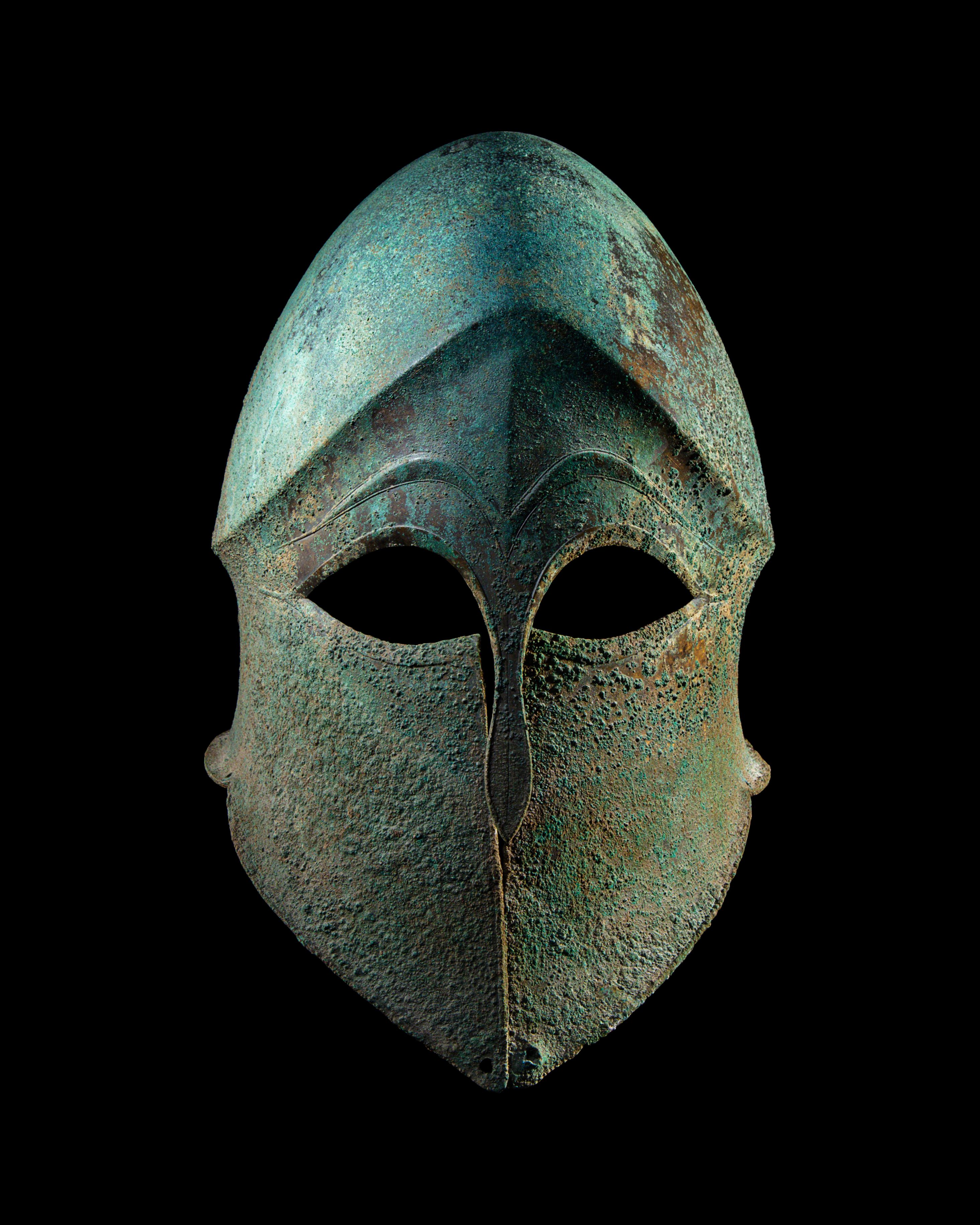
Lot 195 | A Corinthian Bronze Helmet
Circa 5th Century B.C.
Estimate: $200,000 – $300,000
Property from a Pacific Northwest Collection
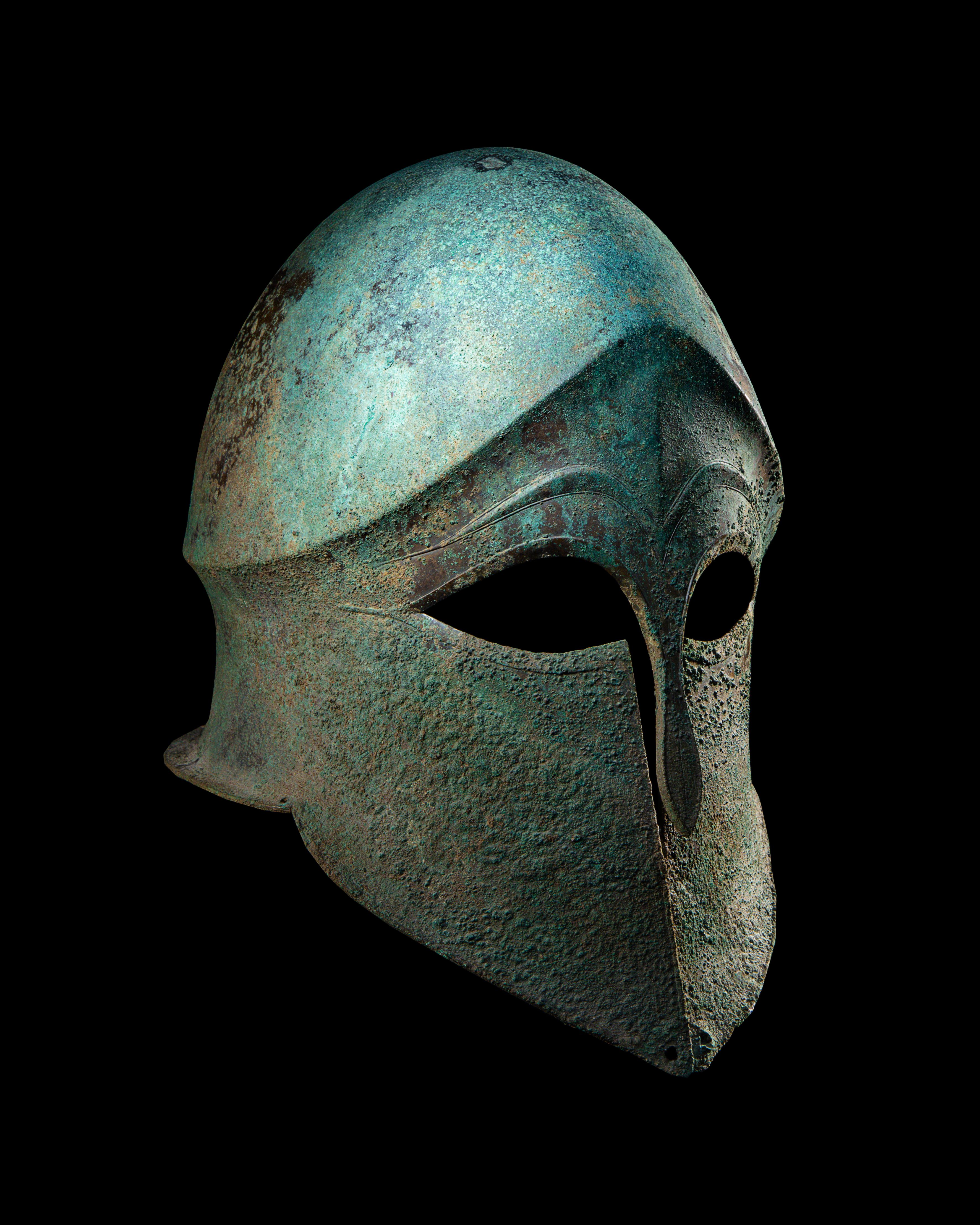
Raised from a single sheet of bronze, this Corinthian helmet presents the type in its late and fully developed form. The ovoid crown is set off from the walls below by a pronounced step, and the face is rendered with clarity and restraint: almond-shaped eye openings sit beneath incised double brows that converge above the long nose guard. The cheekpieces sweep downward until they nearly meet, each pointed tip pierced, probably to secure a chin strap. A blue-green patina, pitted and crusted with red-brown, gives the surface considerable depth while leaving the profile crisp and legible.
The Greeks knew the form by this name. Herodotus records a Libyan festival in which the fairest maiden was dressed in “a Corinthian helmet and Greek panoply” and driven around a lake in a chariot (Histories 4.180). Such helmets were bound up with kleos, the glory that outlives the warrior who wins it, and at Olympia they were dedicated to Zeus as spoils and thank-offerings, some inscribed with the names of those who gave them, among them, very probably, the Athenian general Miltiades after Marathon. In art, the helmet is often shown pushed back to reveal the man beneath. As the catalogue notes, art lifted the bronze to show the man; the present helmet keeps the face he showed the enemy.
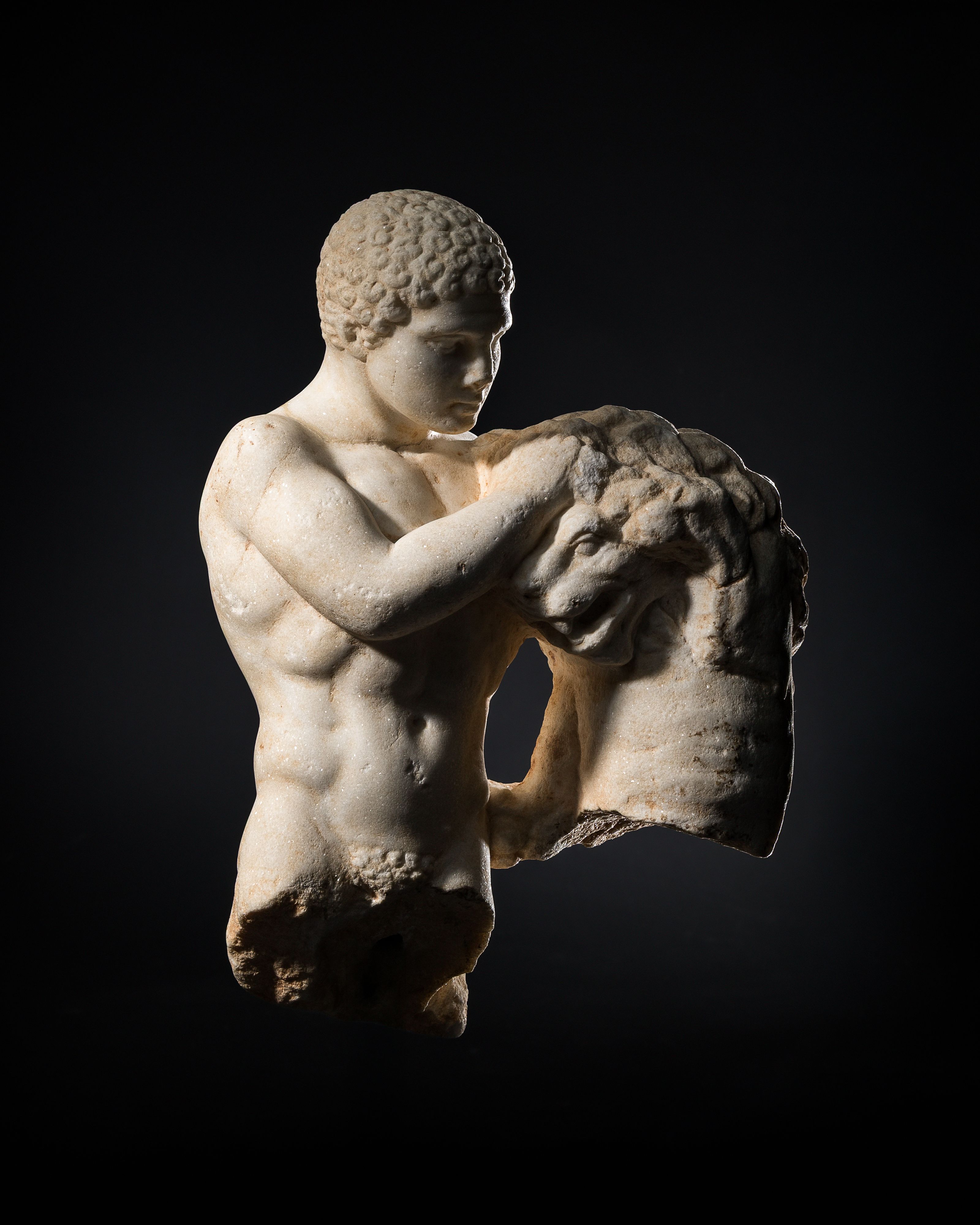
Lot 115 | A Roman Marble Hercules Wrestling the Nemean Lion
Circa 1st–2nd Century A.D.
Estimate: $30,000 – $50,000
Property from the Estate of Ray Retzlaff, sold to Benefit Charitable Organizations
The first of the twelve labors of Hercules was to kill the Nemean lion, whose hide no weapon could pierce. Here the sculptor captures the decisive moment when the hero, as Apollodorus tells it, holds the beast’s neck tight until he has choked it. Hercules appears as a beardless young man with tightly drilled curls, looking down calmly despite the struggle, his smooth, softly modeled muscles contrasting with the mane’s rougher texture. The carving suggests a workshop in the eastern provinces of the Roman Empire, in the region of modern Syria and Lebanon, where Hercules was especially popular. At Dura-Europos alone, excavators found more than forty images of the hero. Small marble groups like this one were likely displayed in homes and gardens.
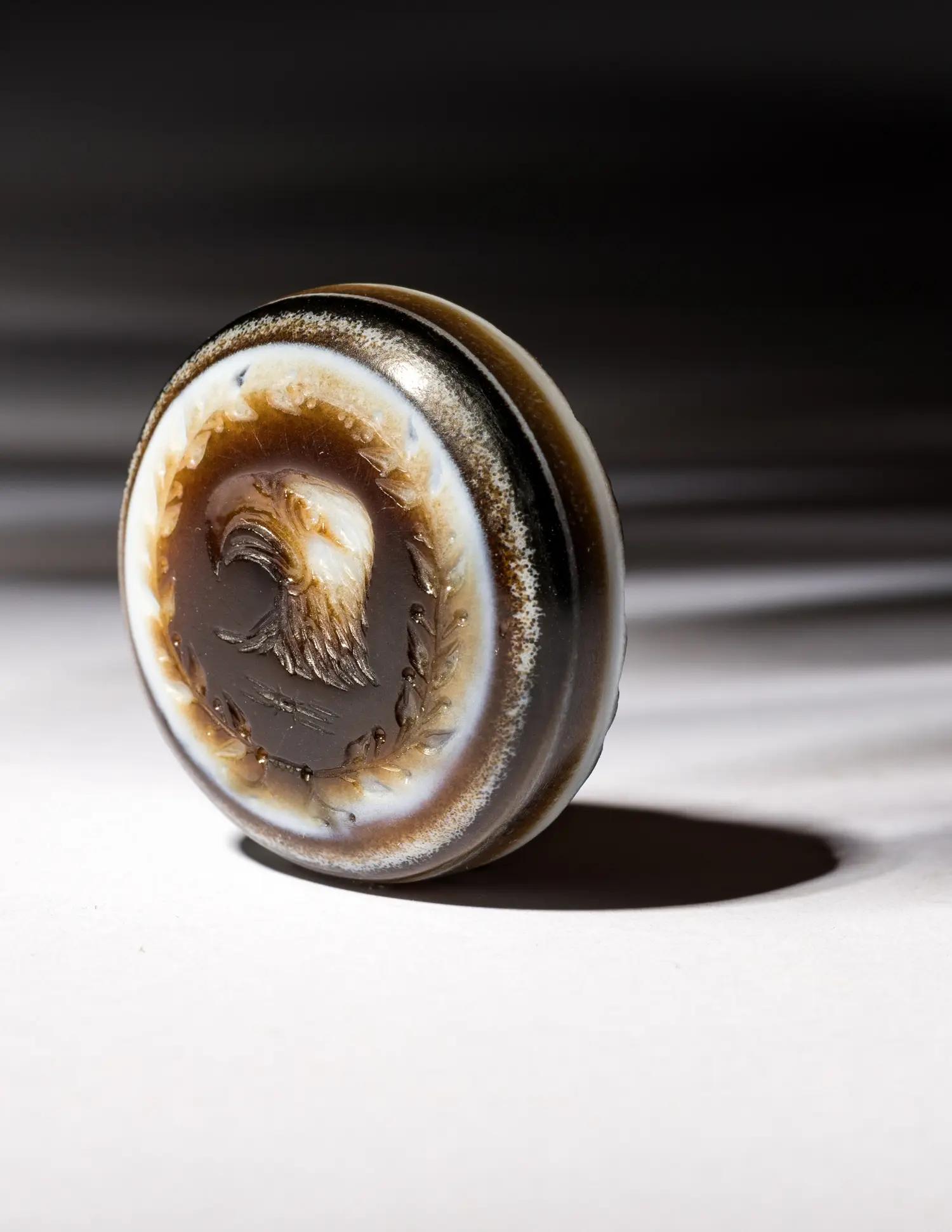
Lot 200 | A Roman Sardonyx Intaglio with an Eagle
Augustan Period, Circa 27 B.C.–14 A.D.
Estimate: $30,000 – $50,000
Cut from a thick disc of banded sardonyx, this intaglio presents the head of an eagle in profile, its plumage built up in fine, layered strokes, with the stone's banding making the crown read pale against the darker ground. A thunderbolt lies below, and a laurel wreath with twinberries encloses the whole. By choosing the eagle’s head alone rather than the whole bird, the engraver turned the image into a compact, immediately recognizable emblem.
Each element belongs to the vocabulary of Roman power: the eagle of Jupiter and his thunderbolt, and the laurel of Apollo, Augustus’s patron god, which crowned every Roman triumph. Together they place the stone within the imagery Augustus established from 27 B.C., the same moment commemorated on the great Eagle Cameo in Vienna. To an American eye, the pale head above the darker neck readily recalls the bald eagle of the Great Seal of the United States, adopted some eighteen centuries after the present stone was cut.
Additional Auction Highlights
- Lot 207 | A Roman Chalcedony Head of a Julio-Claudian Woman, Circa 1st Century A.D. (Estimate: $60,000 – $80,000)
- Lot 131 | An Egyptian Alabaster Canopic Jar, New Kingdom, 18th Dynasty, Reign of Thutmose III, 1479–1425 B.C. (Estimate: $50,000 – $70,000)
Property from Gerald Gowitt, Georgia
Auction Details
Antiquities and Ancient Art: Including Property from the Estate of Ray Retzlaff
Thursday, November 19, 2026
Chicago
Preview by Appointment
About Freeman’s
Freeman’s is a premier American auction house offering services in multiple categories including fine art, jewelry, design, books and manuscripts, furniture, decorative arts, antiquities, couture, and Asian works of art. With 16 regional locations nationwide, the firm provides auctions, appraisals, private sales, and art advisory services, connecting clients to the global art market. Freeman’s strives to bring art, history, and design to life by connecting people with extraordinary objects through exceptional service and expertise.