To request further details about this lot, please email Antiquities@freemansauction.com
Please email Antiquities@freemansauction.com for any additional information or questions you may have
Sale 6578
| Chicago
| Chicago
To request further details about this lot, please email Antiquities@freemansauction.com
Please email Antiquities@freemansauction.com for any additional information or questions you may have
Estimate$200,000 – $300,000
Provenance:
Private Collection, Germany, acquired in the 1980s.
Private Collection, Canada, acquired in 2004.
Ward Gallery, New York; where acquired by the present owner, 29 March 2007.
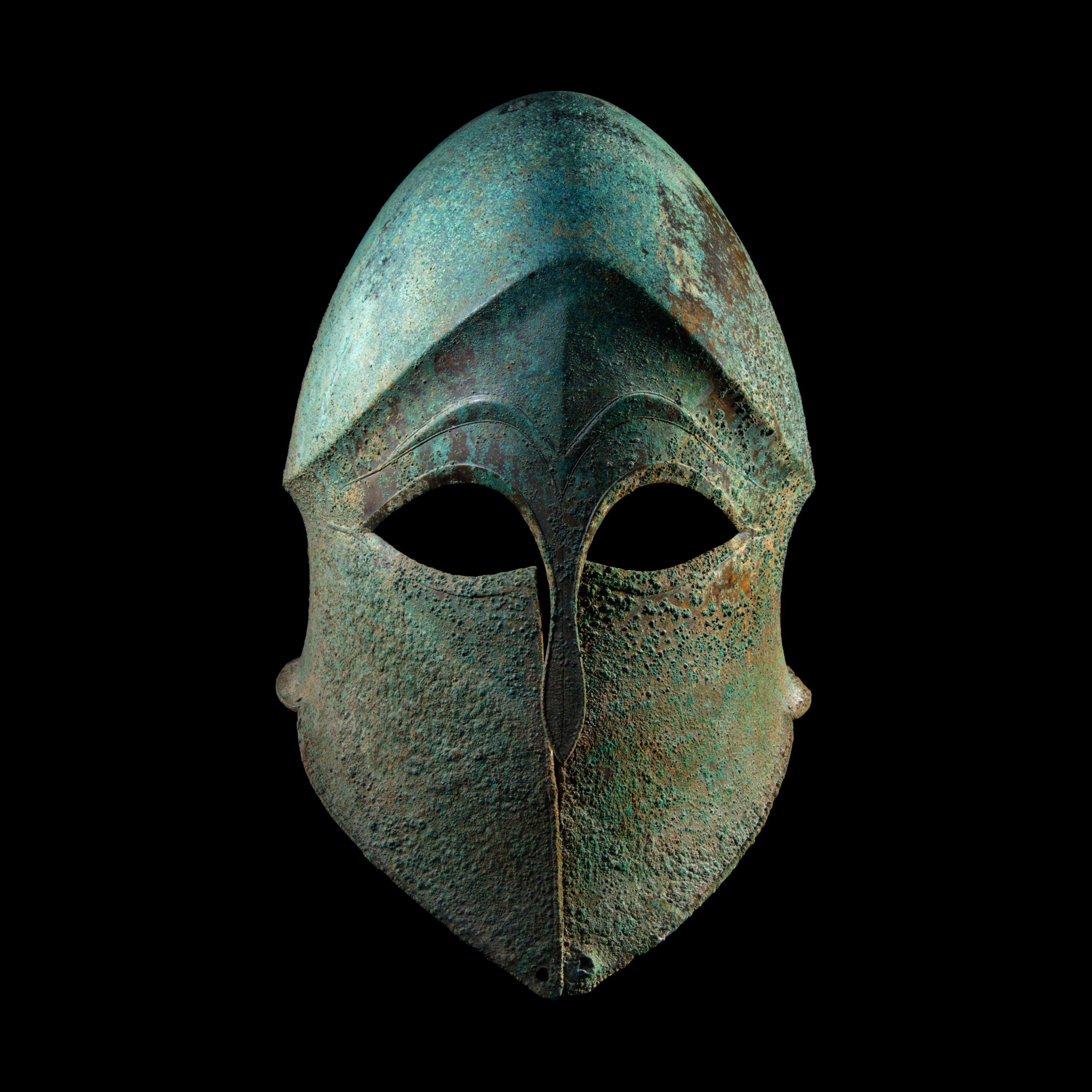
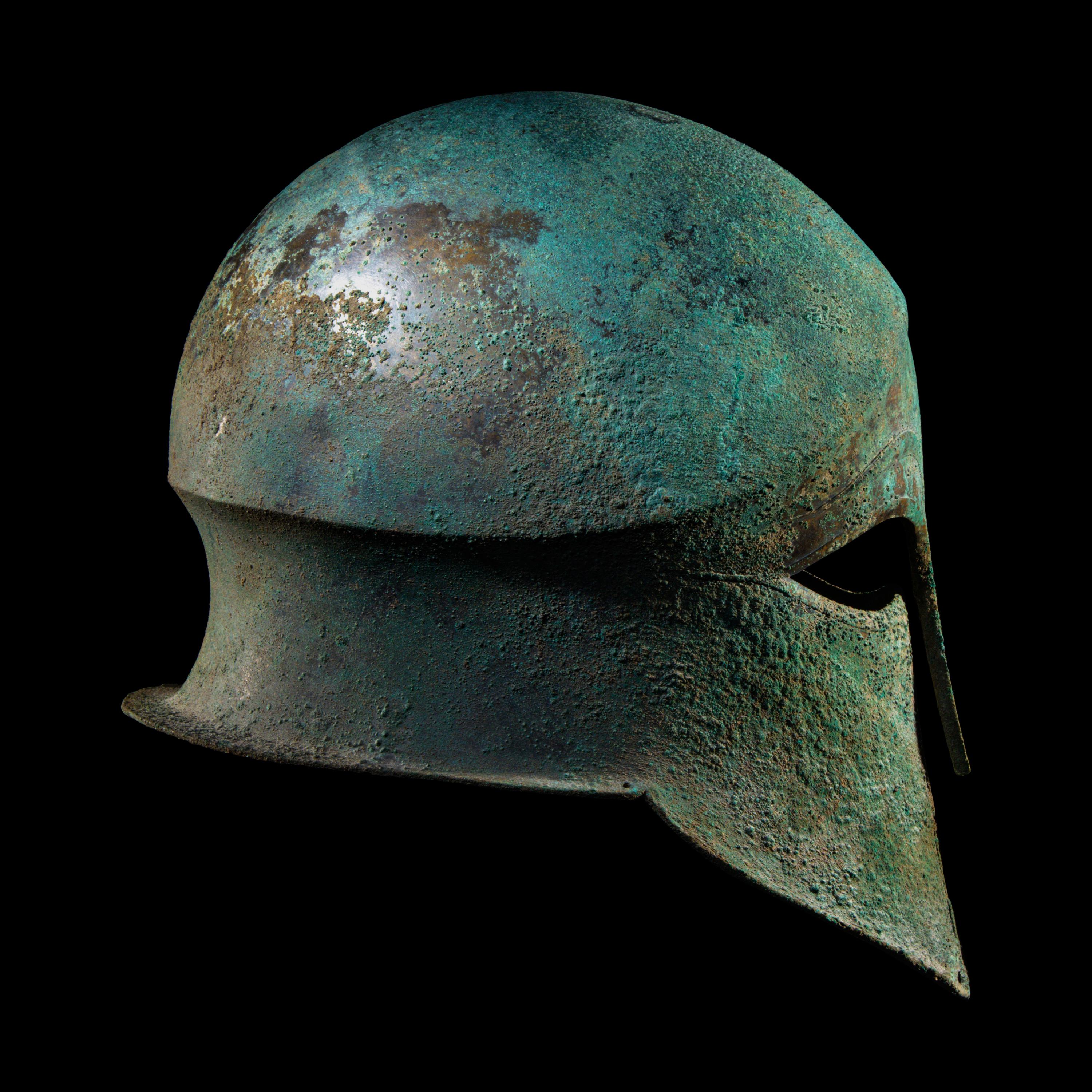
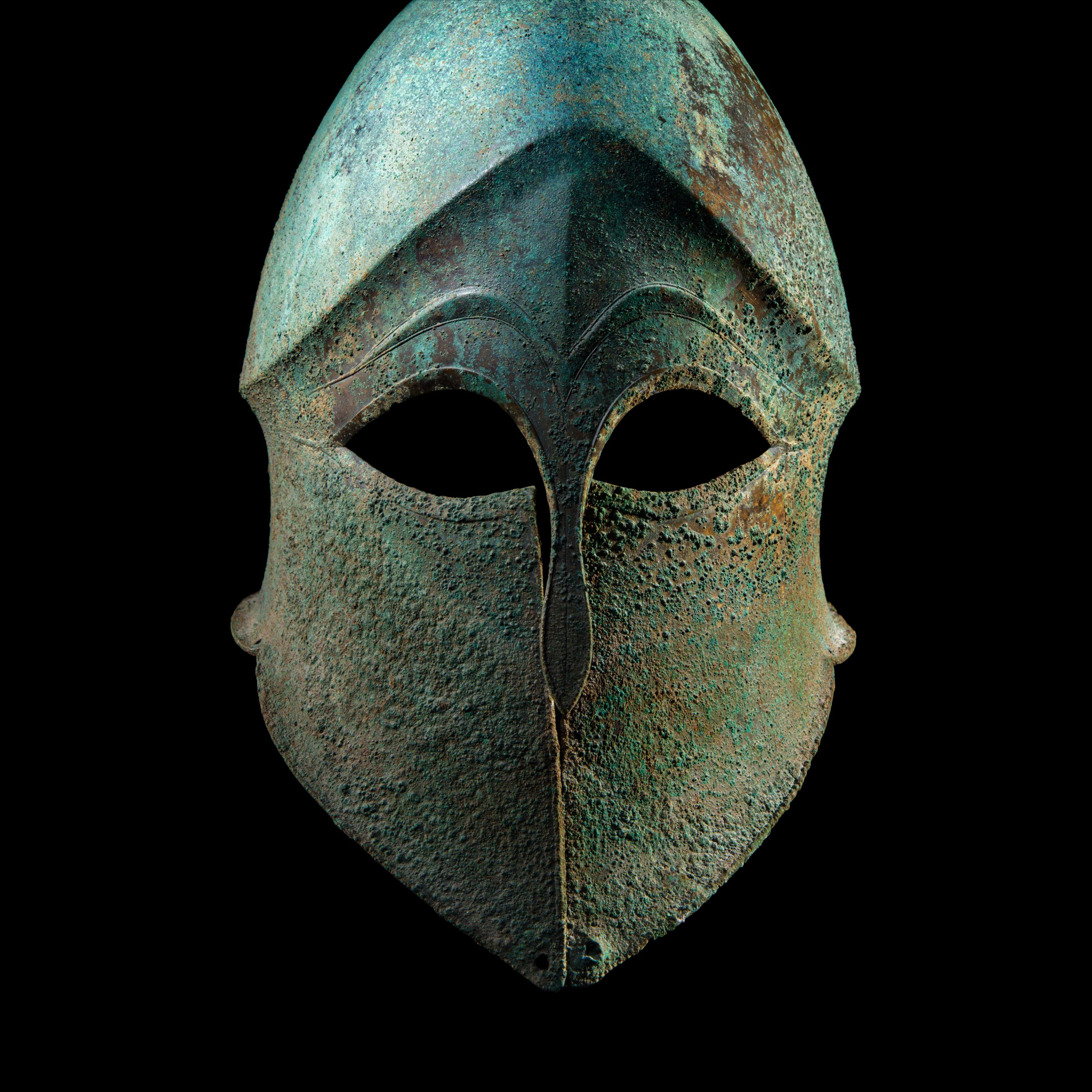
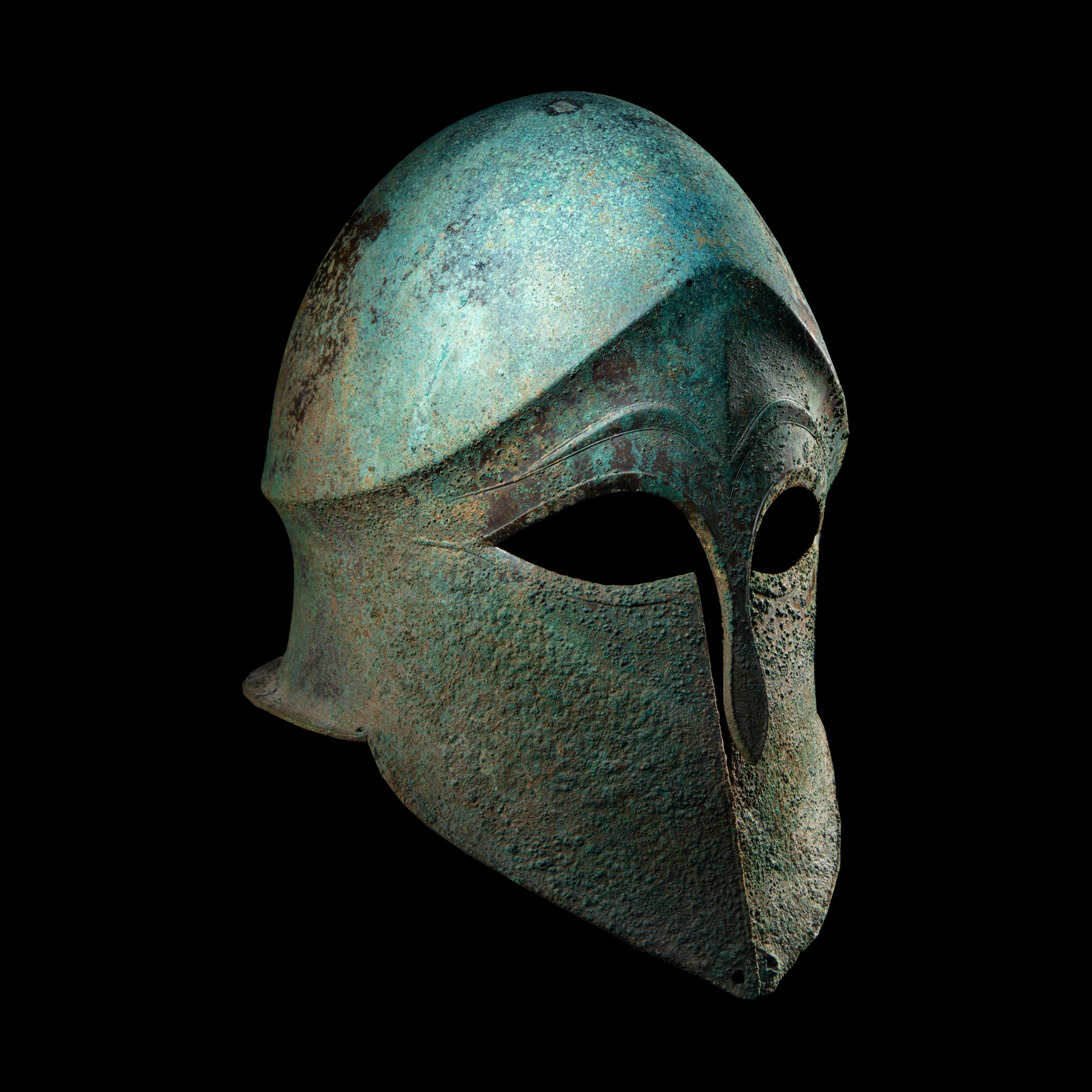
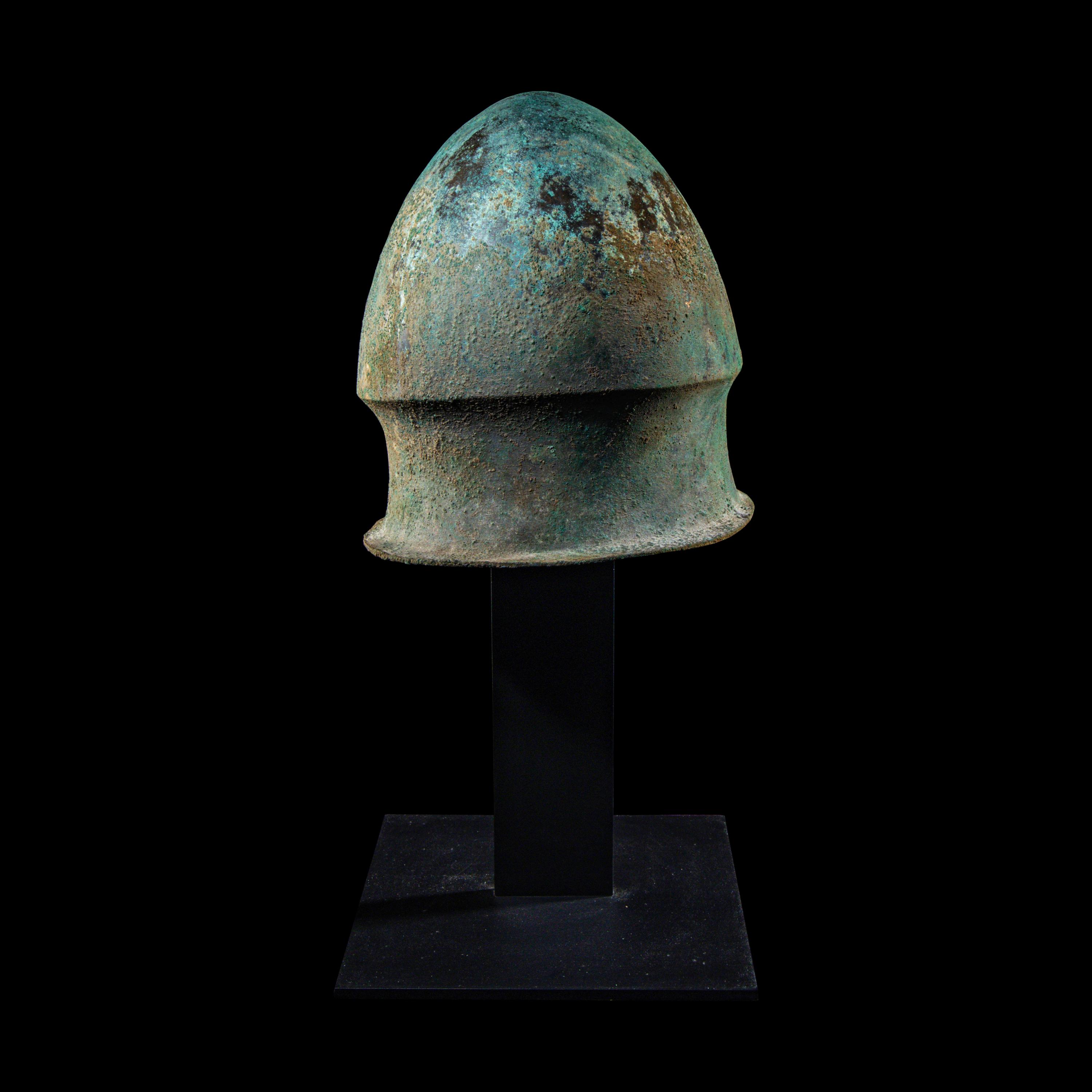
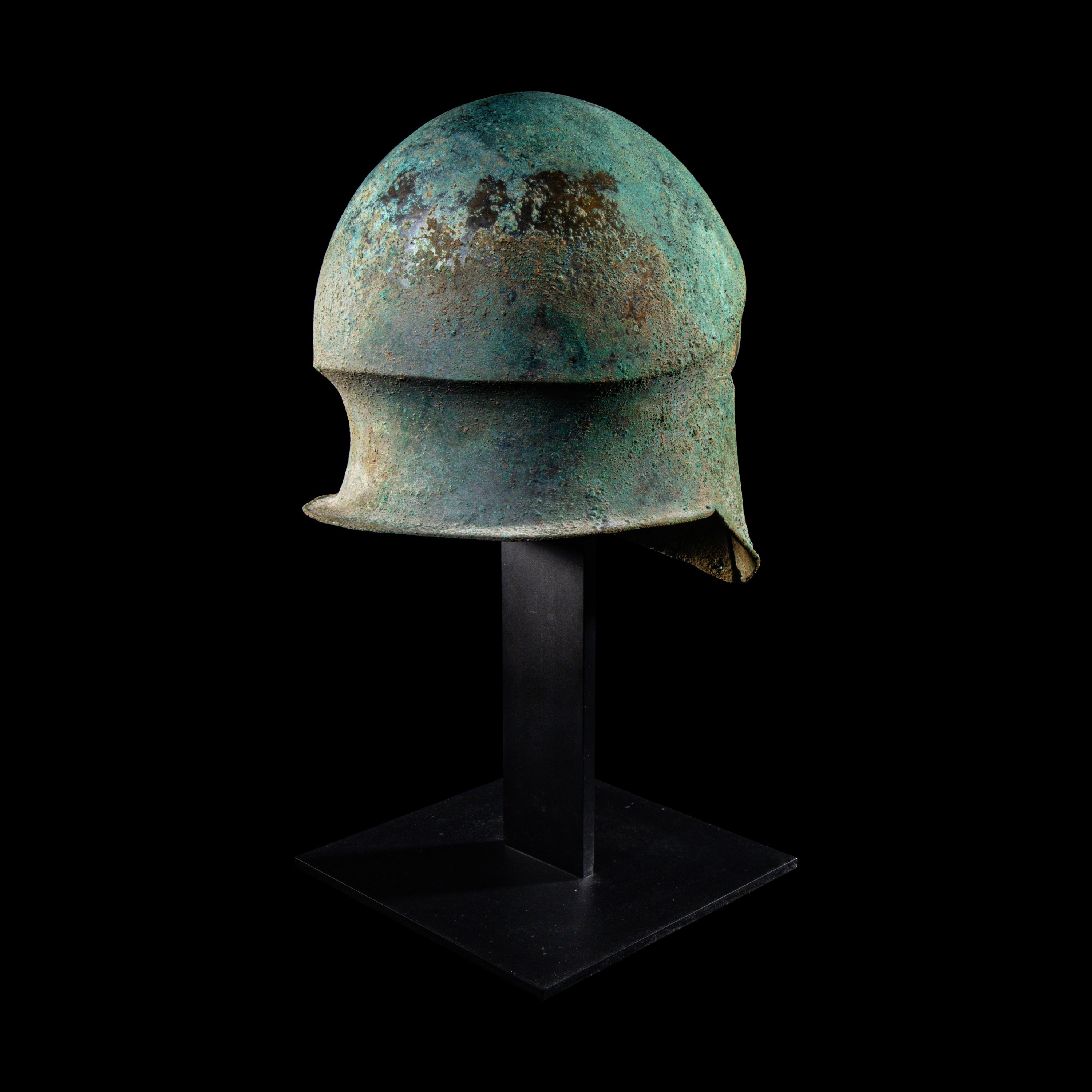
This Corinthian helmet, raised from a single sheet of bronze, presents the type in its late and fully developed form. The ovoid crown, gently peaked, is set off from the walls below by a pronounced step that runs from the brow around to the nape. At the back, the neck guard flares outward to meet the cheekpieces at a shallow angle. The face is rendered with clarity and restraint: almond-shaped eye openings sit beneath incised double brows that converge in a point above the long nose guard, its tip slightly flared. The cheekpieces sweep downward until they nearly meet, leaving only a narrow opening at the front, and each pointed tip is pierced, probably to secure a chin strap. A blue-green patina, pitted and crusted with red-brown, gives the surface considerable depth while leaving the profile crisp and legible.
The Greeks knew the form by this name. Herodotus, describing a festival among the Auseans of Libya, records that each year the fairest maiden was dressed in “a Corinthian helmet and Greek panoply” and driven around a lake in a chariot (Herodotus, Histories 4.180). The type appeared at the end of the eighth century B.C. and was refined over the centuries that followed. The great number of examples dedicated at Olympia has made that development unusually well understood. The step dividing crown from walls belongs to its later phase, a design A.H. Jackson places from around 530 B.C. Here it is paired, as on many helmets of the period, with lengthened cheekpieces.
Such helmets were bound up with kleos, the glory that outlives the warrior who wins it. The Spartan poet Tyrtaeus promised the man who fell among the front fighters that his name and fame would never perish (Tyrtaeus, fr. 12). At Olympia that promise took material form. Helmets were dedicated to Zeus as spoils and thank-offerings, some inscribed with the names of those who gave them: the Argives on armor taken from Corinth, the people of Rhegion on a helmet won from the Locrians around 488-485 B.C., and the Athenian general Miltiades on a helmet very probably offered after Marathon.
In the late sixth and fifth centuries, the Corinthian helmet also took on a second life in art. It is often shown pushed back onto the crown, the cheekpieces hanging and the face beneath exposed. On an Athenian red-figured cup of circa 510-500 B.C. in the British Museum, a winged youth lifting the body of Sarpedon wears his helmet tipped back. A marble warrior from the sanctuary of Aphaia on Aegina, circa 490 B.C., wears his raised. On the silver staters of Corinth, Athena wears hers uncrested. Art lifted the bronze to show the man; the present helmet keeps the face he showed the enemy.
For a helmet of the same carinated form, see British Museum, inv. no. 1824,0407.32. For the development of the type and its dedication at Olympia, see H. Frielinghaus, Die Helme von Olympia, Berlin, 2011, pp. 41-45; and A.H. Jackson, “Argos’ Victory over Corinth,” Zeitschrift für Papyrologie und Epigraphik, vol. 132 (2000), pp. 295-311.
Inspected under UV light and 10x loupe. Oxidized surface with overall green verdigris patina, with areas of reddish and honey-brown exposed metal, and some malachite. Areas of azurite present on the interior. The front end of the proper right cheekpiece has been repaired. Two rectangular fittings are preserved on the crown, likely for the attachment of plumes. An internal patch is present, possibly an ancient repair (see additional images). Two small perforations are at the ends of the cheekpieces, with two more at the junction of the cheekpieces and neck guard. Overall in very fine and attractive condition, with excellent preservation. See additional images. Length 27 cm (10 5/8 inches).
Rests on a stand. Height with stand 42 cm (16 1/2 inches).
The physical condition of lots in our auctions can vary due to age, normal wear and tear, previous damage, and restoration/repair. All lots are sold "AS IS," in the condition they are in at the time of the auction, and we and the seller make no representation or warranty and assume no liability of any kind as to a lot's condition. Any reference to condition in a catalogue description or a condition report shall not amount to a full accounting of condition. Condition reports prepared by Freeman's staff are provided as a convenience and may be requested from the Department prior to bidding.
The absence of a posted condition report on the Freeman's website or in our catalogues should not be interpreted as commentary on an item's condition. Prospective buyers are responsible for inspecting a lot or sending their agent or conservator to inspect the lot on their behalf, and for ensuring that they have requested, received and understood any condition report provided by Freeman's.
Please email Antiquities@freemansauction.com for any additional information or questions you may have regarding this lot.