To request further details about this lot, please email Antiquities@freemansauction.com
Please email Antiquities@freemansauction.com for any additional information or questions you may have
Sale 6578
| Chicago
| Chicago
To request further details about this lot, please email Antiquities@freemansauction.com
Please email Antiquities@freemansauction.com for any additional information or questions you may have
Estimate$30,000 – $50,000
Provenance:
Private Collection, Brussels, prior to 1960. [by repute]
Royal Athena Galleries, New York, 2006 (Art of the Ancient World, vol. XVII, p. 6-7, no. 9).
Jane Davis Doggett, Hobe Sound, Florida, acquired from the above, 11 February 2006.
Hindman Auctions, Chicago, Fine Furniture, Decorative Arts & Silver, 16 April 2019, Lot 151.
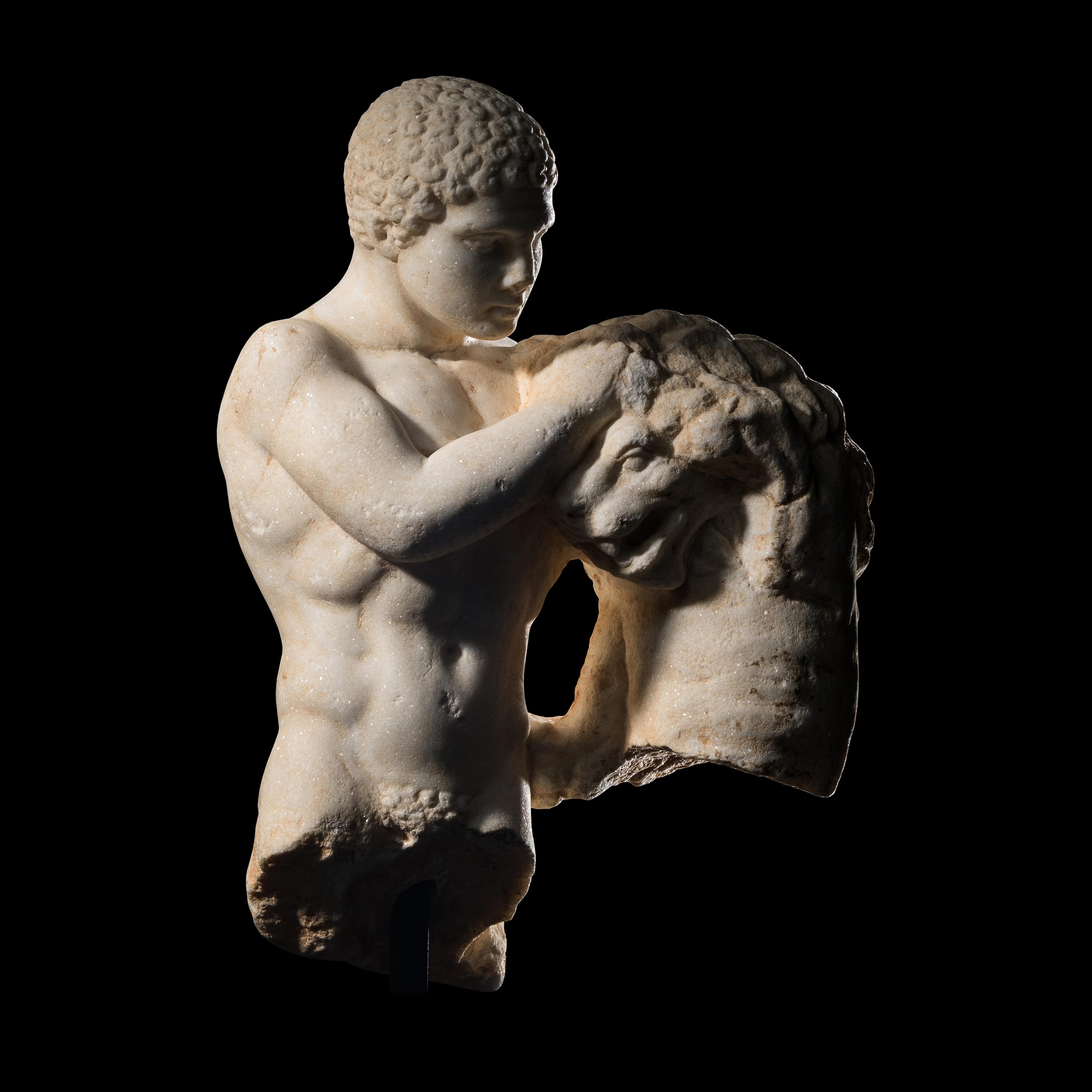
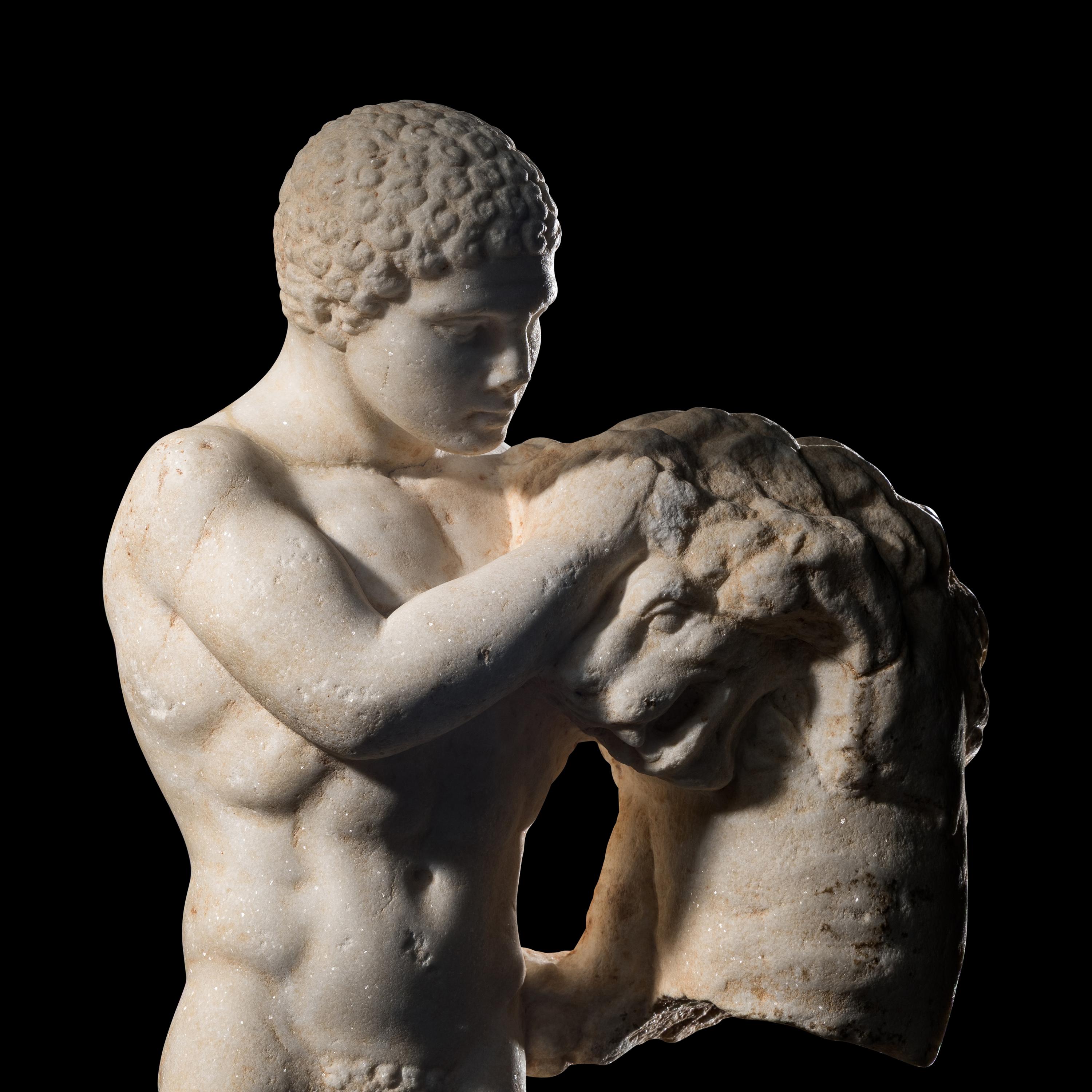
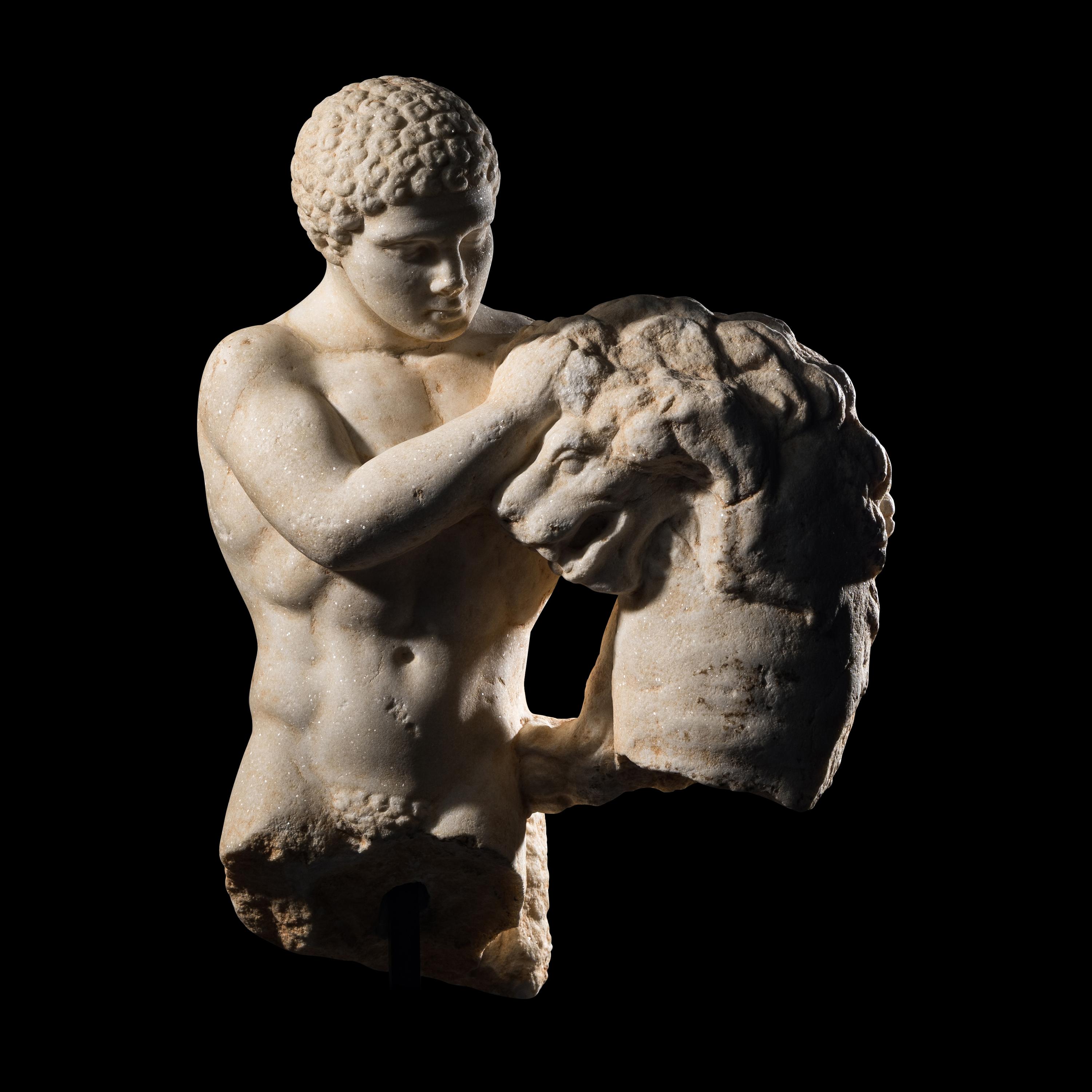
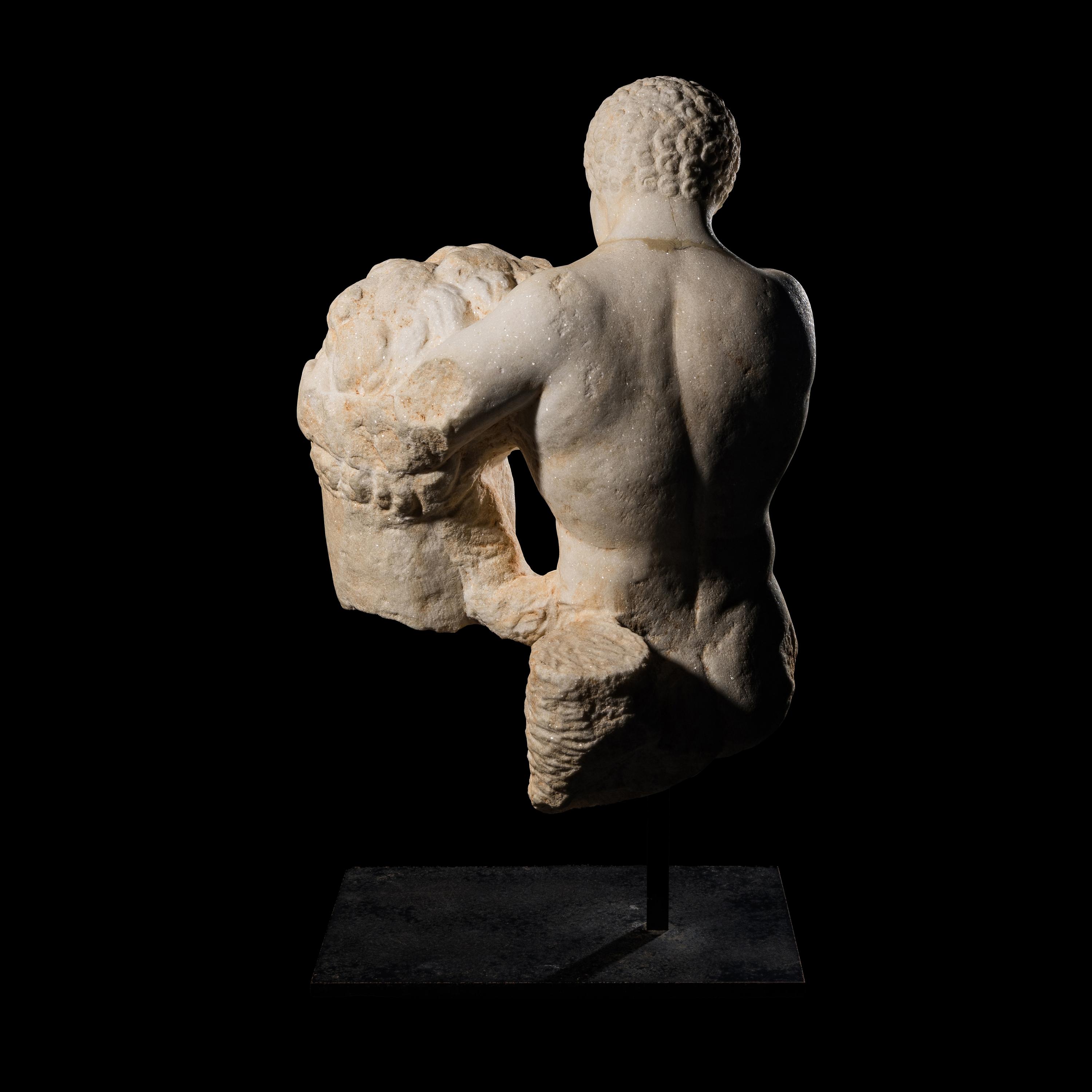
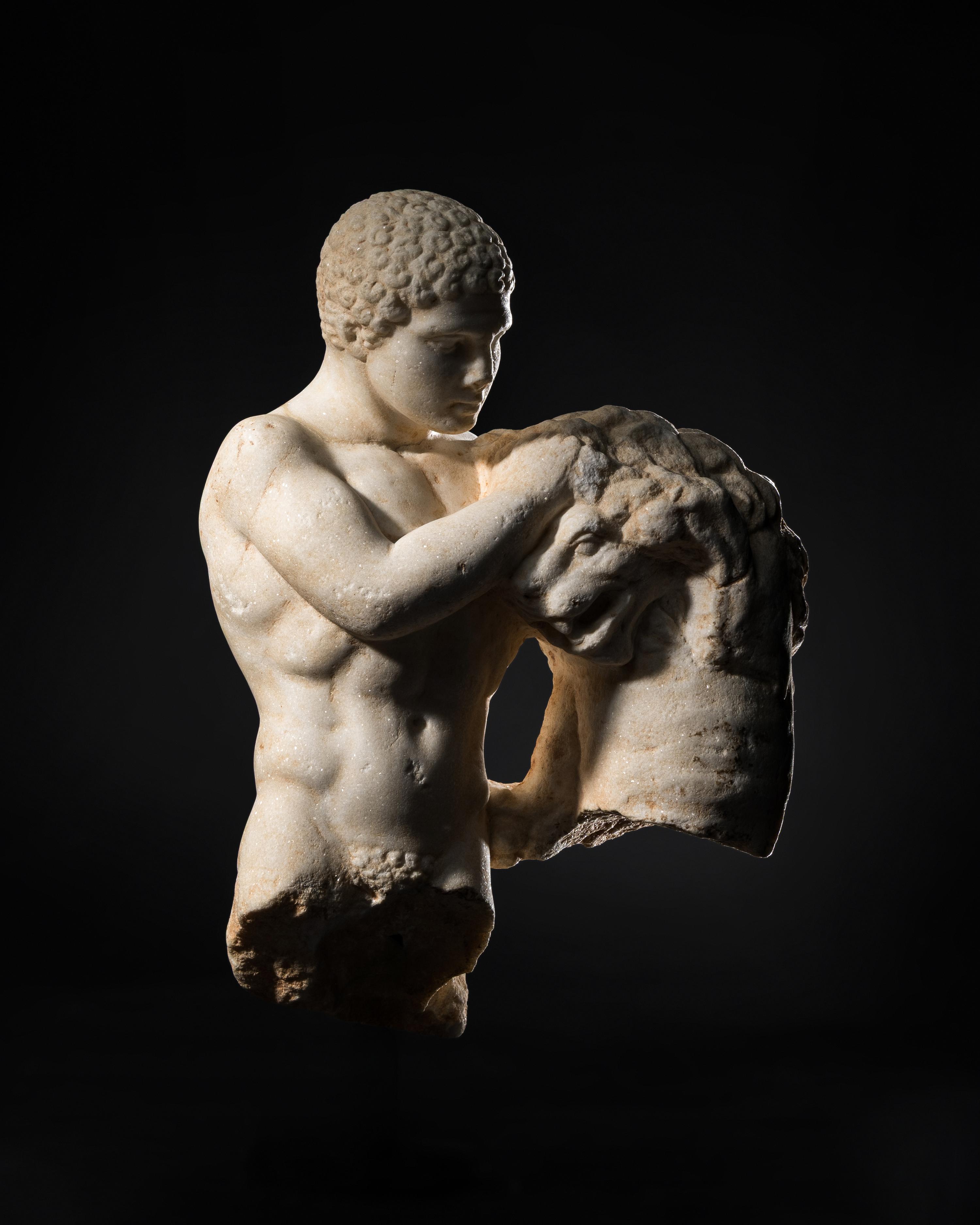
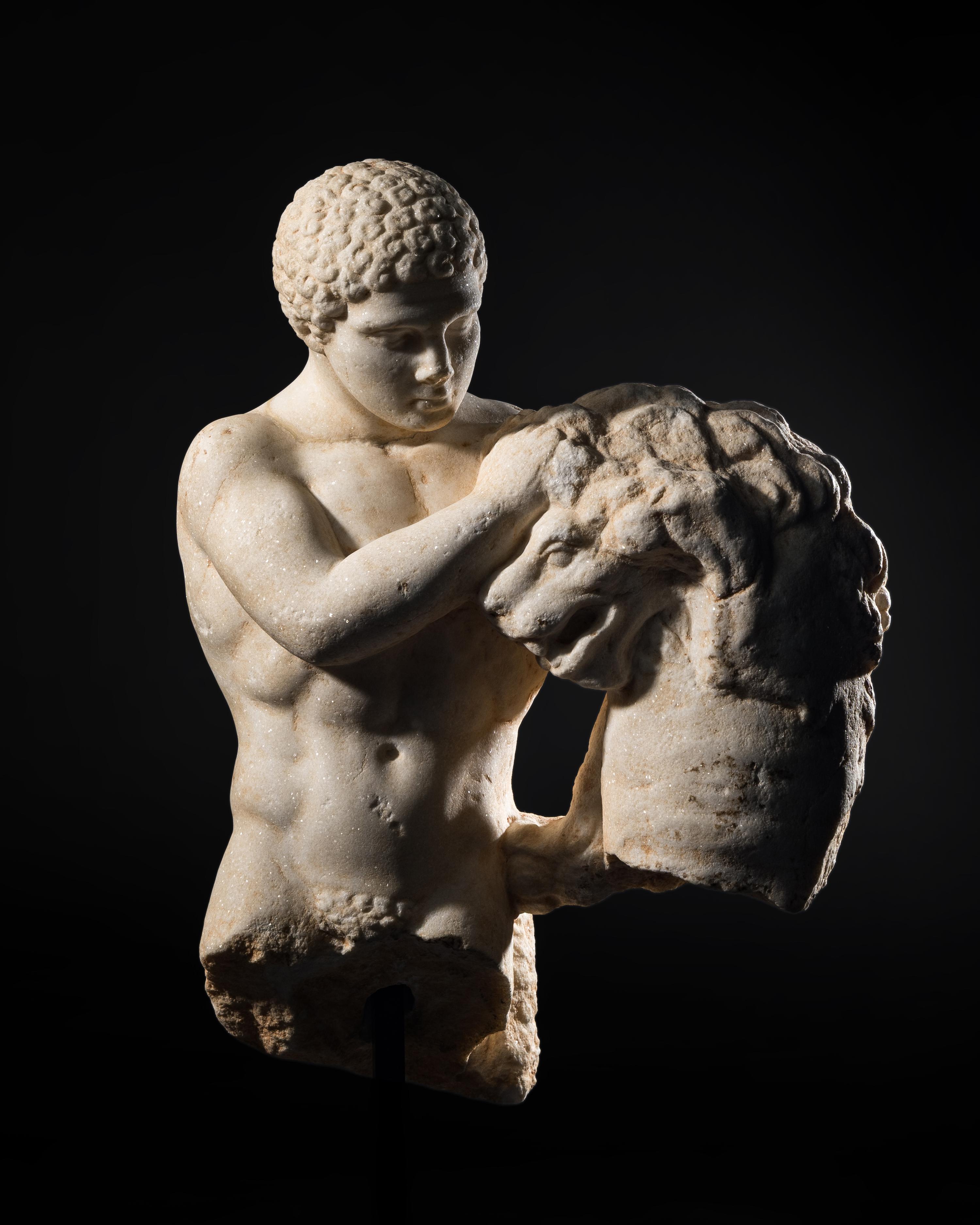
The first of the twelve labors of Hercules was to kill the Nemean lion and bring back its skin. No weapon could pierce the beast’s hide. When his arrows and club failed, Hercules followed the lion into its cave and, as Apollodorus tells it, “putting his arm round its neck held it tight till he had choked it” (Library 2.5.1). This is the moment the sculptor has captured.
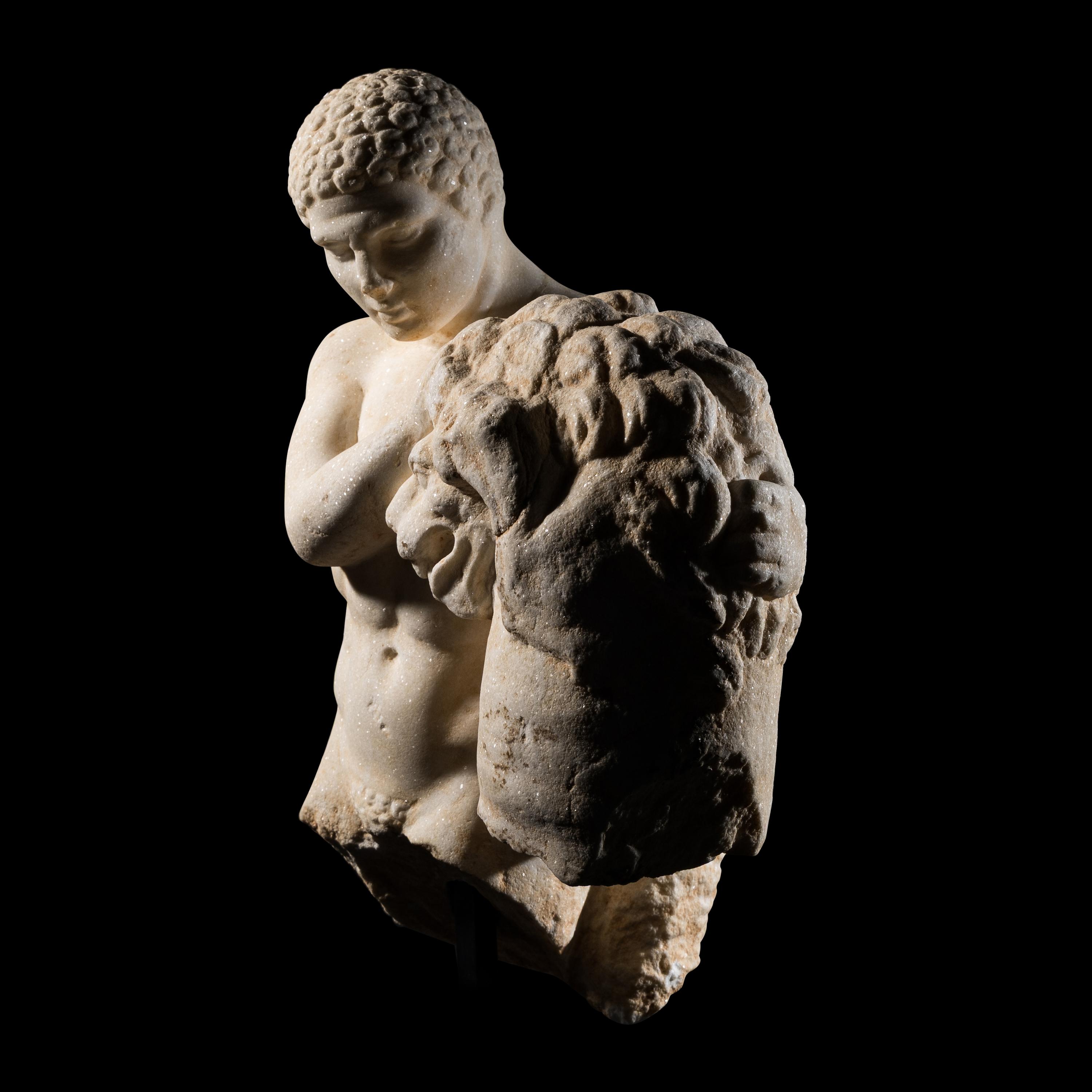
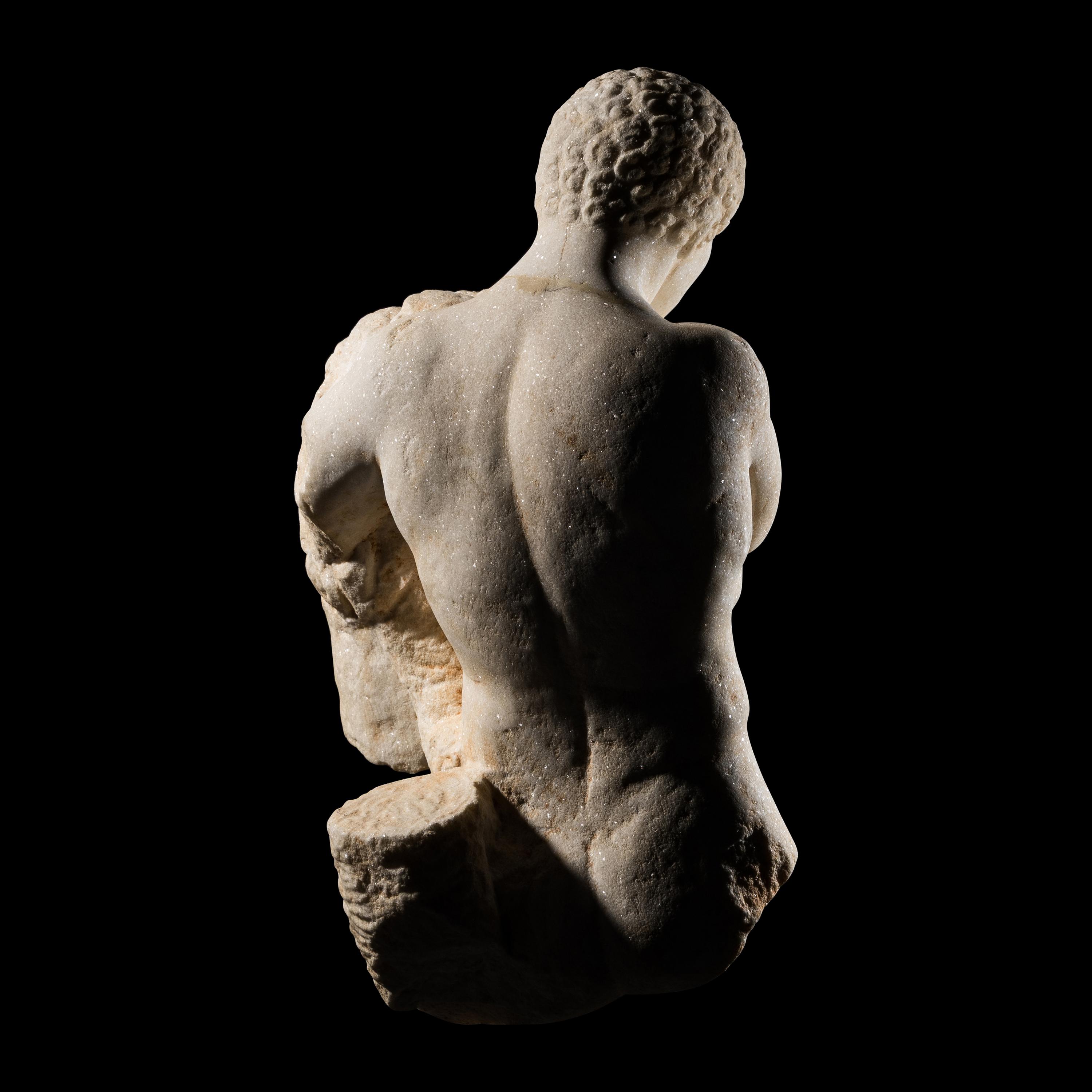
Hercules appears here as a young man, beardless, with short, tightly drilled curls. He looks down calmly at the lion, despite the struggle. His right arm wraps around the animal’s neck and holds its maned head against his shoulder. What remains of his left arm seems to reach under the lion’s body to tighten the grip. The body of the hero is finely carved, with smooth, softly modeled muscles that contrast with the rougher texture of the mane.
The style of the carving suggests a workshop in the eastern provinces of the Roman Empire, in the region of modern Syria and Lebanon. Hercules was especially popular there. On the coast, the people of Tyre identified him with their own god Melqart, and the city’s coins show his head wrapped in the lion skin. Inland, statues of the hero have been found at Scythopolis (Beth Shean), Gadara, Philadelphia (Amman) and Petra (Mazor and Atrash, ‘Atiqot 104, 2021). At Dura-Europos on the Euphrates, excavators found more than forty images of Hercules, five of them showing his fight with the lion (Downey, The Heracles Sculpture, 1969, pp. 44–45). The youthful hero and close cap of curls fit comfortably within this eastern tradition. Small marble groups like this one were likely displayed in homes and gardens.
For a closely related composition from Roman Syria, see the limestone Herakles and the Nemean Lion from the Temple of Zeus Megistos at Dura-Europos, now at the Yale University Art Gallery, New Haven (Acc. no. 1938.5302), in which the hero also holds the lion in a headlock. For the subject on a Roman sarcophagus, see the Metropolitan Museum of Art, New York (Acc. no. 18.145.56).
The physical condition of lots in our auctions can vary due to age, normal wear and tear, previous damage, and restoration/repair. All lots are sold "AS IS," in the condition they are in at the time of the auction, and we and the seller make no representation or warranty and assume no liability of any kind as to a lot's condition. Any reference to condition in a catalogue description or a condition report shall not amount to a full accounting of condition. Condition reports prepared by Freeman's staff are provided as a convenience and may be requested from the Department prior to bidding.
The absence of a posted condition report on the Freeman's website or in our catalogues should not be interpreted as commentary on an item's condition. Prospective buyers are responsible for inspecting a lot or sending their agent or conservator to inspect the lot on their behalf, and for ensuring that they have requested, received and understood any condition report provided by Freeman's.
Please email Antiquities@freemansauction.com for any additional information or questions you may have regarding this lot.