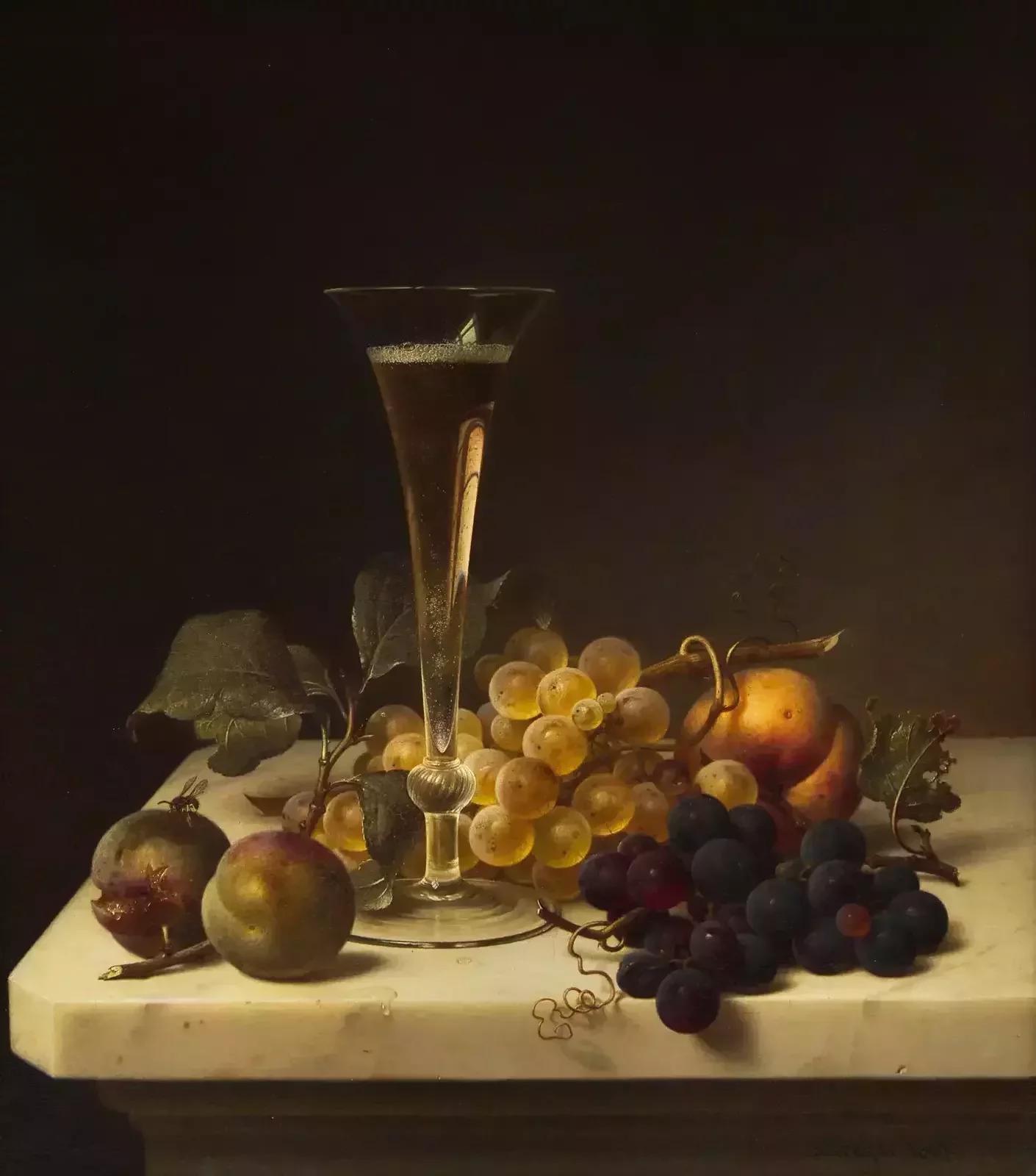
Johann Wilhelm Preyer's 'Still Life with Champagne Flute, Greengages, Peach, and Grapes, 1867,'
This exquisitely rendered still life is by the artist Johann Wilhelm Preyer, a student of the Düsseldorf School of painting, and one of the few of that school to specialize in still lifes.
From 1822, Preyer studied at the renowned Düsseldorf Academy, initially under Peter von Cornelius, and later under Wilhelm von Schadow until 1831. Beginning in the1830s, the artist showed work at the Berlin Academy exhibitions, as well as traveling to the Netherlands, Italy, and Switzerland. In 1837, Preyer went to Munich, where he did several of his best still lifes and was so successful that King Ludwig I of Bavaria purchased one of his paintings. By 1848, Preyer settled in Düsseldorf, where he founded the Malkasten Artists' Association and remained the rest of life.
Still Life with Champagne Flute, Greengages, Peach, and Grapes, 1867, depicts on a white marble ledge a slender glass of sparkling wine, greengages (a type of plum), a peach, and two bunches of green and red grapes. Although still lifes were held in rather low esteem within the academy circles, Preyer’s detailed paintings, such as the present work, quickly met with great success among the public, critics, and collectors. The artist’s still lifes were influenced by Dutch Old Master paintings, and drew on their unique compositional elements, as well as their varied range of rich and cool colors. He similarly employed vanitas motifs, such as the housefly perched on a greengage and bubbles in the sparkling wine: ephemeral symbols of life’s transience. However, while the 17th century still lifes carried a Christian symbolism, Preyer's compositions are purely decorative, in keeping with the Biedermeier aesthetic influential among the Düsseldorf school artists.
The technical talent of the artist can be seen in his ability to reproduce the plasticity of objects and texture of surfaces. Here, the smooth slab of marble exudes a coolness that only elevates the lushness of the fruit that appears to be almost overripe, as evidenced by the withered skin of a grape and the bruised and partially exposed flesh of the greengage on which the fly perches. The flute itself is a virtuosic example of trompe l’oiel. If one looks carefully enough, the reflection of not only the window emitting light can be seen, but also a partial reflection of the artist himself. This fine example of Preyer’s still lifes explains the demand for his work, which was to become so great that he painted to order for domestic and foreign customers, and whose works was prized especially with collectors in the United States.
Old Masters & 19th Century Art
Live | New York May 12 | 11:00 AM EDT