Antiquities of the Garden A Collector’s Living Ancient World
A great collection is never only about ownership; it is about recognition. The more than 120 works in this single-owner collection span centuries and civilizations, from Roman marble sculpture and Greek arms and armor to Egyptian amulets, South Arabian works, Near Eastern votives, and precious objects in silver and gold.
What unites them is not geography but feeling: each object seems to have been chosen for its ability to carry memory, presence, and character across time. As the anonymous collector himself put it, “I collected these antiquities because they spoke to me. I felt that they were here with me, teaching me. I also chose some that were like me, as in ‘alike.’ This happens often with the flowers I plant in my garden too: Pelargonium hortorum. They too are, like my antiquities, alive.”
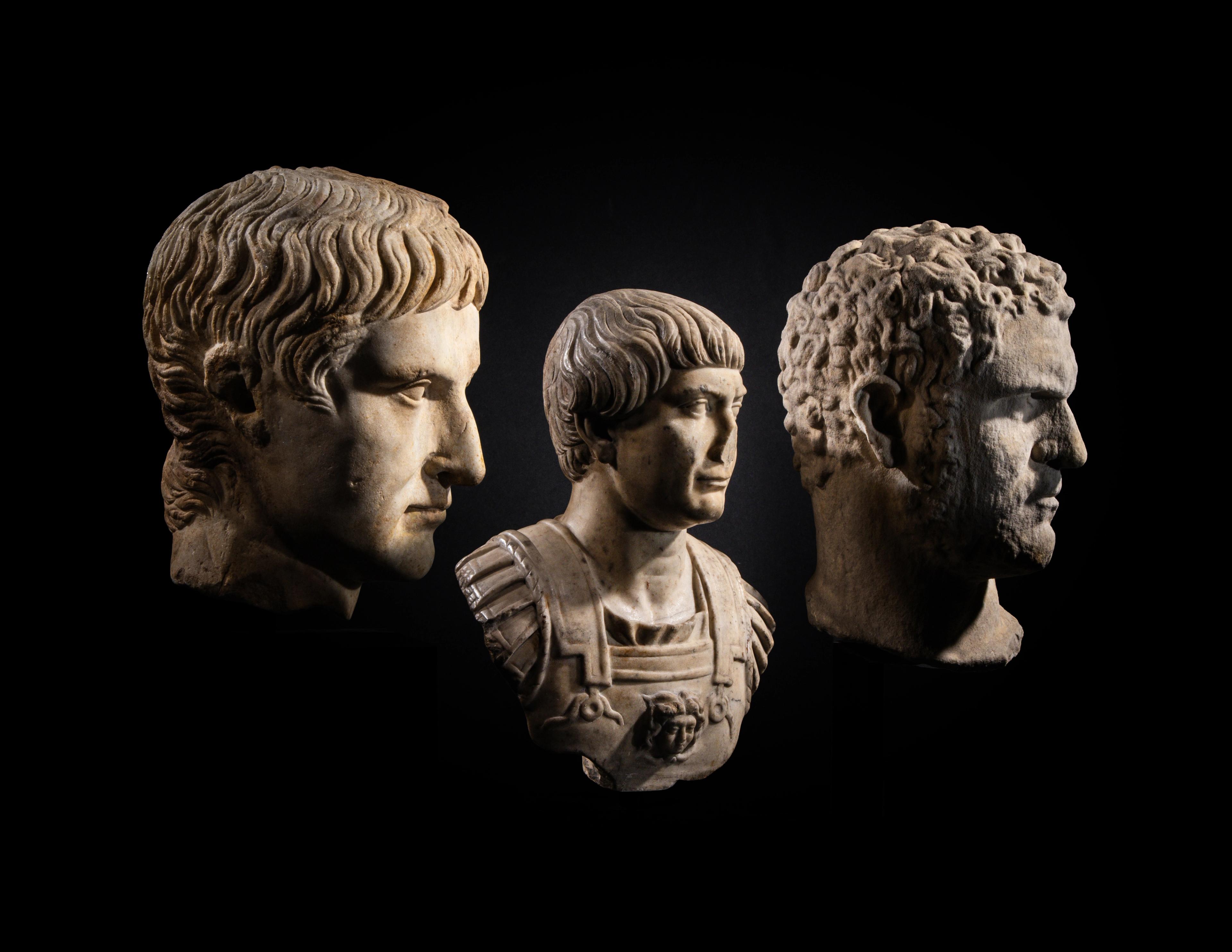
That sense of presence is perhaps strongest in the collection’s remarkable marble portrait heads, including likenesses of Augustus, Trajan, and Caracalla. In them, Roman history becomes startlingly human. Augustus still suggests the calm authority of the age that laid the foundations for the Pax Romana; Trajan, remembered among the Five Good Emperors, embodies imperial ambition joined to public duty; Caracalla, by contrast, carries the harder edge of rule, remembered both for brutality in the ancient sources and for the edict of 212 A.D. that extended Roman citizenship across the empire. Together, these faces do more than represent emperors. They present power as personality, and history as something that can still look back at us.
Elsewhere, the collection turns from the face to the body in armor: a Greek Bronze Phrygian Helmet, a Greek Tinned-Bronze Chalcidian Helmet, and a Greek Bronze Corinthian Helmet. Each is an object of defense, but also of identity. In the ancient Mediterranean, armor was never merely practical; it stood at the meeting point of danger, honor, and self-presentation. These helmets remind us that the ancients did not separate the question of how to live from the question of what was worth defending. They are metaphors, even now, for the “good death” as the Greeks understood it: not death sought for its own sake, but a life made meaningful through courage, duty, and purpose.
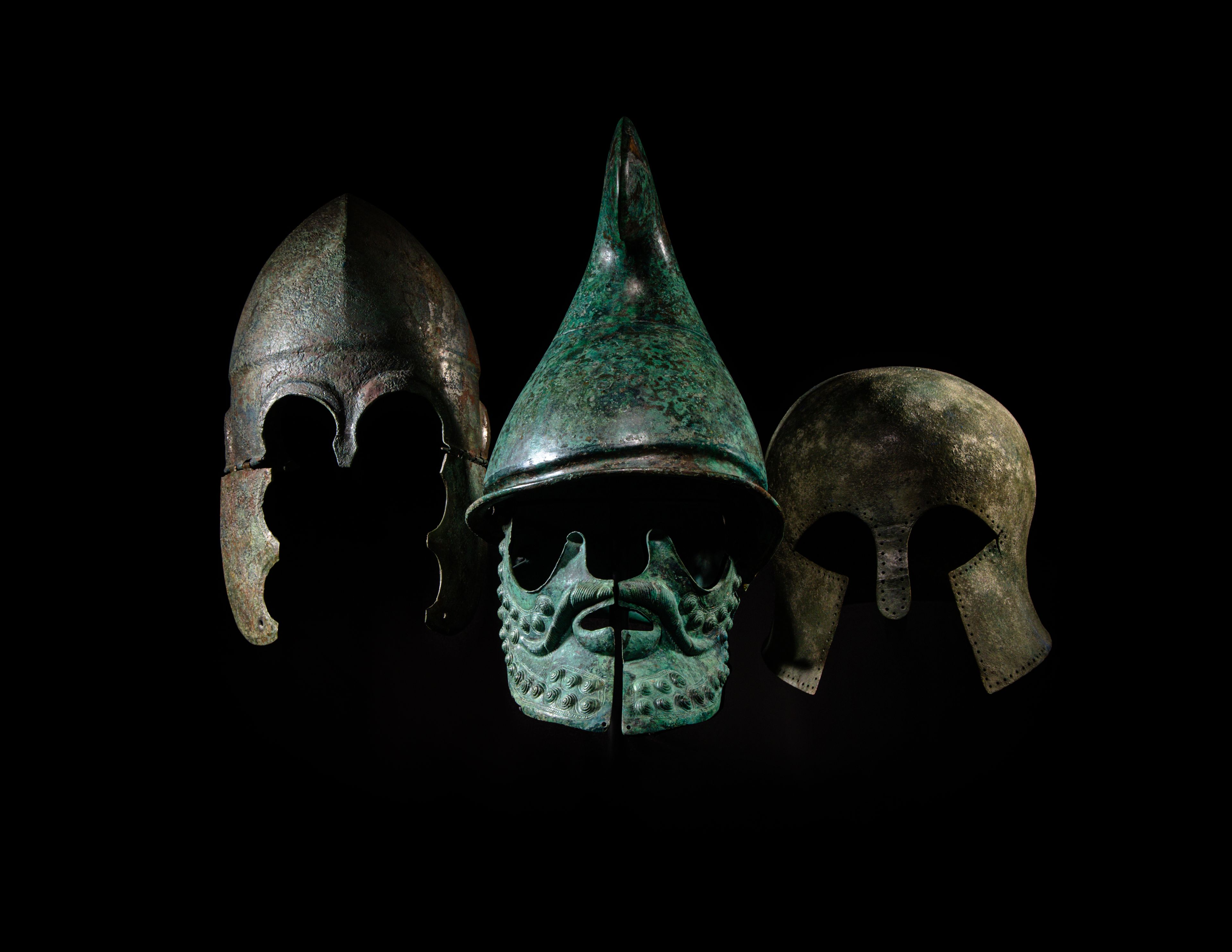
A Greek Tinned-Bronze Chalcidian Helmet (BC 500-301, Estimate: $15,000 – 25,000), Greek Bronze Phrygian Helmet (Circa 350-300 B.C., Estimate: $80,000 – 120,000), and a Greek Bronze Corinthian Helmet (Circa 6th Century B.C., Estimate: $60,000 – 80,000)
The collection’s earliest voices may be its quietest: Near Eastern marble and lapis lazuli inlay statuettes of recumbent cows and felines from the 3rd millennium B.C. In their compact forms is a world being organized for the first time. Mesopotamia, long called one of the cradles of civilization, was shaped by farming, irrigation, and the domestication of animals; art from the region often reflects that close dependence on the natural world. These small creatures are therefore more than ornaments. They speak to the oldest bond between humanity and animal life, and to the twin foundations of settled civilization: animal husbandry and cultivation. For a collector deeply attuned to gardens and growth, it is easy to see how such works could feel vividly, almost tenderly, alive.
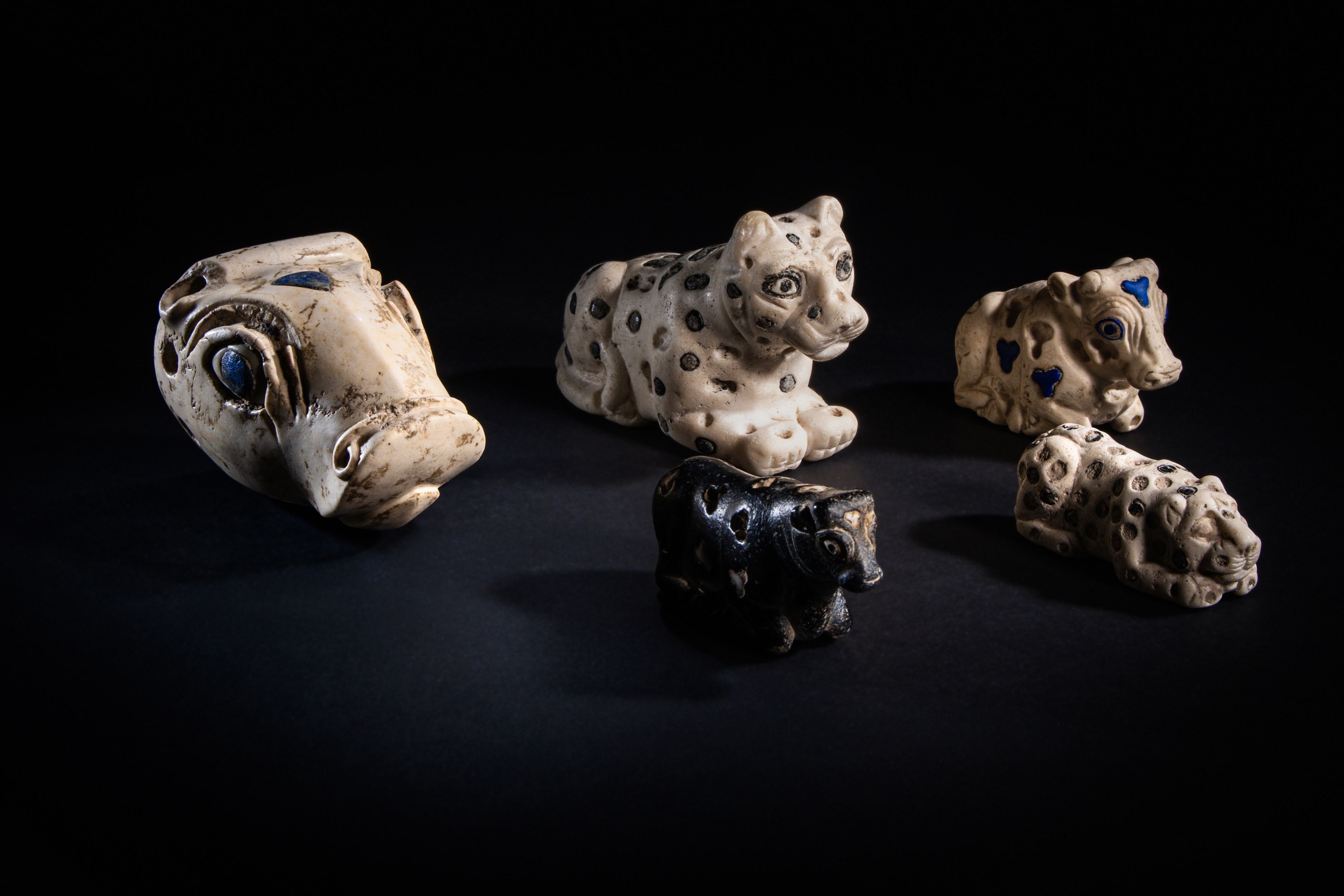
Mesopotamian statuettes of recumbent cows and felines including a Limestone and Lapis Lazuli Inlay Recumbent Calf (far right), Late Uruk-Jemdat Nasr Period, Circa 3300-2900 B.C., Estimate: $5,000 – 7,000
Seen together, the collection forms less a survey than a tapestry. Faces, helmets, animals, tools of devotion, and objects of luxury all speak in different registers, yet each reflects the same enduring human concerns: power, mortality, beauty, protection, memory, and life lived in relation to the world around us. That breadth is what makes this collection so compelling. It does not present antiquity as distant or inert, but as a living garden of encounter, where many cultures, many objects, and many histories are woven into one collector’s sustained passion for the ancient world.
This remarkable single-owner collection will be offered in Freeman’s Antiquities of the Garden: A Collector's Living Ancient World auction on Wednesday, May 20, 2026, at 9:00 am CT.
INQUIRIES: jacobcoley@freemansauction.com