In Conversation: Evan Bellantone
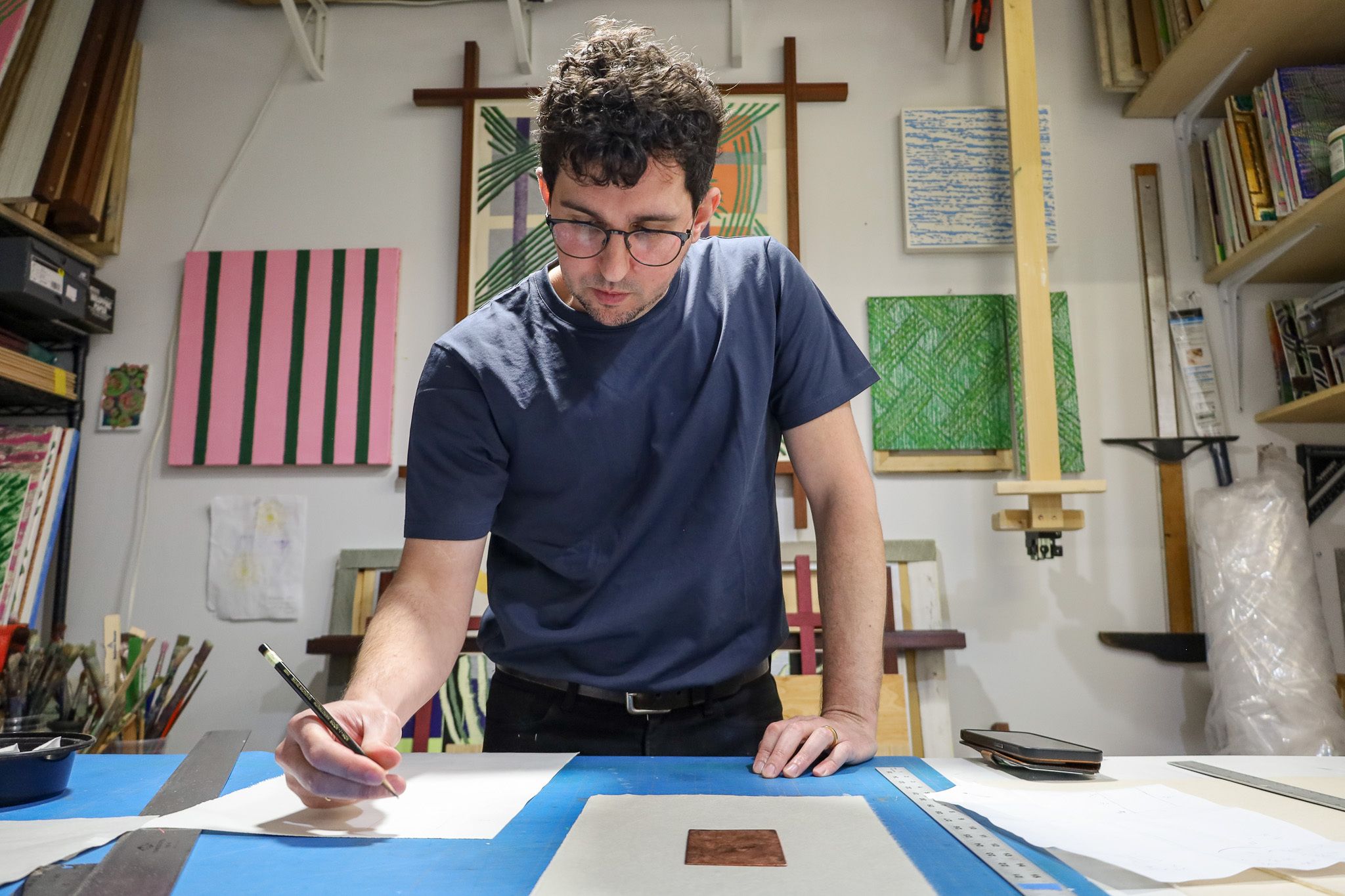
Following a successful event on April 10th celebrating the printing process in Freeman’s New York gallery, Senior Specialist, Prints and Multiples, Matthew Stavro sat down with master printer Evan Bellantone.
Gain insights into Evan’s career in printmaking, the intricate relationship between artist and printer, and the comprehensive process involved in creating a print from inception to completion.
Freeman's: What path and experience are required to become a master printer, and how is that distinction earned within the field?
Evan Bellantone: I view the role of a printmaker first and foremost as that of an artisan. Understanding the intricacies of printmaking requires dedication to the craft and a collaborative spirit to work successfully with artists. That said, there is no specific path to becoming a master printmaker, but an apprenticeship or degree-granting program in printmaking can go a long way toward building that understanding. The designation of "master," as I see it, relates to accrued experience in the collaborative process, where a printmaker can engender trust and shepherd a creative project with an artist. It should be noted that the term "master printmaker," while still widely used, is somewhat antiquated and almost guild-like in its association. Today, there is no governing body determining membership, and a printmaker is a master when someone else believes in your skills enough to call you one.
F: How would you describe the collaborative relationship between artist and printer, and how does that dynamic shape the final work?
EB: I think there's a ready analogy to the relationship between artist and printer in the relationship between musician and producer. Artists provide the content, and printmakers help shape it into a finished product using the specific sets of expertise at their disposal. Ultimately, a printmaker works toward the artist's vision, but each collaboration uniquely depends on the artist's interest in expressing their work, which informs the relationship. An artist might have a really clear idea of the exact outcome, but I think the most interesting projects are those in which the artist brings an interest in experimentation and curiosity to bear on the project. That, in turn, challenges the printmaker to expand their skills to meet the artist's expectations. The question both artist and printmaker are working toward is what is the best version of this print that it can be? I think a lot of the art in a project is found in exploring that space.
F: Can you walk us through the printmaking process, from initial concept to finished edition?
EB: There is probably an entire book's worth of material to unpack in this question. Broadly speaking, a print project begins with an artist's idea to translate their work into a print medium and ends when a lengthy process of iterative experimentation yields something that satisfies the vision. That's why making a print is a very big deal. All print media, from etching to lithography to relief to silkscreen, offer a unique character that must meld with the image and concept the artist is producing. Once the medium and subject are worked out, the print itself needs to be tested in a proofing stage, where colors, papers, and dimensions (among other considerations) are determined. The artist and printmaker will work together, analyzing the results, until a print is made that becomes the definitive version. This print is called the BAT, or bon à tirer, which means "good to pull," and serves as the qualitative benchmark after which the print edition will be made. It can take hundreds of proofs and feature as many variations just to reach that stage, at which point the print run is printed by hand, each one perfectly matching every minuscule detail of the BAT. Finally, when the prints are complete and checked for quality, the artist will sign and number them.
F: How have techniques such as etching evolved over the past century, both technically and conceptually?
EB: Printmaking is one of those media that feels both old and new. A technique like etching metal with acid, as it applies to printmaking, has its roots in the 16th century and is still used today, while screen printing, as we know it, was popularized in the early 20th century. While these are not really bleeding-edge technologies, photolithography is the technological basis for semiconductor manufacturing. Obviously photolitho is used quite differently in the hands of a printmaker, but what continues to resonate with print collectors and makers is the way the medium is made legible through the artisanal process, particularly through collaboration. Prints are handmade objects that reflect the intellect and skill of both artist and printmaker in their production and envisioning. Collaborative printmaking in the US took off in the 1960s and made extraordinary advances in the state of the art by working with artists who wanted to make editions at a scale that reflected an increasingly interconnected and expanding world. Legendary print ateliers such as Gemini GEL and Tyler Graphics expanded printmaking into sculptural editions while retaining the artisanal approach to their construction. Papermaking workshops, like Dieu Donne, did the same with paper editions, inspiring many of the same household-name artists to expand their artistic practices. It's easy to take the ambitious output of that time for granted as the skills those projects demonstrate become less understood, but these projects, led by the vision of their artists, fostered an era of aggressively experimental printmaking that continues to the present.