Morgan Colt's Largest Known Oil Painting: A Rare New Hope School Masterwork of Delaware River Life
Born in Summit, New Jersey in 1876 and trained at Columbia University’s School of Architecture, Colt initially joined a New York architectural firm before abandoning the discipline altogether, eager to escape what he once described as the restrictive demands of “clients’ tastes or whimsies.”
Drawn instead to the freedom of artistic expression, Colt settled at Phillips’ Mill, where he formed a close friendship with William Langson Lathrop, Edward Willis Redfield, Daniel Garber, Charles Rosen, Rae Sloan Bredin, and Robert Spencer–the first generation of New Hope School painters. Though he pursued painting, design, and crafts with equal devotion, Colt is remembered today primarily for his luminous Impressionist landscapes, which he composed in the studio because of a chronic heart condition that prevented prolonged outdoor study.
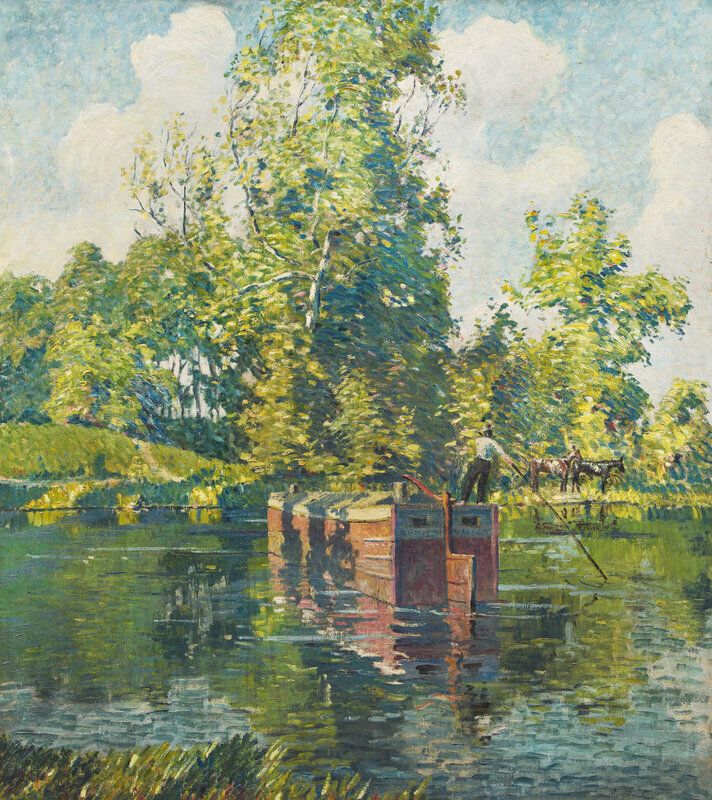
The present painting stands apart within the limited corpus of Colt’s work. The largest known oil by the artist, it represents one of his most ambitious surviving compositions ever to appear on the market. On the monumental canvas, Colt inscribes a now-vanished chapter of life along the Delaware River with an almost cinematic immediacy. Rather than offering a distant vista, Colt brings the viewer directly onto the river, where the diagonal movement of a barge contrasts gently with the horizontal (and echoing) banks as well as the rustling canopy of trees overhead. A figure stands at the stern, pole in hand, while a team of mules waits at the riverbank; small yet evocative details that anchor the composition in lived history. In this sentimental view, Colt memorializes the everyday labor and quiet poetry of river life before mechanization transformed the region’s rhythms forever.
Colt’s brisk, shimmering brushstrokes animate the reflections on the river’s surface, while the bright, sun-filled palette envelops the entire composition in a sense of warmth and pastoral calm. The canvas resonates with nostalgia, not only because it preserves a nearly forgotten mode of transportation, but because Colt renders it through a screen of dappled light, mirrored water and soft atmospheric haze, which transforms the industrial subject into an homage to the enduring beauty of Bucks County.
Colt died suddenly of a heart attack in 1926, leaving many canvases unfinished and an even greater number tragically destroyed by subsequent occupants of his home. This historic loss makes the reappearance of the present canvas on the market even more exciting and momentous. Discover this landmark work by Morgan Colt and explore the full selection of Pennsylvania Impressionist offerings in our upcoming sale.