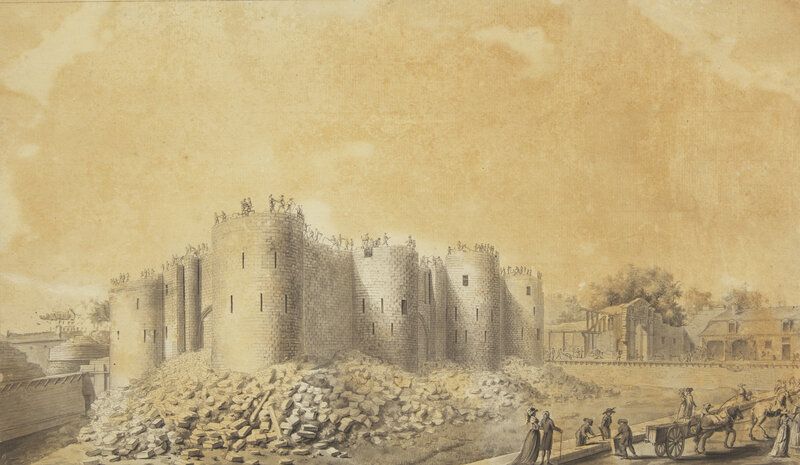
The Destruction of the Bastille Drawing, Once Owned by George Washington, Sells for Nearly $2 Million
Historic The Destruction of the Bastille Drawing, Once Owned by President George Washington, Skyrockets Past Expectations with a Nearly $2 Million Sale
PHILADELPHIA – A rare ink-wash drawing, The Destruction of the Bastille (Lot 35), created just weeks after the fall of the Bastille at the onset of the French Revolution, soared past expectations during Freeman’s | Hindman’s September 10 Books and Manuscripts auction, nearly quadrupling its pre-sale estimate of $500,000 - 800,000. Following an intense ten-minute bidding war in Freeman's | Hindman’s Philadelphia saleroom, the historic piece was sold via phone for an extraordinary $1,996,000. The drawing was originally gifted to George Washington, the first President of the United States, by the Marquis de Lafayette, a key figure in both the French and American Revolutions. It became one of the President’s most treasured possessions, hanging prominently in the presidential house during his two terms and then in the entryway of his Mount Vernon home.
“Over the past six years, I’ve had the privilege of working with thousands of incredible items, but The Destruction of the Bastille is truly extraordinary,” says Darren Winston, Head of the Books and Manuscripts department in Philadelphia. “When you're handling something that George Washington—the man whose face is on the quarter in your pocket—once had hanging in his home, it truly takes your breath away. We are delighted that the proceeds will benefit the worthy cause of the Shriners Hospitals for Children and the Masonic Charity Foundation. Their decision six months ago to partner with their advisor, Art Peritus, and Freeman's | Hindman allowed us to do what we do best: work collaboratively with private clients, institutions, advisors, and collectors to achieve an outstanding result.”
Darren Winston, Head of the Books and Manuscripts Department, Philadelphia
The Destruction of the Bastille | Sold for $1,996,000
A Symbol of “Liberty over Despotism”
As the French Revolution unfolded, the Marquis de Lafayette sent his dear friend and former commander, George Washington, two gifts on behalf of the French people in appreciation of his embodiment of worldwide liberty: a drawing of the demolished Bastille and the main key to the prison. Less than a month after Parisians stormed the Bastille, in August 1789, Étienne-Louis-Denis Cathala—an architect and inspector overseeing the prison’s demolition— captured the historic moment of its destruction in this ink-wash drawing. For Lafayette, these items signaled his gratitude and indebtedness to his mentor, both for Washington's leadership as well as his friendship that began over a decade earlier on the battlefields of America when Lafayette was only 19 years old. And, as the prison served as a symbol of French royal oppression, the drawing capturing its demise reflected their shared experience and victory over British oppression during the American Revolution.
While Lafayette continued to serve as commander of the Paris National Guard, he entrusted the delivery of the gifts to Thomas Paine, who gave them to South Carolinian John Rutledge, Jr., who was then returning to America. Four months later, in August 1790, the drawing and key were presented to Washington in New York during his first term as President. Upon receiving them, Washington would enthusiastically declare them tokens of “victory by Liberty over Despotism.”
An International Journey
In its over 200-year history, the drawing had rarely been exhibited to the public. However, in the lead up to the auction, the drawing retraced its original steps during an international tour beginning with a stop in Paris, France. Its appearance at Didier Aaron & Cie gallery marked the first time the drawing was on French soil since it departed for the newly created United States in 1790. The drawing then returned stateside where it was exhibited in New York at Freeman’s | Hindman’s Upper East Side gallery, followed by Philadelphia. Marking the impending 200th anniversary of Lafayette’s 1824-25 tour of America, the drawing was prominently displayed at the Museum of the American Revolution for the month of August, four blocks from where it once hung in Washington’s Philadelphia home, and only blocks away from where Freeman’s first set up shop only 15 years later, in 1805.
Illustrious Provenance
In 1858, John A. Washington III, the last member of the Washington family to live at Mount Vernon, sold the estate to the Mount Vernon Ladies' Association, gifting several of George Washington's personal belongings including the key to the Bastille—though not The Destruction of the Bastille drawing. The Washington family held onto the drawing until 1891, when it was auctioned in Philadelphia as part of "The Final Sale of the Relics of George Washington." Prominent autograph dealer Walter E. Benjamin purchased it, later selling it to media mogul William Randolph Hearst. After World War II, Connecticut resident Alan Carswell acquired the piece and passed it on to his wife, who bequeathed it to the Shriners Hospitals for Children and the Masonic Charity Foundation. As a result, the proceeds from the sale of The Destruction of the Bastille at Freeman’s | Hindman will directly support these two charitable organizations.
Additional Highlights | Books and Manuscripts Auction
- A fine association copy of the rare first edition of The Federalist (Lot 34), from the library of George Washington’s nephew, Bushrod Washington, heir to his Mount Vernon estate and a Supreme Court Justice achieved $53,975.
- A Fine First Edition of Izaak Walton's The Compleat Angler or the Contemplative man's Recreation. Being a Discourse of Fish and Fishing... (Lot 108) realized $34,925.
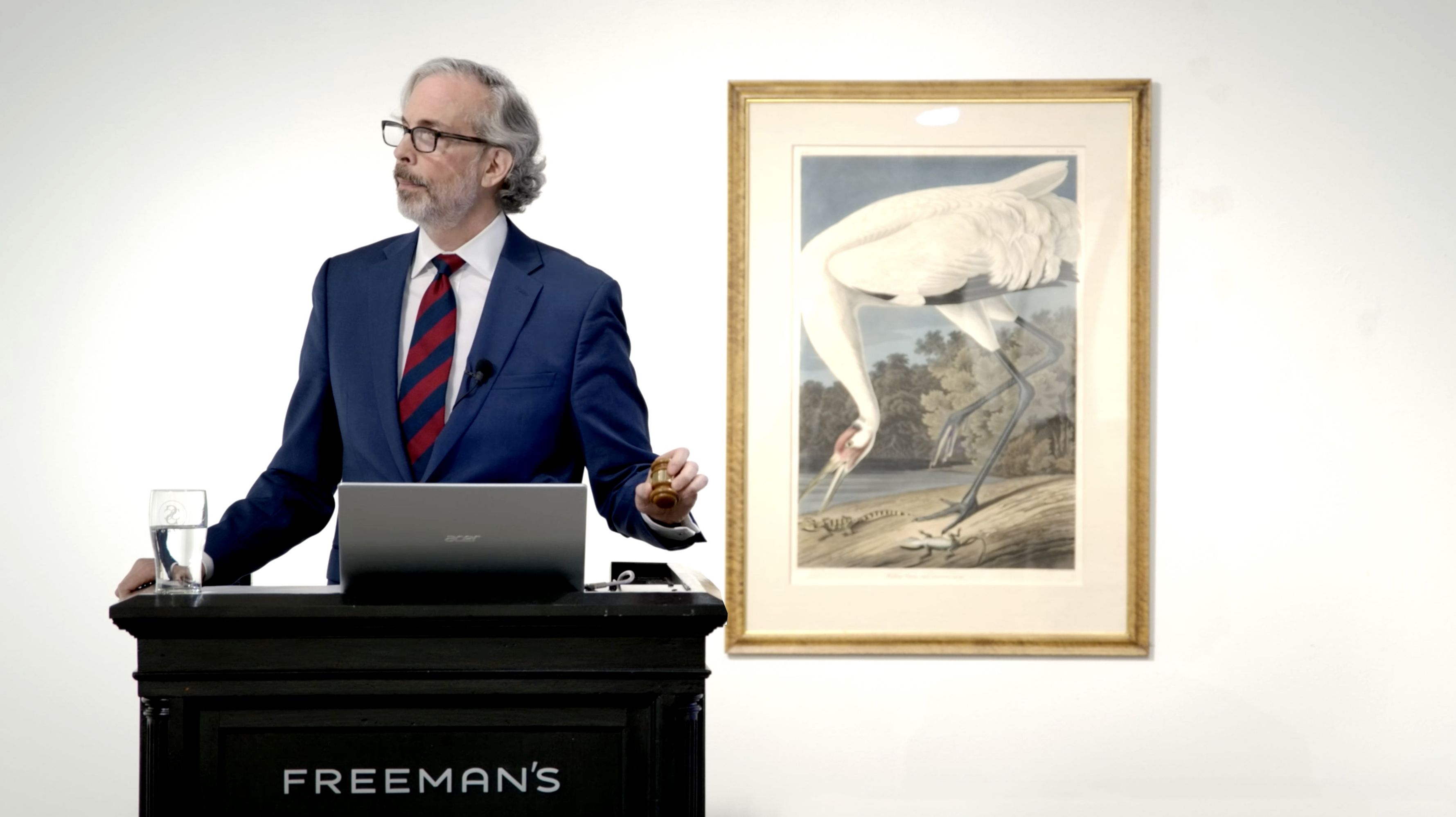
- A group of vibrant prints by John James Audubon was led by Hooping Crane (Lot 128) which tripled its pre-sale estimate of $30,000 – 50,000 to sell for $95,250.
- A handsome set of Giovanni Ramusio Battista’s early travel narratives, Delle Navigationi et Viaggi...(Lot 149), sold for $13,970.