Frank Gehry’s Icehenge Desk, from the Lobby of the Inland Steel Building
“If you actually had an explosion at a glass factory, apart from everyone getting killed, it would be pretty exciting visually.” - Frank Gehry, Chicago Tribune, July 28, 2013
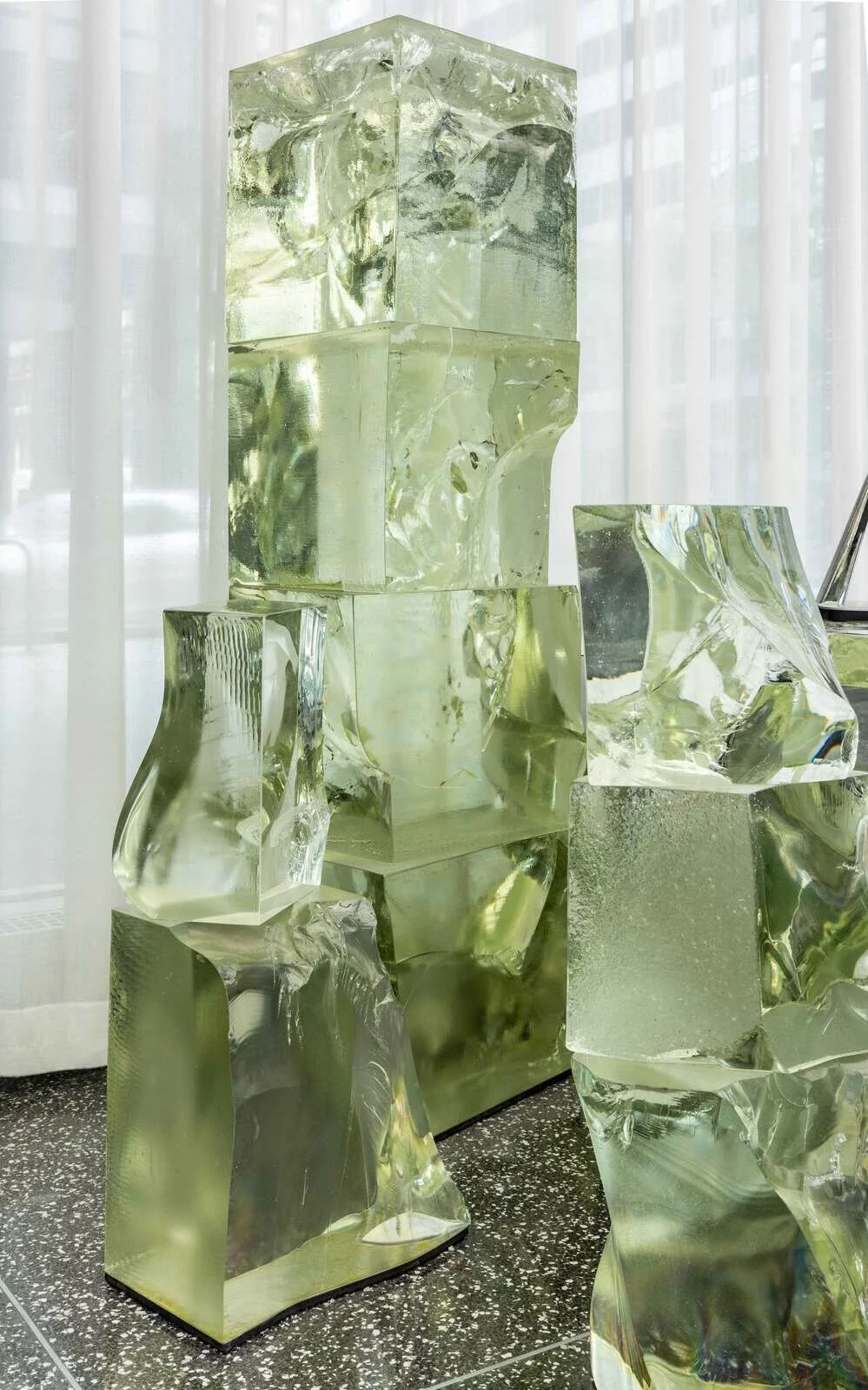
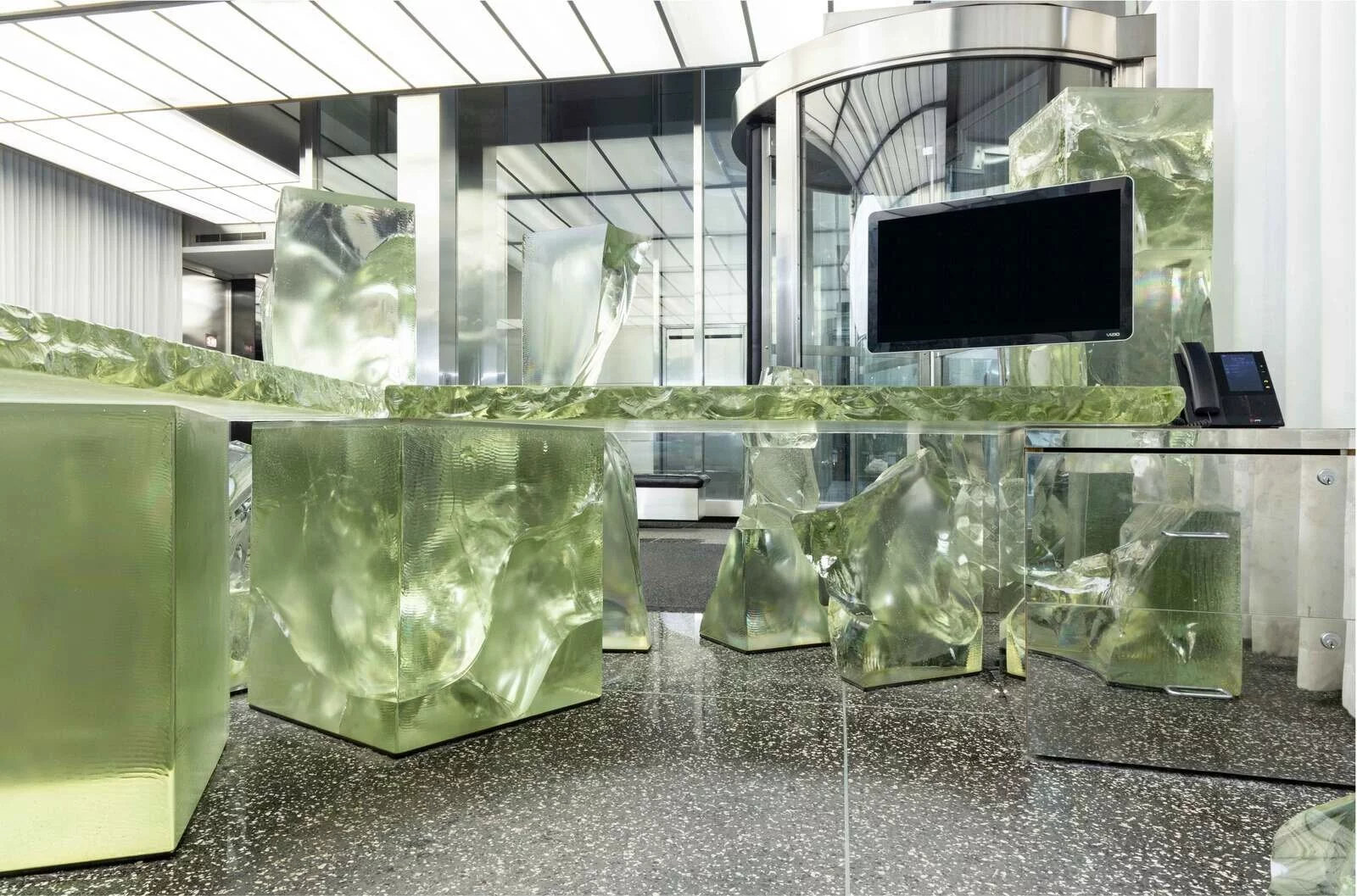
The contents of a desk may contain many secrets, but in this rare and expressive case, transparency itself is the allure. Those passing by or through Chicago’s Inland Steel Building are immediately confronted by a gleaming, jagged structure of green glass that commands the space. Anchored by two monumental slabs, the 16-piece composition catches and refracts light like a fractured glacier. Known colloquially as Icehenge, the work is Frank Gehry’s singular vision for the building’s lobby.
Gehry first encountered the Inland Steel Building in the 1950s, an early experience that may help explain his lifelong fascination with metal as a material. That sensibility would later define some of his most celebrated Chicago projects, including the Jay Pritzker Pavilion and BP Bridge in nearby Grant Park, where steel becomes fluid, sculptural, and expressive.
By the time Gehry became a partial owner of the Inland Steel Building in 2005, the 1958 modernist landmark was in need of restoration. Few figures were better suited to steward such an architectural treasure, though Gehry’s involvement was never likely to result in a purely conservative intervention. True to form, his renovation introduced an unexpected sculptural gesture.
The idea for the desk was sparked by a rogue piece of glass Gehry encountered while developing another project. The possibility of stacking thick glass slabs at shifting angles, allowing light, texture, and material imperfections to become the focal point, proved irresistible. The resulting work possesses an almost internal luminosity. Rough-cut edges collide with polished surfaces, while suspended bubbles and flowing distortions deep inside the molten glass create mesmerizing depth and movement. Against the restraint of the modernist lobby, the work feels intentionally provocative - Gehry at his finest.
Throughout his career, Gehry has embraced unconventional materials with little concern for strict functionalism, consistently challenging the orthodoxies of modernist design. That spirit was evident early on in the corrugated cardboard furniture that reimagined everyday materials as design objects, and in the chain-link fencing and sheet metal that transformed his Santa Monica home into one of the defining architectural statements of its era.
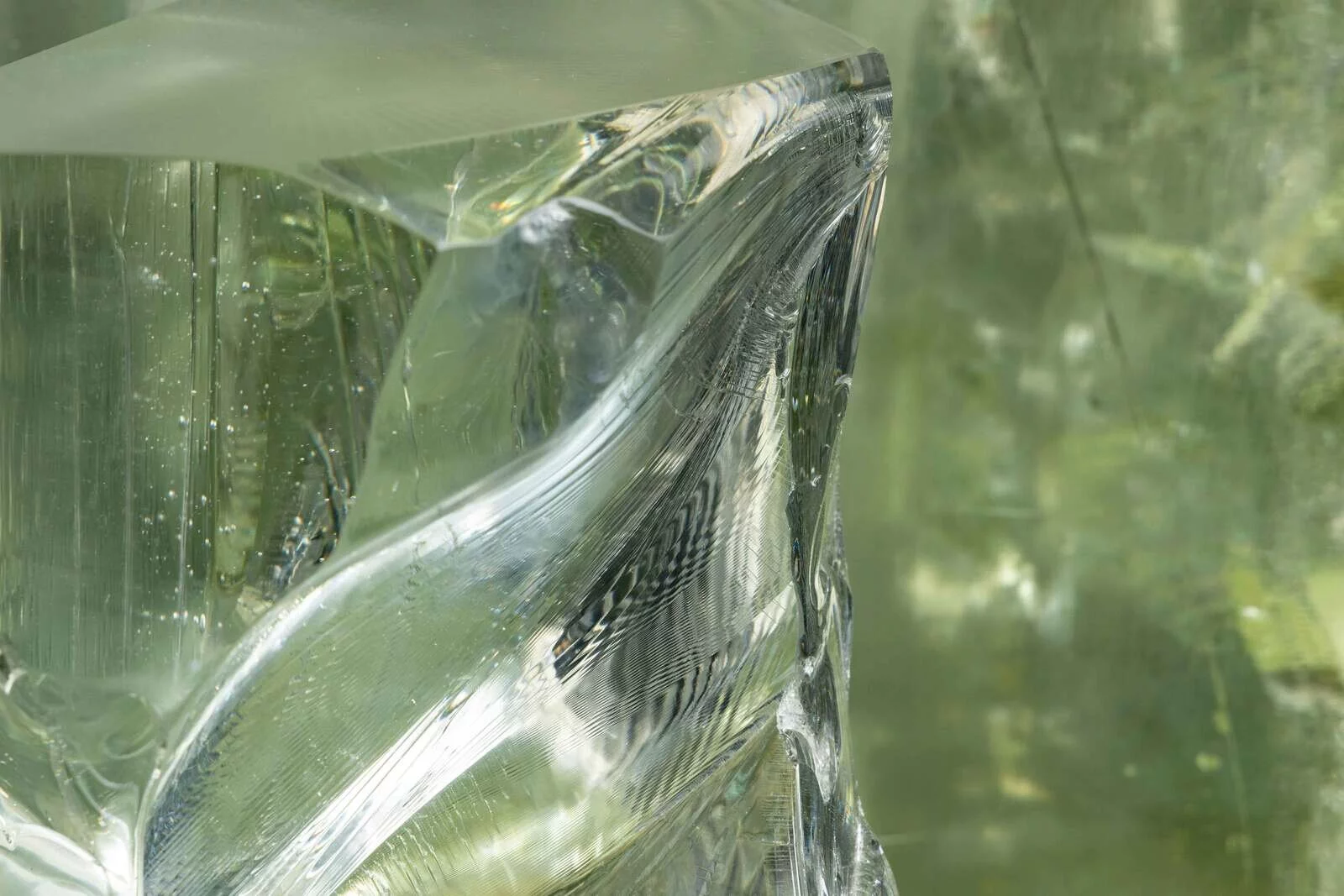
Viewed from outside the building, Icehenge echoes the pale green glazing of the Inland Steel façade, its stacked forms appearing playful yet monumental. Up close, however, the work reveals extraordinary complexity: liquid textures, undulating surfaces, and organic inclusions more commonly associated with studio art glass than furniture design.
The result is less a reception desk than a monumental sculptural installation. Carved from six-foot blocks of emerald glass and weighing approximately 15,000 pounds, the work was realized by the John Lewis Glass Studio in Oakland, California.
Although conceived specifically for its site, Gehry reportedly entertained the possibility of reconfiguring the 16 elements, allowing the work to evolve in new settings. Different lighting conditions, architectural surroundings, or simplified functional contexts could dramatically transform its presence while preserving the power of its composition.
Personal and experimental works by major architects rarely appear on the market, and pieces of this scale and significance within Gehry’s oeuvre are exceptionally uncommon. Icehenge stands apart even within his body of work. Occupying a space somewhere between furniture, sculpture, and architectural installation, Icehenge is a monumental meditation on light, material, and the restless imagination of one of the most influential architects of the modern era.
INQUIRIES | Roger Ward
Vice President, Head of Department, Design
312.447.3280 | [email protected]