

Condition Report
Contact Information
Auction Specialists
Lot 82
Sale 6388 - Western Manuscripts and Miniatures
Jul 8, 2025
10:00AM CT
Live / Chicago
Own a similar item?
Estimate
$5,000 -
10,000
Price Realized
$11,520
Sold prices are inclusive of Buyer’s Premium
Lot Description
FOLLOWER OF TADDEO CRIVELLI (b. Ferrara, 1425; d. Bologna, 1479)
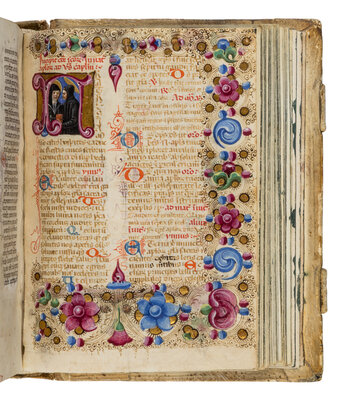
The von Wolkenstein Breviary, for Franciscan Use, in Latin, illuminated manuscript on parchment [Italy, Ferrara? 1499]
The von Wolkenstein Breviary, for Franciscan Use, in Latin, illuminated manuscript on parchment [Italy, Ferrara? 1499]
Luxurious dated Franciscan Breviary offering a late flowering of the courtly Ferrara style shaped by Taddeo Crivelli and his circle.
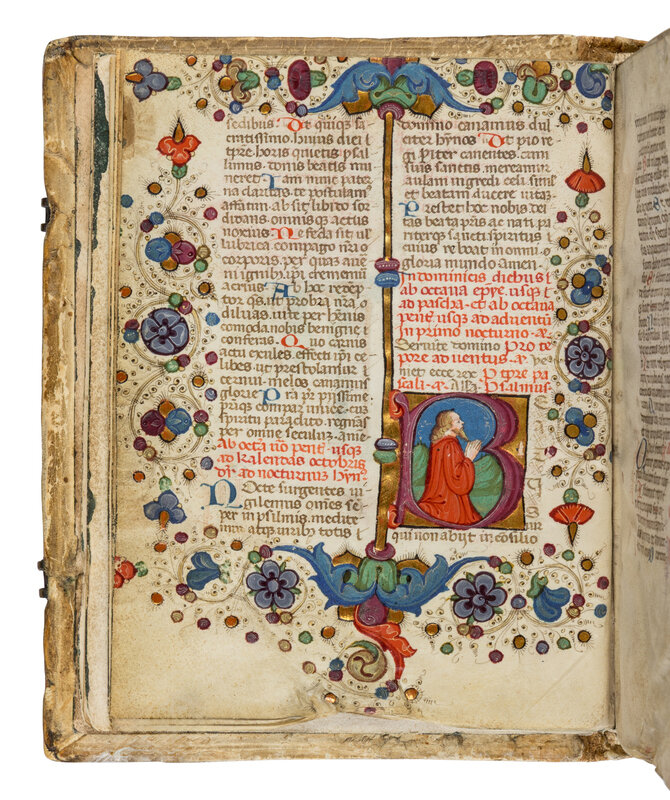
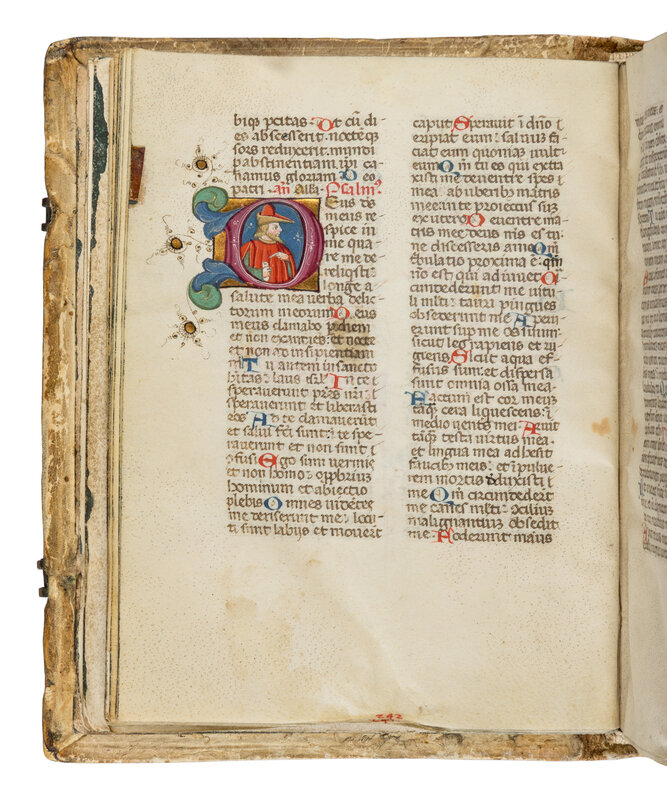
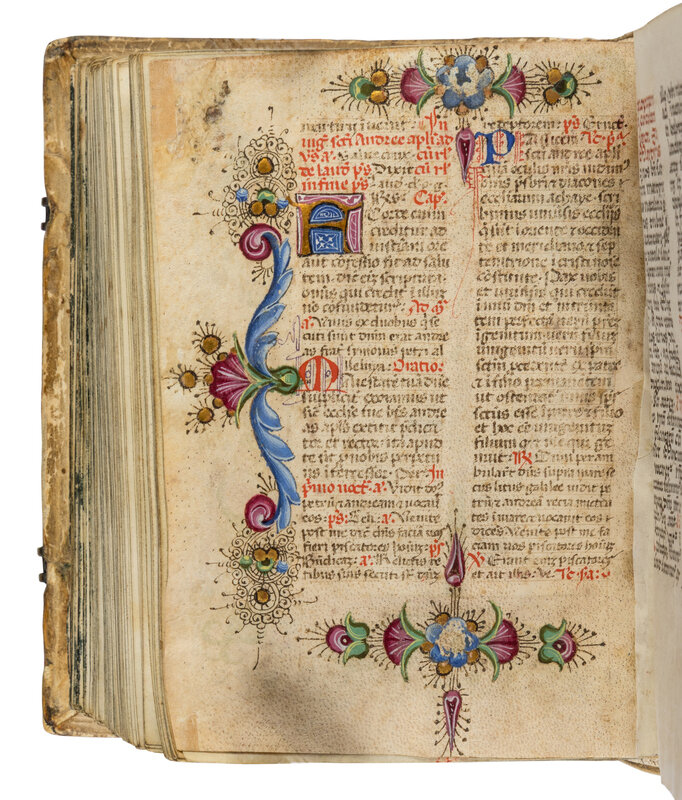
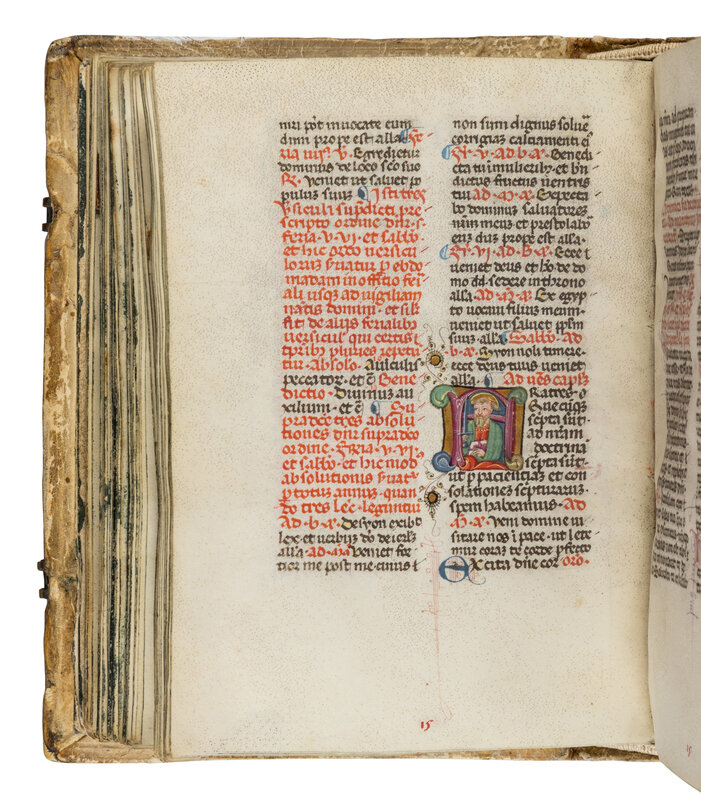
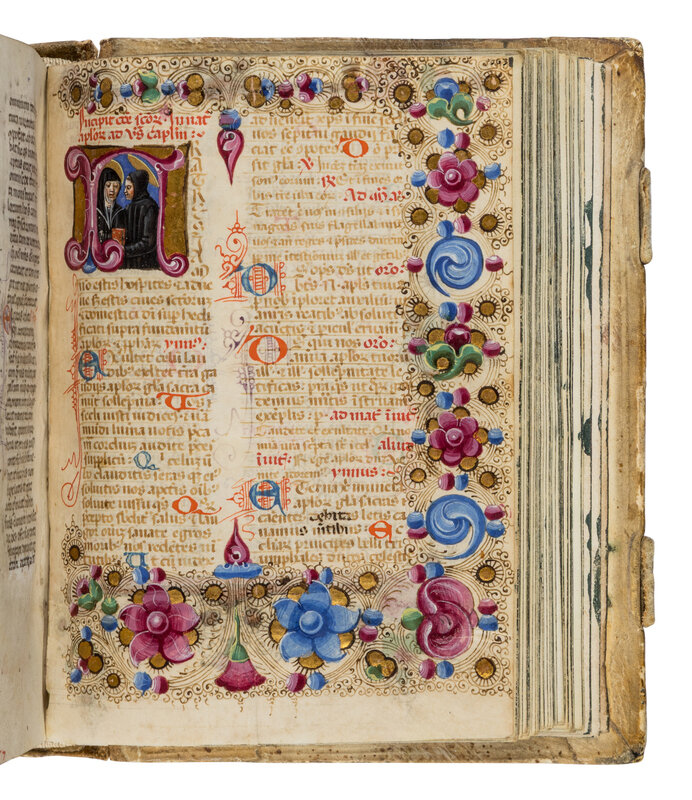
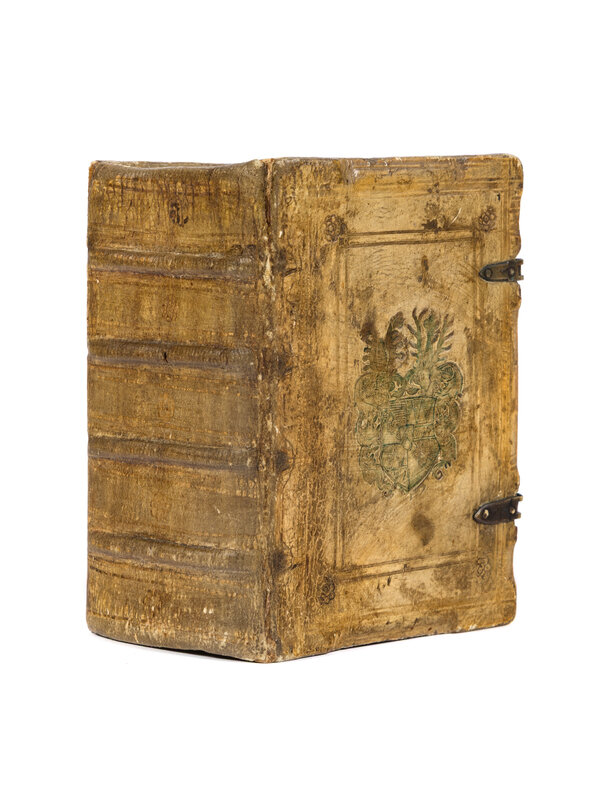
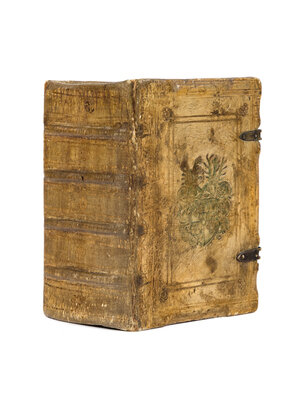
127 × 95 mm, iii (paper) + 619 + ii (paper) leaves, foliated in modern pencil 1–619 in upper right corners with earlier foliation in red ink at bottom center, rebound and altered in the sixteenth century with the Psalms originally following the Temporal; sixteen leaves replaced (ff. 27–28, 49–50, 55–56, 60–61, 77–78, 92–93, 109–110, 351, 563) by near-contemporary additions [collation: 62 quires, mostly bound in quires of 10]; catchwords present between ff. 119–320 and resuming between ff. 530–600; ruled in double columns of 31 lines (justification: 79 × 60 mm); written in rotunda script with extensive rubrication in red ink; two-line initials with penwork decoration throughout; the additions have large pen-decorated initials of 8 lines; 825 ILLUMINATED INITIALS (3–7 lines) in floral designs, sometimes with marginal sprays; 10 HISTORIATED INITIALS (6–11 lines), mostly with partial borders, that on f. 7v with a full border (ff. 7, 7v, 19v, 36v, 43, 68, 116v, 136, 524, 540); TWO HISTORIATED INITIALS WITH FULL BORDERS (f. 351r and f. 563); cockling to lower margin from ff. 1–35, minor water stain to gutter from ff. 585–618, otherwise in excellent condition. Sixteenth-century armorial binding in tan pigskin with the stamp of Baron Christopher von Wolkenstein on the cover, clasps missing, hinges and backstrap renewed, with modern leather slipcase.
Provenance
(1) Made for Franciscan use and dated 1499 on f. 350r. All feasts of greatest importance for Franciscan liturgy are included in the calendar and ranked at the highest level, transcribed in red and inscribed duplex (reflecting the doubling of antiphons), including St. Francis, dies natalis (4 Oct), octave (11 Oct), translation (25 May), and the feast of the Stigmata (17 Sept); St. Anthony of Padua, dies natalis (13 June), octave (20 June), and translation (June 9); St. Bernardino of Siena (20 May; canonized in 1450); St. Clare of Assisi, dies natalis (12 Aug), octave (19 Aug), and translation (2 Oct); and Louis the Confessor, translation (November 8). The feast for Saint Bonaventure occurs on March 14 instead of the more widely celebrated July 15, likely due to the recent translation of the saint’s relics to his hometown of Bagnoregio, which occurred nine years prior, on March 14, 1490.
(2) Bound for Baron Christopher von Wolkenstein (1530–1600), who amassed a library of almost 3,000 volumes at Rodeneck Castle; with his armorial bookplate dated 1594. See Anton Dörrer, “Die Bibliothek des Freiherrn Christoph von Wolkenstein auf Schloss Rodenegg,” Zentralblatt für Bibliothekswesen 57 (1940), pp. 18–43.
(3) Signature of Edward A. L. Batters on flyleaf.
(4) Private collection, Norwich, England.
(5) Scott Schwarz, New York; his bookplate and catalog number “MS 35” on front pastedown.
Text
ff. 1–6v, Calendar; ff. 7–108v, Psalms, Canticles, Hymns, Litanies; ff. 331–563, Temporal; ff. 563–593v, Sanctoral; ff. 563–593v, Common of Saints; ff. 594–599v, Office of the Blessed Virgin; ff. 600–604v, Office of the Dead; ff. 604v–608, Prayers at Meals; ff. 608–608v, Absolutions; ff. 609–611, Visitation of the Sick; ff. 611v–617, Commendation of Souls and Burial Services; ff. 617–618v, Blessings.
Illumination
Dated 1499 (f. 350), the von Wolkenstein Breviary – named for its notable early owner – offers a late reprise of the celebrated Ferrarese illumination style perfected several decades earlier by Taddeo Crivelli and his circle at the d’Este court. Crivelli, among the most distinguished manuscript painters of the Italian Renaissance, was the principal illuminator of the famed Borso d’Este Bible (1455–1461), one of the supreme masterpieces of fifteenth-century Italian illumination. His workshop established the visual language that defined Ferrara’s golden age of manuscript production: a fusion of International Gothic elegance with the spatial sophistication and naturalism emerging in Renaissance art, reflecting both courtly taste and innovative pictorial language. The enduring prestige of Crivelli’s workshop—together with that of his collaborators such as Franco dei Russi and Guglielmo Giraldi—continued to shape Ferrara’s manuscript art well into the final years of the century, as exemplified by the present volume. Commissioned for Franciscan use, the compact format of the von Wolkenstein Breviary suggests personal devotional use by a member of the Franciscan order within Ferrara or its environs and reflects both the continued vitality and adaptation of d’Este court models for private patrons at the close of the century. Dated manuscripts, such as this one, are significant in establishing fixed criteria for dating other works of uncertain origin.
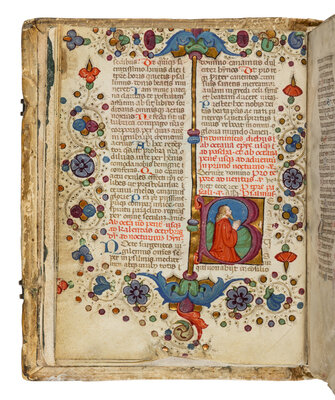
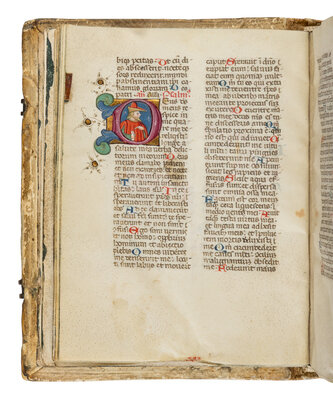
The subjects of the illuminations are: f. 7, God the Father holding an orbis terrarum and book; f. 7v, Christ on the Mount of Olives; f. 19v, David holding a scroll; f. 36, David in thought with finger pressed to his chin; f. 43, David with harp; f. 68r, monks singing around a lectern; f. 116v, Saint Paul with sword and book; f. 136, Nativity of Christ; f. 351, Saint Jerome; f. 524, Saint Francis receiving the Stigmata; f. 540, Saint John the Evangelist; f. 562, Mourners Clad in Black.
LITERATURE
Unpublished; Related literature: Giordana Mariani Canova, La miniatura ferrarese, Modena, 1985; Adriana di Lorenzo, “La miniatura estense: Taddeo Crivelli, Franco dei Russi e Guglielmo Giraldi,” in Ferrara: il Rinascimento da Cosmè Tura a Dosso Dossi, ed. Mauro Natale, Milan, 1991, pp. 119–27; Giordana Mariani Canova, “L’eredità di Taddeo Crivelli e la miniatura emiliana tra Quattro e Cinquecento,” in Miniatura e Rinascimento in Emilia Romagna, ed. Mauro Natale, Milan, 1992, pp. 53–71; Ada Labriola, “Miniatura ferrarese nel Quattrocento: Taddeo Crivelli e la Bibbia di Borso d’Este,” Arte cristiana 85 (1997), pp. 255–74; Gennaro Toscano, “La Bibbia di Borso d’Este: Arte e politica a Ferrara nel Quattrocento,” Arte antica e moderna 35 (1997), pp. 23–45.
We thank Senior Consultant Sandra Hindman and Peter Bovenmyer for their assistance in preparing this sale and Federica Toniolo for consultation on this entry.
Collection of Dr. Scott Schwartz
This lot is located in Chicago.