Condition Report
Contact Information
Auction Specialists
Lot 81
Sale 6388 - Western Manuscripts and Miniatures
Jul 8, 2025
10:00AM CT
Live / Chicago
Own a similar item?
Estimate
$5,000 -
10,000
Price Realized
$6,080
Sold prices are inclusive of Buyer’s Premium
Lot Description
MUSIC RITES FOR FUNERALS
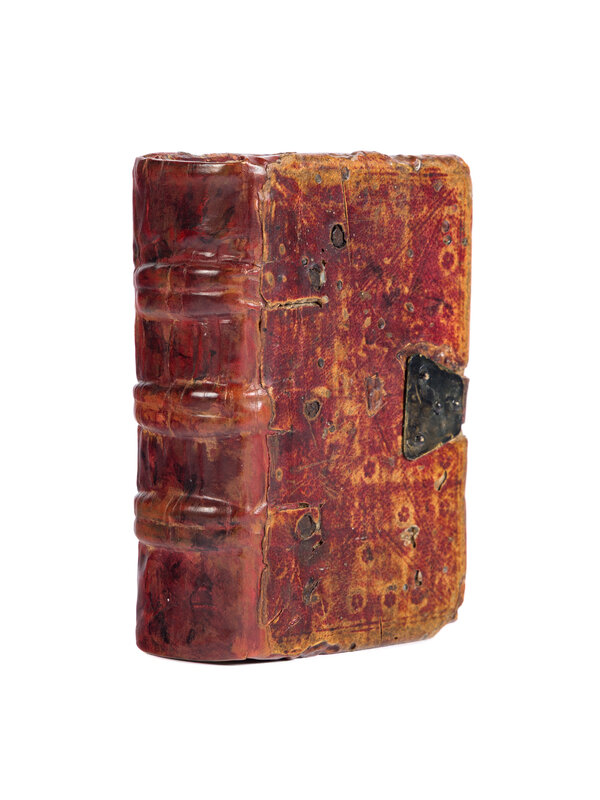
Ritual, Use of Rome, in Latin and Italian, music manuscript on parchment [Italy, 1450–1456]
Ritual, Use of Rome, in Latin and Italian, music manuscript on parchment [Italy, 1450–1456]
In its original condition, this small Ritual helps shed light on the humanity of death and dying in the later Middle Ages.
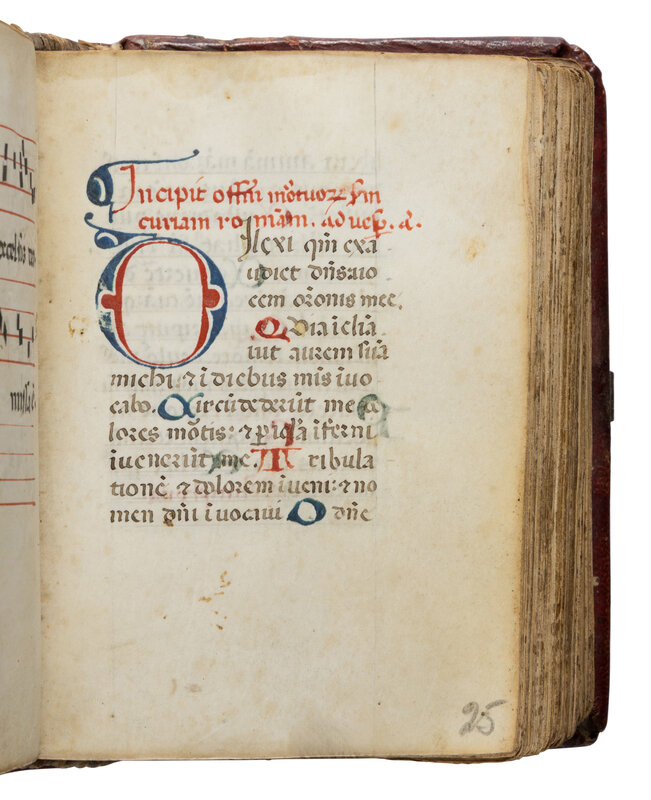
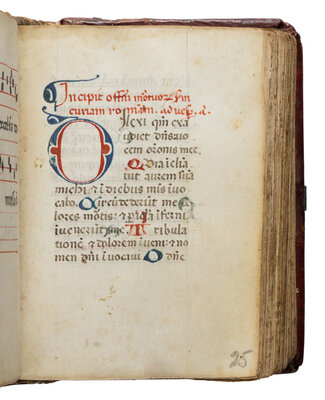
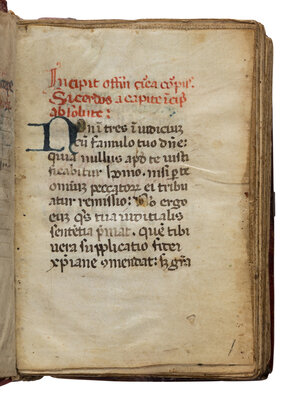
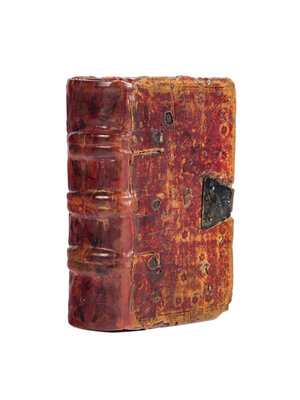
Dimensions 108 × 76, iii (vellum) + 151 + ii (vellum), front flyleaves and pastedown repurposed from a contemporary book of hours (Matins from the Hours of the Virgin), rear flyleaves with Papal decree and a date of 1456, foliated in pencil 1–151 in lower right corners [collation: i10, ii10, iii12, iv8, v8, vi10, vii10, viii10, ix6+2, x4, xi10, xii10, xiii10, xiv10, xv10, xvi10+1], catchwords present intermittently, ruled in single column of 13 lines (justification: 57 × 38), notation in 3 staves per page, written in rotunda script by several hands, seventeenth-century additions between ff. 83–85, rubrication in red, versal capitals alternating in red and blue, some touched with glair, incipits for text divisions beginning with 2-line red and blue initials, TWO FIVE-LINE INITIALS painted in red and blue at ff. 25 and 59 introducing the Office of the Dead and the Penitential Psalms, worming to flyleaves, minor cockling and staining throughout, else in good condition. CONTEMPORARY RED STAMPED CALF BINDING, three fiber bands laced into oak boards with brass catch on lower board, strap attached to upper board with metal plate, strap replaced, slight cracking and some worming to boards, else in good condition.
Provenance
(1) Potentially made for Franciscan use as the Litany includes Bernard of Siena, Louis of Toulouse, and Francis of Assisi. A fragmentary text on the rear flyleaves refers to a papal document issued by Pope Callixtus III on 10 March 1456 describing a planned crusade against the Turks after the fall of Constantinople in 1453.
(2) Indulgence added to f. 85 in a seventeenth-century hand issued by Pope Clement VIII and sponsored by the Duchess of Savoy.
(3) Heavily faded owner inscription of “Don Giovanni … [?]” on rear flyleaf.
(4) Albert Van Loock, a Belgian bookseller and art dealer active in Brussels during the mid-twentieth century, catalog description, mark (“Kenteken”), and inventory number “16” on front pastedown.
(5) Dr. Scott Schwartz, New York, his book plate and manuscript number “31” on front pastedown.
Text
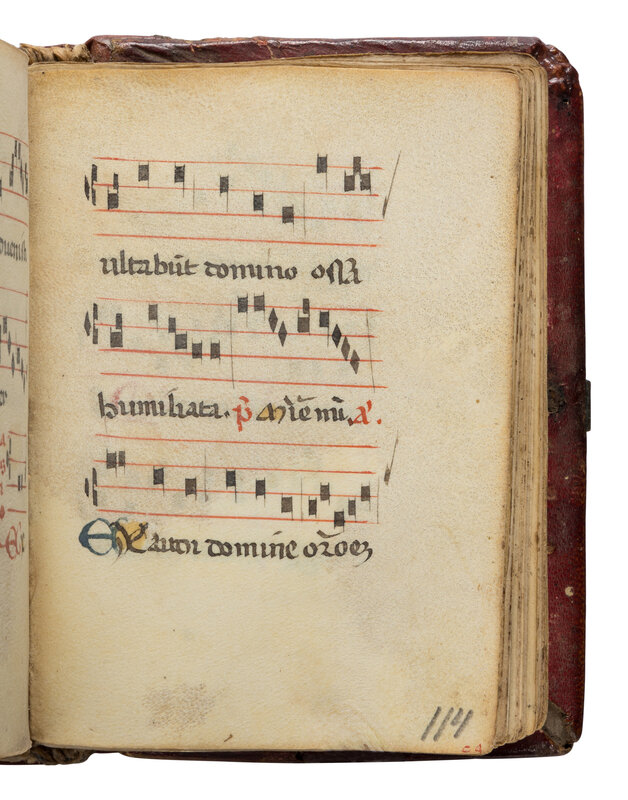
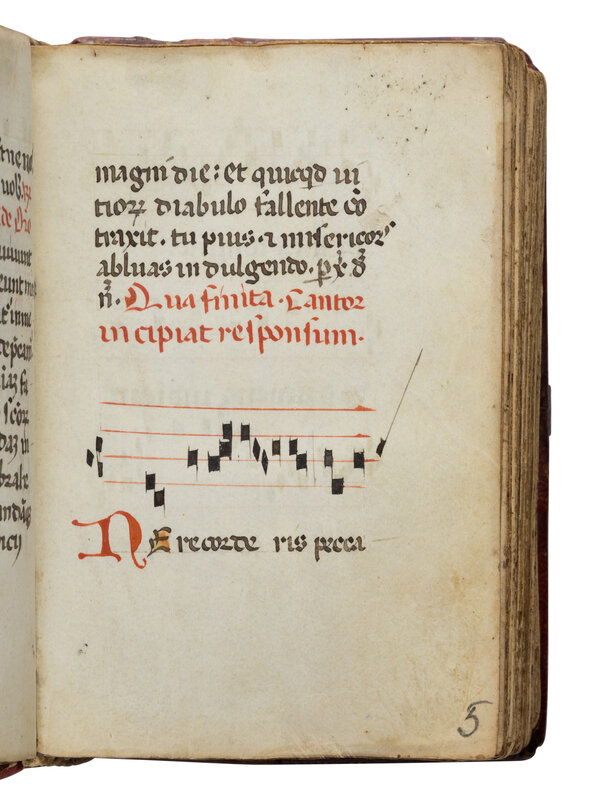
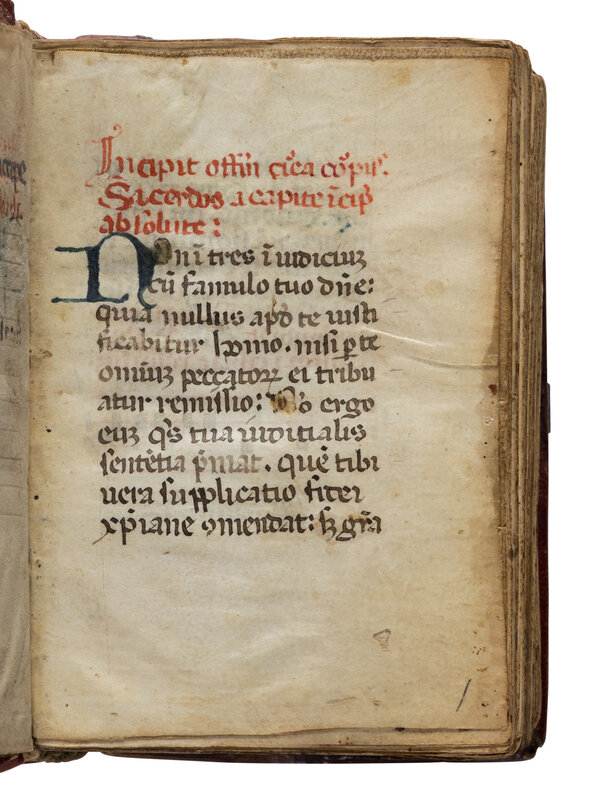
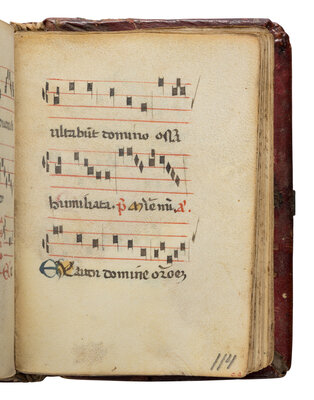
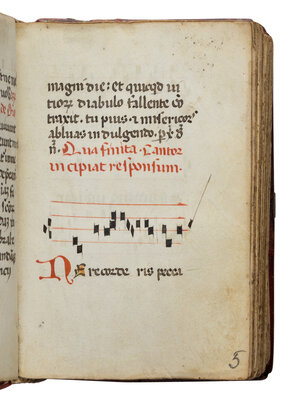
ff. 1r–24r, Burial Service (Incipit officium exequea corpus) with responsories; ff. 25–58v, Office of the Dead (Incipit officium mortuorum secundum cursum Romanum ad vesperas); ff. 59r–77r, Penitential Psalms and Litanies; ff. 77r–82v, Theological Precepts (Ten Commandments; Apostles Creed; Seven Sacraments: Seven Corporal Works of Mercy; Spiritual Works of Mercy; Three Theological Virtues, Four Cardinal Virtues: Gifts of the Holy Spirit; Seven Deadly Sins; Five Bodily Senses); 83r–85v, Seventeenth-Century Additions (Antiphons: Dixit dominus domino meo; Sede ad dextris meis; Indulgence in Italian: Chi dirà l’infracritta, guadagna indulgenza plenaria per ogni volta with following prayer: Deus qui nobis in sancta sindone ); ff 87r–151v, antiphons for the office of the dead (Incipit officium mortuorum cum nota).
One of the central duties of medieval religious life was to pray for the souls of the dead, to reduce their time in purgatory. This manuscript includes texts and music for funeral services and, in a seventeenth-century addition, an indulgence for the relief of souls in purgatory. Its annotations and later additions attest to centuries of continuous use, an appealing feature in a practical devotional book. The core of the manuscript focuses on the rituals associated with funerary offices, particularly the burial service (Exequiae corporis) with accompanying antiphons, and the Office of the Dead (Officium mortuorum), including only Vespers (typically sung before the burial) and corresponding antiphons. Rubrics, marked in red, are specifically addressed to the officiating priest (sacerdos).
These texts belong to a category of books known to liturgical scholars as Rituals, which contain the rites for occasional sacraments and sacramentals performed by priests, such as funerals, baptism, confirmation, or extreme unction (Gy 1990, 108–20). This abbreviated Ritual, limited to funeral services, is designed for portability. Small independent liturgical volumes—known as libelli or “little books”—such as this one, could be easily carried by a priest when administering specific rites (Gy 1991; Palazzo 1993, 187–94). In the Middle Ages, such booklets were often left unbound or housed in lightweight parchment wrappers and were sometimes later bound together with related material, as seen with this manuscript. Often left unbound, their survival is relatively rare. The manuscript’s adaptation and accumulation of additions over time vividly illustrates the enduring importance of burial rites and the efficacy of prayers to aid the souls of the dead in the afterlife.
Recent studies of Rituals from the later Middle Ages explore their relationship to the more visceral aspects of death and dying, emphasizing their paraliturgical content and reminding us that music held a privileged position at the time of death (see Hild, 2024).
LITERATURE
Unpublished; Related literature: Philippe Rouillard, Histoire des liturgies chrétiennes de la mort et des funérailles, Paris, 1999; Eric Palazzo, A History of Liturgical Books from the Beginning to the Thirteenth Century, trans. Madeline Beaumont, Collegeville (MN), 1998; Knud Ottosen, The Responsaries and Versicles of the Latin Office of the Dead, Aarhus, 1993; Pierre-Marie Gy “The Different Forms of Liturgical Libelli,” in Fountain of Life, ed. Gerard Austin, Washington, 1991, pp. 22-34; Pierre-Marie Gy, “Collectaire, rituel, processional,” in La liturgie dans l’histoire, Paris, 1990, pp. 91–126; Geoffrey Rowell, The Liturgy of Christian Burial: An Introductory Survey of the Historical Development of Christian Burial Rites, London, 1977; Elaine Stratton Hild, Music in Medieval Rituals for the End of Life, Oxford, 2024.
We thank Senior Consultant Sandra Hindman and Peter Bovenmyer for their assistance in preparing this sale.
Collection of Dr. Scott Schwartz