Condition Report
Contact Information
Auction Specialists
Lot 83
Sale 6388 - Western Manuscripts and Miniatures
Jul 8, 2025
10:00AM CT
Live / Chicago
Own a similar item?
Estimate
$20,000 -
30,000
Price Realized
$24,320
Sold prices are inclusive of Buyer’s Premium
Lot Description
FRANCESCO PETRARCH (b. Arezzo, 20 July 1304; d. Arqua Petrarca, 19 July 1374)
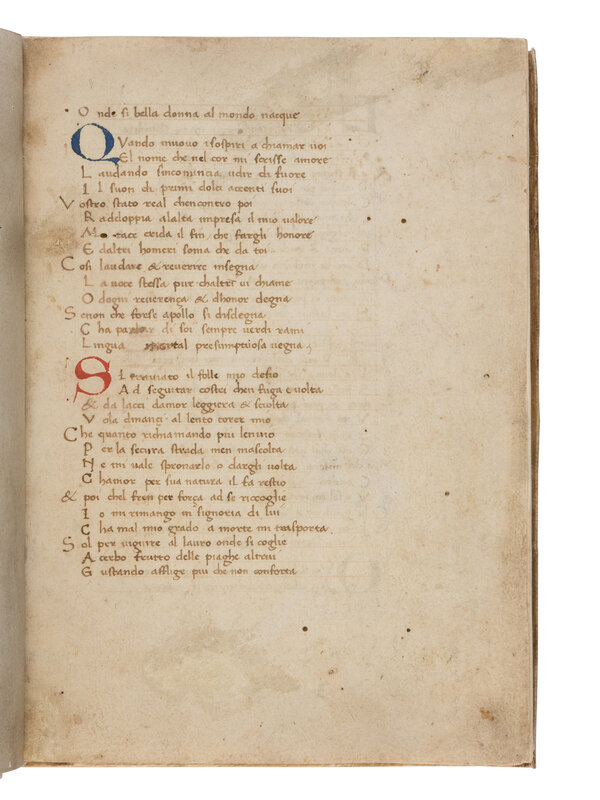
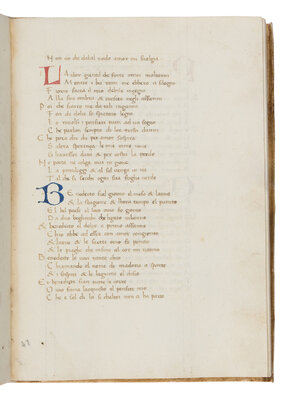
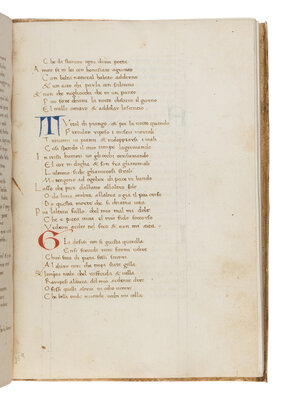
Il Canzoniere (The Songbook), in Italian, manuscript on parchment [Italy, second half of the 15th century]
Il Canzoniere (The Songbook), in Italian, manuscript on parchment [Italy, second half of the 15th century]
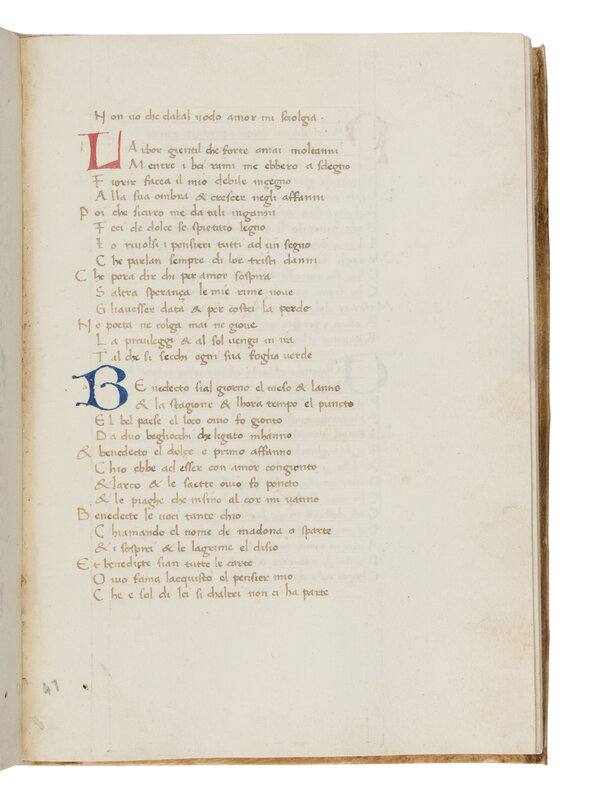
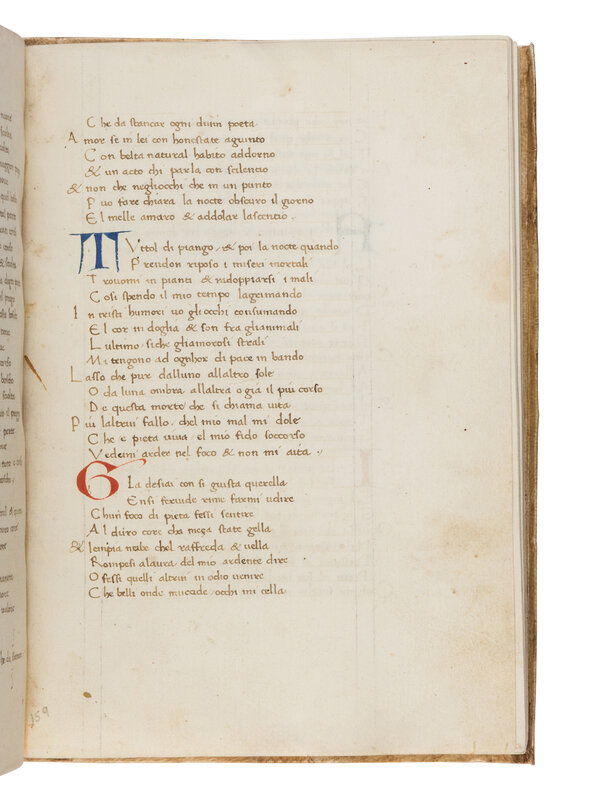
An exceptional wide margined, and beautifully written manuscript of Petrarch’s Canzoniere—a foundational work of Italian lyric poetry—preserving nearly the entire poetic cycle, including a rare dispersed ballata.
209 × 149 mm. Manuscript on parchment, 132 folios, written in a single column of thirty lines (justification: 205 × 145 mm), with alternating red and blue Lombard capitals throughout, one leaf missing, (omitting Rvf 1–4 except for v.14 of Rvf 4: “Onde si bella donna al mondo nacque”), Part Two (Rvf 264) opens with a four-line red and blue penwork initial and rubric: “Queste cancione & soneti seguenti furono facti dreto la morte di madona Laura per il predicto Miser Francesco petrarcha,” manicules and marginal reading marks in Latin, wide margins. Minor worming to lower margins and inner gutters, primarily at the beginning, with a few early repairs, light browning and occasional small stains, not affecting legibility. Bound in modern limp vellum. A remarkably clean and well-preserved manuscript.
The earliest of the great Renaissance humanists, Francesco Petrarch (1304-1374) wrote widely on the classics, but he is best known for the series of love poems addressed to Laura, the Canzoniere, written in vernacular Italian. Laura, whom he first saw in 1327 at Avignon (possibly Laure de Noves, married in 1325 to Hugo de Sade), inspired him with a passion that has become proverbial and is placed at the center of his vernacular poetic opus.
An exceptional wide-margined manuscript of Petrarch’s Il Canzoniere (The Songbook), written in a single humanist hand and decorated throughout with alternating red and blue Lombard initials. The Canzoniere was first assembled by the author and made known by him under the title of Rerum vulgarium fragmenta or “Fragments of vernacular matters.” The collection of 366 poems consists of sonnets (and these are the more numerous), of canzoni, of sestine, of ballate, and of madrigals. Intensely self-reflective, the majority of the poems champion the love motive, celebrating the Poet’s love for Laura as the idealized woman, but political, patriotic, moral, and religious themes also underlie some of the most famous poems. The work represents one of the foundational texts of Italian vernacular literature and a cornerstone of Renaissance humanism. Petrarch’s fusion of classical ideals with personal introspection shaped the development of lyric poetry across Europe, influencing writers from Boccaccio to Shakespeare. The present manuscript testifies to the continued transmission and readership of the Canzoniere into the late Quattrocento, at a time when its status as a literary model was firmly established.
The critical editions of Petrarch’s Rerum vulgarium fragmenta are based on the autograph codices, Vatican, Cod. Vat. lat. 3195 (final version) and lat. 3196 (early draft). Notably, the present manuscript includes the rare additional ballata “Donna mi viene spesso ne la mente,” generally considered part of Petrarch’s dispersed or uncollected poems (see Solerti 1898, no. 1). Despite the loss of the first leaf, which contained Rvf 1–3 and most of 4, the manuscript largely follows the final redaction established by Petrarch himself in his autograph Vatican codex (Vat. lat. 3195), although the anonymous scribe adopts a single-column layout typical of later poetic presentation, rather than the original two-column mise en page. The text is transcribed in the following sequence (reflecting physical order): [one leaf missing], 4 (v.14), 5–37, 39, 38, 40–79, 81–82, 80, 83–120, 122, Disp. 1, 123, 121, 124–242, 121b (repeat), 243–327, 329, 328, 330–339, 342, 340, 350–355, 359, 341, 343, 356, 344–349, 357–358, 360–366. This complex ordering is characteristic of the manuscript tradition of the Canzoniere, where textual rearrangements, duplications, and interpolations reflect both the fluid transmission of Petrarch’s corpus and the preferences of individual scribes or commissioning readers. While divergent from the canonical order, this manuscript nonetheless preserves the full arc of Petrarch’s poetic project, from idealized love to spiritual introspection.
An important census of all extant Petrarch manuscripts in public collections is underway, the results of which are published under the title “Censimento dei Codici Petrarcheschi” (Padua, ed. Antenore). There are over 30 copies of the Canzoniere in the United States alone (see Dutschke, 1986). To our knowledge, the present manuscript is hitherto unrecorded and thus should be confronted with other later fifteenth-century copies of the Canzoniere to determine better the context and circumstances of its production. Further inquiry into the incunable tradition of the Canzoniere might also be revealing (first incunable edition, Venice, 1470; followed by Rome, 1471 and Padua, 1472; see Goff, P-371-373; E. H. Wilkins, “The Fifteenth-century Editions of the Italian Poems of Petrarch,” in Modern Philology 40 (1943), pp. 229 and ff.).
Provenance
(1) On the final recto is an ink inscription dated 1577, accompanied by an earlier hand transcribing the last ten verses of Rvf 366, followed by a vernacular astrological prognostication: “Dominacione Nascerà in questo dì homo grasso e pieno di carne e ben membruto [?] colore palid” (“Under the dominion [of the day], a fat man will be born, full of flesh, well-formed [?], with a pale complexion”).
(2) Private Collection, UK.
LITERATURE
Unpublished: For Il Canzoniere see: G. Mestica, ed. Le Rime di Francesco Petrarca, restituite nell' ordine e nella lezione del testo originario sugli autografi col sussidio di altri codici e di stampe e corredate di varianti e note da Giovanni Mestica, Florence, 1896; A. Solerti, ed. Rime disperse di Francesco Petrarca o a lui attribuite, per la prima volta raccolte a cura di A. Solerti, Florence, 1909; Francesco Petrarch, Il Canzoniere, ed. Gianfranco Contini, Turin, 1964; Francesco Petrarch, Petrarch’s Lyric Poems: The Rime Sparse and Other Lyrics, trans. and ed. Robert M. Durling, Cambridge (MA), 1976; Dennis Dutschke, Census of Petrarch Manuscripts in the United States, Padua, Editrice Antenore, 1986 [Censimento dei codici Petrarcheschi, 9]. E. Pellegrin, Manuscrits de Pétrarque dans les bibliothèques de France, Padua, Editrice Antenore, 1986 [Censimento dei codici Petrarcheschi, 2]; Marco Santagata, I frammenti dell’anima: Storia e racconto nel Canzoniere di Petrarca, Bologna, 1992; Wayne H. Storey, Translating the Past: Laurent de Premierfait and Petrarch’s Canzoniere in France, New York, 1993; Wayne H. Storey, Petrarch’s Canzoniere in the English Renaissance, Amsterdam, 2005; Peter Thornton, Petrarch’s Canzoniere: Scattered Rhymes in a New Verse Translation, London, 2023.
We thank Senior Consultant Sandra Hindman and Peter Bovenmyer for their assistance in preparing this sale.
This lot is located in Chicago.