Condition Report
Contact Information
Auction Specialists
Lot 8
Sale 6388 - Western Manuscripts and Miniatures
Jul 8, 2025
10:00AM CT
Live / Chicago
Own a similar item?
Estimate
$2,500 -
3,500
Lot Description
CIRCLE OF WILLIAM DE BRAILES (active Oxford, c. 1230-1260)
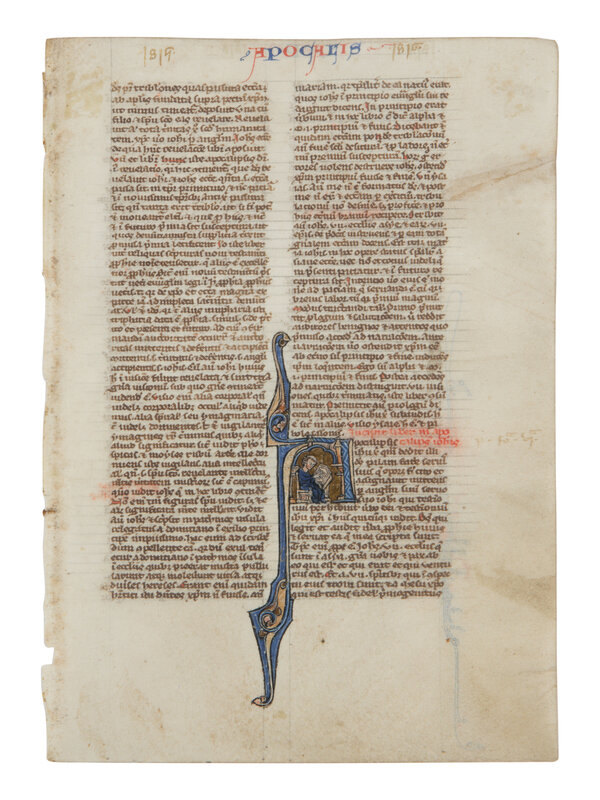
Leaf from a Bible with a historiated initial ‘A’ depicting Saint John writing the Book of Revelation, in Latin, illuminated manuscript on parchment [England, Oxford, c. 1250–1270]
Leaf from a Bible with a historiated initial ‘A’ depicting Saint John writing the Book of Revelation, in Latin, illuminated manuscript on parchment [England, Oxford, c. 1250–1270]
One of only two English artists whose names we can associate with known works in thirteenth-century England.
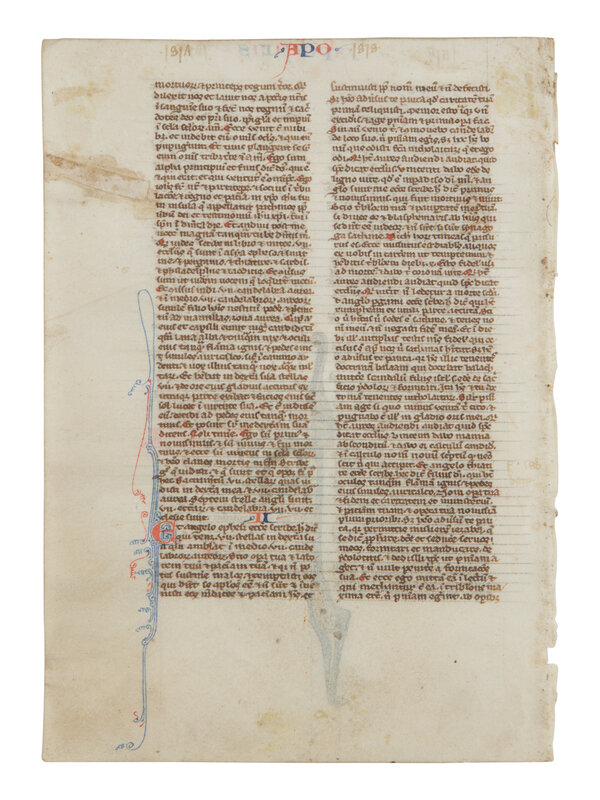
180 × 130 mm. Single leaf ruled in brown ink for two columns of 54 lines, written in black ink in a compact Gothic textura script, with rubrics in red and a running header in alternating red and blue, marginal corrections are framed in blue, and each column is numbered at the top in ink using medieval Arabic numerals, ONE HISTORIATED INITIAL ‘A’ containing a miniature of Saint John writing the Apocalypse, executed in rich tones of blue, rose, and gold, with fine white penwork highlights and burnished gold accents, elongated ascender and descender of the initial extend deeply into the margins, terminating in decorative foliate terminals and geometric ornament. The parchment is generally well-preserved, with only minor staining along the lower margin and some smudging near the text column. The paint and gold in the historiated initial remain vibrant. Slight edge wear and toning are visible, and the inner margin bears evidence of prior binding.
A leaf from a now dispersed English Bible, this folio contains a tall and elegantly rendered historiated initial ‘A’ introducing the Book of Revelation opening with the words Apocalypsis Iesu Christi. The initial, painted in rich blue and highlighted in white and gold, encloses a finely detailed miniature of Saint John and the angel. Seated and writing on a scroll or codex, John gazes upward toward an angel who gestures heavenward—an evocative iconographic rendering of Revelation 1:1–2 that signals both the visionary nature of the text and its theological gravitas.
While the illumination does not precisely match the signed works of William de Brailes, it is strikingly close in its decorative idiom. De Brailes, a pivotal figure in the development of Oxford illumination during the second quarter of the thirteenth century, is best known for his richly narrative miniatures, compact page designs, and dynamic figural style—as seen in such manuscripts as the De Brailes Psalter (British Library, Add. MS 49999). His workshop marks one of the earliest known names in English book production and played a crucial role in shaping Gothic manuscript art in university and devotional contexts. The present initial shares several hallmarks of this milieu: notably, the lower extension of the letter terminates in thick, weighty tendrils, a flourish typical of de Brailes’s circle and mid-thirteenth-century Oxford work. Similarly, the chapter initials on this leaf show transitional penwork—moving from simple flourishes to the more elaborate cascading ‘J’-forms, alternating in red and blue—indicative of a slightly later moment within the same tradition.
Leaves from this Bible are now widely dispersed, but a consistent set of codicological features helps identify them. Most notably, the columns are headed by distinctive medieval Arabic numerals, not to count every fifth line (as in some Oxford Bibles), but to number each column—enabling precise cross-referencing in concordances or scholia. In addition, many leaves are divided into seven sections with marginal letters “a” through “g,” following a system developed in the 1230s for use in the Dominican Concordance of St. Jacques. The presence of both reference systems suggests that this Bible was purpose-built for intensive scholarly use, likely within a Dominican house in Oxford. Founded in the city in 1221, the Dominicans quickly became renowned for their rigorous biblical scholarship, and this leaf stands as a rare and compelling witness to that intellectual culture.
Provenance
(1) Parent volume created for unidentified Dominican (?) house. The original volume contained a note referring to use in the refectory (f. 107v), and several surviving leaves include marginal annotations indicating liturgical readings. For example, the beginning of the present leaf features a note indicating the first reading on Friday (“p. feri[a] vi”), while the verso includes a similar note at Revelation 2:18 for Saturday (“p. sabbato”). Numerous folios bear marginal letters ‘p’, ‘s’. and ‘t’ ,(for primus, secundus, tertius—not the canonical hours of Prime, Terce, and Sext), a system characteristic of Dominican Bibles.
(2) 16th-century names and inscriptions include: William George (fols. 56r, 206v), Robert Wyet (fol. 151r), and Henry Consteny (fols. 264v, 296v, and 340r).
(3) Charles M. Manning, with his late 18th- or early 19th-century signature and shelfmark “B” above “c.4.”
(4) Charles Kirkpatrick Sharpe (1781–1851), eccentric Edinburgh literary figure and associate of Sir Walter Scott; his signature appears on a flyleaf.
(5) Sir John Jaffray (1818–1901), Scottish journalist and newspaper proprietor; his signature appears beneath Sharpe’s.
(6) Sold anonymously at Sotheby’s, 14 October 1946, lot 147; purchased by Alan G. Thomas (1911–1992), the English book dealer who worked under Grace G. Commin in Bournemouth from 1936, later establishing his own firm and relocating to London in 1964. He retained the Bible in his private collection for more than 25 years.
(7) Posthumously sold at Sotheby’s, 22 June 1993, lot 6; purchased by Sam Fogg, and later broken (possibly by Bruce Ferrini).
(8) Present leaf sold with a group of sister leaves by Les Enluminures 28 February1998, lot package no. 29.
(9) Robert McCarthy, London, MS BM 1167
Parent manuscript
The parent volume of 402 leaves is described in Sotheby’s 1993 catalogue (see Provenance); it contained 55 large painted initials for prologues and 78 historiated initials for books, beginning imperfectly at Joshua 7:20.
Sister leaves
A group of leaves—including twenty-seven with historiated initials—was saved from further dispersal by Scott Schwartz, New York. Ninety-one leaves from the parent manuscript are identified in Kidd 2019 and include seven leaves in the McCarthy Collection of which this leaf was counted. The remaining eighty-four leaves are listed in here with folio numbers and subject descriptions based on the 1993 Sotheby’s catalogue. Cleveland Museum of Art: 7 leaves: (fol. 339v) Colossians, (fol. 341r) I Thessalonians, (fol. 342v) II Thessalonians, (fol. 344r) I Timothy, (fol. 345r) Titus, (fol. 345v) Philemon, (fol. 345v) Hebrews; Scott Schwartz: 5 leaves: (fol. 367r) II John, (fol. 367r) III John, (fol. 367v) Jude, (fol. 368r) Apocalypse, (fol. 371r) Interpretations of Hebrew Names; University of Iowa: 2 leaves: II Kings (end)–Prologue to I Chronicles, II Maccabees 2–4; Charles Puckett: 3 leaves: IM-mo5, IM-mo8, IM-mo9; (fol. : Unknown collection: 63 leaves: (fol. 7v) Judges, (fol. 9r) Ruth, (fol. 10v) I Samuel, (fol. 24r) II Samuel, (fol. 34r) I Kings, (fol. 45v) II Kings, (fol. 57r) I Chronicles, (fol. 67r) II Chronicles, (fol. 80r) I Ezra, (fol. 83r) Nehemiah, (fol. 88r) II Ezra, (fol. 93v) Tobit, (fol. 97r) Judith, (fol. 102r) Esther, (fol. 107r) Job, (fol. 116r) Psalm 1, (fol. 119v) Psalm 26, (fol. 121v) Psalm 38, (fol. 124r) Psalm 52, (fol. 126r) Psalm 68, (fol. 128v) Psalm 80, (fol. 131r) Psalm 97, (fol. 133v) Psalm 109, (fol. 139r) Proverbs, (fol. 147r) Ecclesiastes, (fol. 149v) Song of Songs, (fol. 151r) Wisdom, (fol. 157r) Ecclesiasticus, (fol. 171r) Isaiah, (fol. 179r) Jeremiah, (fol. 205v) Lamentations, (fol. 210r) Prayer of Jeremiah, (fol. 210v) Baruch, (fol. 213r) Ezechiel, (fol. 217r) Daniel, (fol. 241r) Hosea, (fol. 244r) Joel, (fol. 245r) Amos, (fol. 247v) Obadiah, (fol. 248r) Jonah, (fol. 248v) Micah, (fol. 250v) Nahum, (fol. 251v) Habakkuk, (fol. 252v) Zephaniah, (fol. 253v) Haggai, (fol. 254v) Zechariah, (fol. 258r) Malachi, (fol. 259r) I Maccabees, (fol. 271r) II Maccabees, (fol. 280r) Prologue to Matthew, (fol. 286r) Matthew, (fol. 292v) Mark, (fol. 300r) Luke, (fol. 313v) John, (fol. 323r) Romans, (fol. 324v) I Corinthians, (fol. 332v) II Corinthians, (fol. 335v) Galatians, (fol. 337r) Ephesians, (fol. 338v) Philippians, (fol. 349v) Acts, (fol. 362v) James, (fol. 363v) I Peter, (fol. 365r) II Peter, (fol. 366r) I John.
LITERATURE
Sotheby’s, Autograph Letters and Historical Printed Books, London, 14–16 October 1946, lot 147; Sotheby’s, Fine Books and Manuscripts from the Library of the Late Alan G. Thomas, London, 22 June 1993, lot 6; Peter Kidd, The McCarthy Collection: Spanish, English, Flemish & Central European Miniatures, London, 2019, no. 11.
We are grateful to Peter Kidd for permission to quote from his catalogue for this entry, and we thank Senior Consultant Sandra Hindman and Peter Bovenmyer for their assistance in preparing this sale.
The Robert McCarthy Collection
This lot is located in Chicago.