Condition Report
Contact Information
Auction Specialists
Lot 9
Sale 6388 - Western Manuscripts and Miniatures
Jul 8, 2025
10:00AM CT
Live / Chicago
Own a similar item?
Estimate
$2,000 -
3,000
Lot Description
JOHANNES GRUSCH ATELIER (active Paris c. 1230s–1270s)
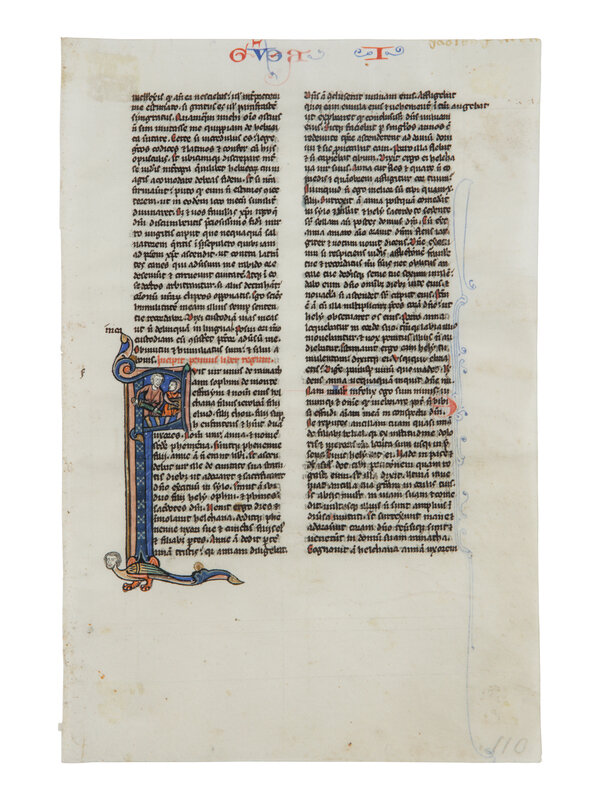
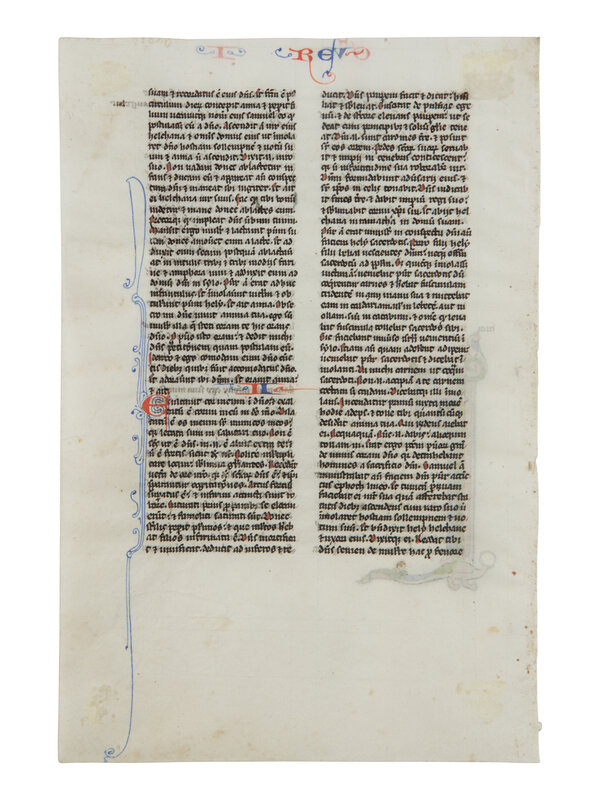
Single leaf with historiated Initial ‘F’ with The Killing of the Sons of Heli from a Bible, in Latin, illuminated manuscript on parchment [France, Paris, c. 1250]
Single leaf with historiated Initial ‘F’ with The Killing of the Sons of Heli from a Bible, in Latin, illuminated manuscript on parchment [France, Paris, c. 1250]
One of the finest works by the Johannes Grusch Atelier, named for a priest responsible for copying one of the Bibles.
155 × 100 mm. Single leaf ruled in plummet for double column of forty-four lines and written below the top line, foliated in thirteenth-century pencil in the lower right corner of the rectos,upper outer corners inscribed in German with the names of biblical books (now cropped), gutter edge of each leaf displays four holes or cuts, possibly from medieval stab-stitching, rubrics in red, header alternating in blue and red ink, ONE HISTORIATED INITIAL ‘F’ of approximately twenty lines, painted in rich tones of blue and rose, with white penwork and burnished gold accents, the lower vertical shaft descending into the margin, ending in a curling terminal with an animal head and subtle marginal flourishes. The decoration is well preserved with only minor pigment loss, cropping at the bottom has affected the flourishing, else in good condition.
This illuminated initial marks the beginning of 1 Samuel, opening the incipit Fuit vir unus de Ramathaim Sophim de monte Ephraim. The historiated scene depicts the dramatic episode of the Killing of the Sons of Heli and the Taking of the Ark—a pivotal moment in the biblical narrative wherein the Israelites, under threat from the Philistines, suffer defeat despite bringing forth the Ark of the Covenant from Shiloh. Accompanied by Hophni and Phinehas, the corrupt sons of the high priest Eli (Heli), the Ark fails to secure divine favor, and both sons are slain as the Ark is captured—fulfilling the prophecy against Eli’s house. This subject was especially favored in mid-thirteenth-century Parisian illumination, where it often appeared in deluxe biblical commissions.
The miniatures were initially identified by Christie’s as “one of the finest works of the Johannes Grusch atelier,” an attribution with which the Cleveland Museum of Art concurs for a sister leaf, (inv. 2001.74). Branner named this “paintshop” (his term) after the priest responsible for copying one of its Bibles in 1267 (Sarnen, Switzerland, Collegium, MS 16). Over a period of thirty years, many artists were associated with the workshop, and the style changed considerably, so that Branner divided it into early, middle, and late periods. The earliest work is a Missal made for Rouen Cathedral between 1235 and 1245 (Rouen, Bibliothèque municipale, MS Y-50271; see Branner, fig. 212). The figural style, seen here in our leaf, displays flat little figures with inked draperies, bodies with white heads with small features, such as short-bearded chins for the men and pursed mouths. The present miniature may fit with the manuscripts of the middle period.
Provenance
(1) Unidentified 14th-century German-speaking owner, responsible for notes on the final leaf of the volume.
(2) Unidentified 16th-century (or possibly later) German-speaking owner, who inscribed the names of biblical books in the upper margins of many leaves (e.g., “Spruch Salomons”). The binding, described by Sotheby’s as “19th-century black leather,” was more accurately identified by Christie’s as “German 16th-century blind-stamped goatskin over wooden boards.”
(3) Sold anonymously as “The Property of a Gentleman” at Sotheby’s London, 10 July 1967, lot 52, and purchased by “Jessel.”
(4) Resold anonymously at Christie’s London, 25 November 1992, lot 9.
(5) Subsequently broken up, likely by Bruce Ferrini.
(6) Present leaf sold by Les Enluminures in February 1998.
(7) Robert McCarthy, London, MS BM 1177a
Parent manuscript and sister leaves
The parent manuscript, briefly described by Sotheby’s in 1967 and more fully in a 1992 Christie’s catalogue, comprised 586 of 588 leaves and measured 153 × 100 mm. Written in a very small Gothic script in two columns of 44 lines, it featured red rubrics, alternating red and blue initials, and extensive pen flourishing. Decoration included fifty-nine large, illuminated initials—many with dragon-grotesques—and seventy-eight historiated initials, often with elaborate leaf or dragon terminals. The manuscript contained contemporary corrections and marginal notes and was bound in sixteenth-century German blind-stamped goatskin over wooden boards, later rebacked, with gilt edges and added clasps. Following its dismemberment, its leaves were dispersed to numerous public and private collections. For sister leaves, see Cleveland Museum of Art, inv. 1999.123, inv. 2001.74; Northern Illinois University, ND3355.C655 1150a; and Figeac, Musée Champollion, inv. 03-24-1, 03-24-2 (for a complete list of sister leaves, see Kidd 2018). A reconstruction is offered in Kidd 2021.
LITERATURE
Published: Sotheby’s, Catalogue of Western Manuscripts and Miniatures (London, 10 July 1967), lot 82 (“France, thirteenth century”); Christie’s, Valuable Manuscripts, Autograph Letters, Printed Books & Historical Bookbindings (London, 25 November 1992), lot 9 (with color illustration) (“Paris, mid-13th century… one of the finest products of the Grusch atelier”); Peter Kidd, The McCarthy Collection, Vol. III, French Miniatures, London, 2021, no. 24. Related literature, see Robert Branner, Manuscript Painting in Paris during the Reign of Saint Louis, Berkeley, CA, 1977.
We are grateful to Peter Kidd for permission to quote from his catalogue for this entry, and we thank Senior Consultant Sandra Hindman and Peter Bovenmyer for their assistance in preparing this sale.
The Robert McCarthy Collection
This lot is located in Chicago.