Condition Report
Contact Information
Auction Specialists
Lot 7
Sale 6388 - Western Manuscripts and Miniatures
Jul 8, 2025
10:00AM CT
Live / Chicago
Own a similar item?
Estimate
$3,500 -
4,500
Price Realized
$3,840
Sold prices are inclusive of Buyer’s Premium
Lot Description
DOMINICAN PAINTER? (active Paris; mid-13th century)
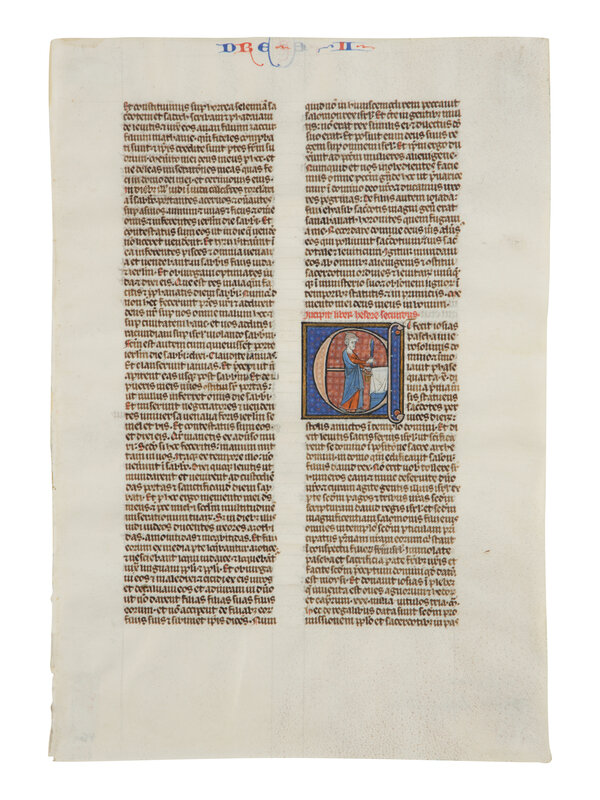
Single leaf from the Chester Beatty Bible (MS W.116), with historiated initial ‘E’ with Josia, in Latin, illuminated manuscript on parchment [France, c. 1250–1275]
Single leaf from the Chester Beatty Bible (MS W.116), with historiated initial ‘E’ with Josia, in Latin, illuminated manuscript on parchment [France, c. 1250–1275]
Traditionally attributed to the Dominican Painter, whom Branner calls “a rare and original painter” known for his deep rich colors and delicate stylized poses of the figures.
c. 230 × 160 mm. Single leaf, ruled in plummet, written below top line in two columns of fifty-one lines, in brown ink, the chapters exceptionally marked with 3-line illuminated initials, nineteenth- and twentieth-century pencil foliations present, ONE HISTORIATED INITIAL ‘E’ with Josiah asperging an altar (text includes the end of Nehemiah and beginning of I Esdras). Minor cockling, parchment clean and pigments vibrant.
This leaf derives from the Chester Beatty Bible (MS W.116), often confused with another Bible from the Alfred Chester Beatty collection (Western MSS 116 and 173), both broken and frequently appearing on the market. To distinguish them, the present manuscript is designated MS W.116, while the other is referred to as the Mailhac-Faber Bible, named for its two earliest known owners. The luxurious nature of the commission is demonstrated by the illumination of each chapter initial in this leaf with color and gold, some even extending into the margin. These initials are distinctive for their crisp appearance, the relative lack of gold except for the outer frames and disks of the initials, the use of a ground pattern combining octagonal and square motifs, and a general restraint of the marginal extensions in the borders.
Until 1984, the illumination of this finely executed Bible was generally attributed to northern France. Sotheby’s 1984 catalogue reclassified it as Parisian, and a 1985 Sotheby’s sale proposed a more specific attribution to “probably in the workshop of the Dominican Painter.” Peter Kidd has recently argued, however, for an execution outside of Paris, considering both these stylistic peculiarities and the flaking of the brown ink.
Provenance
(1) According to Sotheby’s (1968), there was no known indication of early ownership. Possibly to be identified with a manuscript described in Ludwig Rosenthal’s Katalog 135:Manuskripte, Inkunabeln, Holzschnitt- und Kupferwerke, und andere Kostbarkeiten (Munich, [1910]), no. 300: “Biblia latina. Manuscrit de la fin du 13ᵉ ou commencement du 14ᵉ siècle... Avec nombreuses initiales illuminées. 549 ff. 2 coll. 51 ll. Veau.”
(2) Bound in blue velvet, likely by Léon Gruel (1841–1923) or his son Paul Gruel, Parisian bookbinders and dealers active until 1954. The binding and reorganization of the manuscript—particularly the removal of most Old Testament leaves—was likely carried out during this period. Acquired from Gruel, according to the Chester Beatty Archive.
(3) Sir Alfred Chester Beatty (1875–1968), by c. 1930: catalogued as “W. MS. VIII,” later renumbered MS W.116 by Robin Flower and R. A. B. Millar in preparation for an intended catalogue (cat. 61); exhibited at Trinity College, Dublin, in 1955.
(4) Posthumous sale, Sotheby’s, London, 3 December 1968, lot 14 — acquired jointly by Alan Thomas and Charles Ede (Folio Fine Art).
(5) Present leaf, The Rendells, Catalogue 146, 1979, no. 26. Unidentified owners: inscribed in pencil “I Esdras I Iosias before altar” (verso, lower left), and “4;00” (lower right), with a Sam Fogg(?) stock number “8042”; acquired from Sam Fogg in December 1996.
(6) Robert McCarthy Collection, MS BM 1073.
Parent manuscript and sister leaves
By the early twentieth century, the parent manuscript appears to have consisted of 549 leaves, but before Chester Beatty acquired it (no later than 1930), a significant portion—likely around 362 Old Testament leaves—was removed, probably by the bookseller Gruel, who rebound the remaining illuminated and New Testament leaves in blue velvet; these were later re-foliated by Eric Millar. When sold in the 1968 Chester Beatty sale, only 187 leaves remained, and the cataloguer proposed that the removal may have followed damp damage, possibly while in the hands of an unverified owner, with the 1955 exhibition already describing the volume as containing only portions of the Old Testament and most of the New.
Sister leaves
Over sixty sister leaves have been identified in public and private collections, including: Amsterdam, Rijksmuseum (RP-T-1969:221), Boston, Public Library (MS q Med. 275), Dublin, Chester Beatty Library (W 116, f. 54), and Notre Dame (IN), Snite Museum (Acc. 1989.20.3) and Hesburgh Library (Frag. I. 34). For a recent list of sixty-one sister leaves with and without historiated initials, see Kidd 2021, no. 37, pp. 141-117 (the present leaf unknown to him).
LITERATURE
R.O. Dougan, A Loan Collection of Western Illuminated Manuscripts from the Library of Sir Chester Beatty, Exhibited in the Library of Trinity College, Dublin, Dublin, 1955, no. 30;
Sotheby & Co., The Chester Beatty: Western Manuscripts, Part I: Catalogue of Thirty-Seven Illuminated Manuscripts of the 9th to the 16th Century, London, 1968, lot 14; Folio Fine Art Ltd, Catalogue 61, London, February 1969, nos. 260–274; The Rendells Inc., Catalogue 146: The Medieval World, 500 AD – 1450 AD, Newton (MA), 1979, no. 26 (ill.); Sotheby’s, Western Manuscripts and Miniatures, London, 5 July 2005, lot 17; Peter Kidd, The McCarthy Collection, vol. 3: French Miniatures, London, 2021, no. 37.
We are grateful to Peter Kidd for permission to quote from his catalogue for this entry, and we thank Senior Consultant Sandra Hindman and Peter Bovenmyer for their assistance in preparing this sale.
The Robert McCarthy Collection
This lot is located in Chicago.