Condition Report
Contact Information
Auction Specialists
Lot 32
Sale 6388 - Western Manuscripts and Miniatures
Jul 8, 2025
10:00AM CT
Live / Chicago
Own a similar item?
Estimate
$3,500 -
5,000
Price Realized
$7,680
Sold prices are inclusive of Buyer’s Premium
Lot Description
CIRCLE OF ANDREA DI BARTOLO (Siena, c. 1360/70-1429)
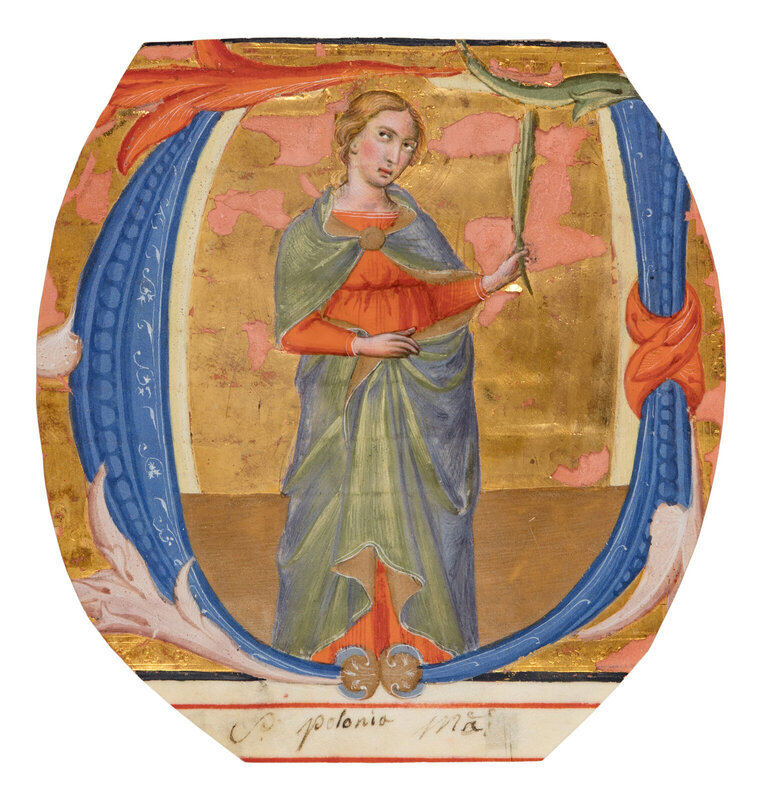
Illuminated cutting with Saint Apollonia, from a Choir Book, illuminated manuscript on parchment, [Italy, c 1390s]
Illuminated cutting with Saint Apollonia, from a Choir Book, illuminated manuscript on parchment, [Italy, c 1390s]
This richly colored cutting of Saint Apollonia, likely from an Antiphonal, reflects the style of Andrea di Bartolo with influences of the Master of the Codex Rossiano.
132 × 126 mm. Single cutting of initial ‘U’ or ‘O’ painted in blue, ornamented with vibrant acanthus and vinework in rose, vermilion, and olive-green tones, embellished with white penwork filigree on a burnished gold ground with tooling, inhabited by a figure of a saint modeled volumetrically with gently rounded drapery and a coiffure of subtle ringlets, overpainting present, especially on the arms and face of the figure, two staves in red ink visible below the initial, later inscription in pencil, “S. Apolonia, Ma[rtyr],” appears below the image. Significant losses to the gold ground, particularly around the figure, with notable flaking to the tooled halo, oddly cut in an oval, else in fair condition.
This cutting likely originated in an Antiphonal, possibly for the Feast of Saint Apollonia (February 9). Although in compromised condition, with losses of gold leaf and some repainting, the miniature reveals stylistic affinities with late Trecento Sienese illumination—particularly the work of Andrea di Bartolo—in its subtle drapery modeling, warm palette of olive green, rose, and vermilion, and finely tooled gold halo. An added inscription below the figure reads “S. Apolonia,” yet the saint lacks her usual attributes—pincers holding a tooth—and instead holds only a generic palm frond, leaving the identification uncertain. The cutting preserves a sense of the luminous color and devotional elegance characteristic of late Trecento Sienese manuscript painting.
Painter and illuminator, Andrea di Bartolo contributed illumination to the Choir Books for Lecceto, as well as for the canons of San Martino in Siena. Toward the end of his career, he returned to Venice where he painted a panel for the Camaldolese church of San Michele in Murano. The stylistic idiom of the initial painted in green, blue, and orange acanthus, the round face with deepset small eyes and pronounced pupils, the blond curly hair, and the relatively flat drapery recall a group of cuttings from an Antiphonal, now dated in the 1390s. On this Antiphonal Andrea di Bartolo collaborated with the Master of the Codex Rossiano, of which there are some similarities here (compare especially his Saint Agatha, Newark Delaware, Alana Collection, Hindman and Toniolo, 2021, fig. 22.2)
Provenance
(1) A later inscription in pencil, “S. Apolonia Ma.,” written between the stave lines, is likely a nineteenth-century owner or dealer addition. The script notably resembles that found on cuttings from the 1856 Christie’s sale of the poet-banker Samuel Rogers, who had acquired numerous Italian miniatures from William Young Ottley in the 1830s. While this cutting does not appear in the Rogers sale, the similarities in letterforms suggest a possible connection to that collection or to a dealer within the same provenance chain—although this remains hypothetical.
(2) Collection of Carl Askonas (1883–1946) and Rosa Askonas (1891–1980), Vienna and later Montréal. Their art collection, which included medieval miniatures (“Buchminiaturen des Mittelalters”), was confiscated by the Gestapo in 1938 and partially restituted in the late 1940s. As the individual miniatures were not itemized in surviving seizure or restitution records, it remains uncertain whether this cutting was part of the original collection or entered it at a later date.
(3) By descent to the heirs of Carl and Rosa Askonas.
Parent manuscript and sister leaves
Possibly related to the same group of cuttings associated with a parent manuscript in Siena (Biblioteca Comunale degli Intronati, MS H.I.7), an Antiphonal with the Proper of Times and a Proper of Saints. So far fifteen cuttings have been identified, forming a coherent group. For a complete listing of the sister leaves and a full discussion, see Hindman and Toniolo 2021, no 22, pp. 232-241.
LITERATURE
Unpublished; Related literature: Gaudenz Freuler, in Painting and Illumination in Early Renaisssance Florence, 1300-1450, exh. Cat., New York, Metropolitan Museum of Art, ed. Laurence B. Kanter et al, New York, 1994; Gaudenz Freuler, “Andrea di Bartolo, Fra Tommasso d’Antonio Caffarni and Sienese Dominicans in Venice,” Art Bulletin 69 (1987), pp. 570-586; Gaudenz Freuler, in Milvia Bollati, ed., Dizionario biografico dei miniatori italiani: Secoli IX-XVI, Milan, 2004, 20-23; Ada Labriola, La miniatura senese nel Quattrocento, Florence, 2006; Gaudenz Freuler, in S. Hindman and F. Toniolo, eds., The Burke Collection of Manuscript Paintings, London, 2021, no. 22, pp. 230-237.
We thank Senior Consultant Sandra Hindman and Peter Bovenmyer for their assistance in preparing this sale and Gaudenz Freuler for consultation on this entry.
This lot is located in Chicago.