Condition Report
Contact Information
Auction Specialists
Lot 33
Sale 6388 - Western Manuscripts and Miniatures
Jul 8, 2025
10:00AM CT
Live / Chicago
Own a similar item?
Estimate
$3,500 -
4,000
Price Realized
$7,040
Sold prices are inclusive of Buyer’s Premium
Lot Description
ANONYMOUS RHENISH ARTIST
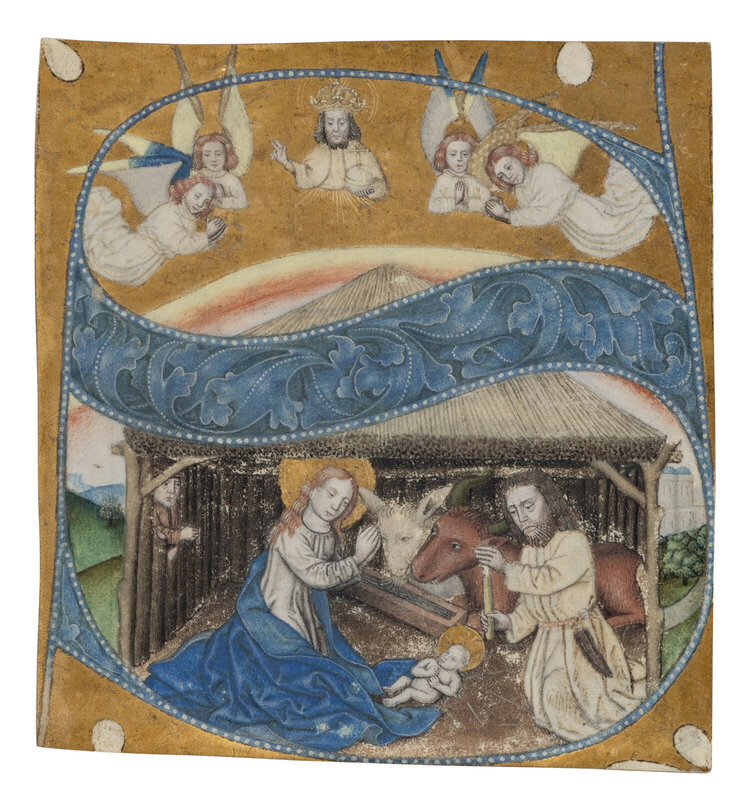
Illuminated cutting of Initial ‘S’ with the Nativity of Christ, from a Choir Book, illuminated manuscript on parchment [Germany, (Lower?) Rhine, c. 1470-80]
Illuminated cutting of Initial ‘S’ with the Nativity of Christ, from a Choir Book, illuminated manuscript on parchment [Germany, (Lower?) Rhine, c. 1470-80]
Charming cutting echoing elements of Flemish panel painting by Rogier van der Weyden.
95 x 90 mm. Single cutting of initial ‘S’, painted in blue, ornamented with plump acanthus, modelled with fine white lines, initial outlined with white dots, against a highly burnished gold, the lower open counter of the ‘S’ including the scene of the Nativity of Christ, the hut placed in the middle, a landscape vista visible on the left and right, the upper open counter of the ‘S’ occupied by pairs of singing angels on left and right, with God the Father in the center, verso not visible, very minor losses, generally in good, fresh condition, framed.
The charming initial ‘S’ portrays the Nativity of Christ in a tumbledown, open shed supported by a tree trunk and covered by a thatched roof. In the center, the Child lies on the ground on top of the folds of the Virgin Mary’s ample blue robe, while Joseph dressed in white appears on the right, holding a candle which he shields from the wind to preserve the flame. The ox and the ass (symbolic of the Old and the New order) are in the middle ground, interrupted from their meal deposited in a trough that separates them from the space of the holy family. Above, two pairs of praying angels dressed in white and with curly blond hair herald the arrival of the Savior. Christ as Salvator Mundi appears in the center holding a globe and raising his hand in blessing. The initial must come from a Choir Book where it would have illustrated a chant from the Feast of the Nativity or Christmas Day on December 25; perhaps it opened the Response at Matins “Sancta et immaculata virginitas quibus laudibus …” (O Mary, how holy and spotless is your virginity).
We have located one possible sister leaf, an initial ‘A’ depicting a Cistercian monk praying before an altar (Philadelphia, Free Library, Lewis E M 44:19). The Philadelphia cutting is attributed to the Lower Rhine and dated c. 1480. Although it is significantly larger, the treatment of the initial with its blue acanthus, the thick burnished gold ground, and the limited, somber palette invite comparison with the present cutting.
Intriguing are the references in the cutting of the Nativity to the central panel of Rogier van der Weyden’s Bladelin Triptych of about 1450. Although not directly copied, the figures appear in similar dispositions but reversed; details such as Joseph shielding the candle and the Christ Child posed on Mary’s garment are revealing of a relationship between the two compositions. So too the angels above, although arranged differently, echo Rogier’s painting. We are grateful to James Marrow for pointing out that models related to the posing of the figures in the Bladelin triptych circulated widely in Germany, both in paintings and manuscripts, as for example in a copy of the Nativity by the Master of the St. Petersburg Liber Precum from a Prayer Book of c. 1488/89 from Cologne now in the Russian National Library in St. Petersburg (MS Lat. O.v.I. 206) (see Logutova and Marrow 2003).
Provenance
(1) Collection of Carl Askonas (1883–1946) and Rosa Askonas (née Rosa Fürth, 1891–1980), Vienna and later Montréal. Following the annexation of Austria in 1938, the Askonas family fled to Canada, settling in Montréal. At the time of their emigration, their art collection was seized by the Gestapo, including an entry described as “Buchminiaturen des Mittelalters”. It remains unclear whether the present cutting was among those items confiscated. The majority of the collection was subsequently restituted to the family in the late 1940s (see Sophie Lillie, Was einmal war: Handbuch der enteigneten Kunstsammlungen Wiens, vol. VIII of Bibliothek des Raubes, Vienna, 2003, pp. 109–111.
(2) By descent to the heirs of Carl and Rosa Askonas.
LITERATURE
Unpublished; Related literature, see Shirley Blum, Early Netherlandish Triptychs, A Study in Patronage, Berkeley, CA, 1969 (for the Bladelin Triptych); Margarita G. Logutova and James Marrow, Liber Precum. Vollständige Faksimile-Ausgabe der Handschrift Ms. Lat. O.v.I. 206 der Russischen Nationalbibliothek in St. Petersburg (Codices Selecti, Vol. CVIII), 2 vols. (Graz, ADEVA, 2003).
We thank Senior Consultant Sandra Hindman and Peter Bovenmyer for their assistance in preparing this sale and James Marrow for consultation on this entry.
This lot is located in Chicago.