Condition Report
Contact Information
Auction Specialists
Lot 31
Sale 6388 - Western Manuscripts and Miniatures
Jul 8, 2025
10:00AM CT
Live / Chicago
Own a similar item?
Estimate
$6,000 -
8,000
Price Realized
$38,400
Sold prices are inclusive of Buyer’s Premium
Lot Description
JOHANNES DE TOUSSENS (active Nord-Pas-de-Calais, 1277–1290)
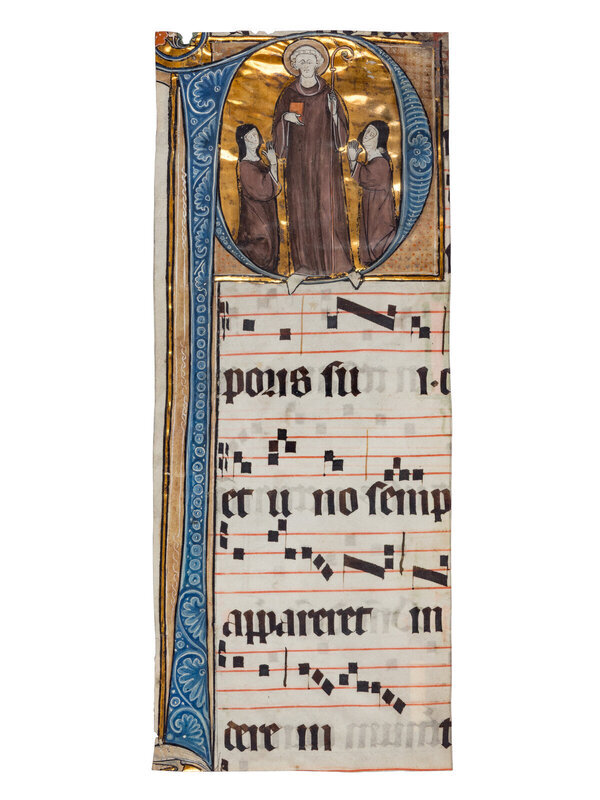
Illuminated cutting of initial ‘P’ with Saint Bernard and two nuns from the Beaupré Antiphonals (Prioress’s Set), in Latin, illuminated manuscript on parchment [Cambrai, Abbey of Sainte-Marie at Beaupré, 1289–90]
Illuminated cutting of initial ‘P’ with Saint Bernard and two nuns from the Beaupré Antiphonals (Prioress’s Set), in Latin, illuminated manuscript on parchment [Cambrai, Abbey of Sainte-Marie at Beaupré, 1289–90]
Previously unknown illumination from one of the most renowned Gothic Choir Book sets of the Middle Ages, a rare survival of the artistic and liturgical culture of Beaupré Abbey.
265 × 109 mm. Single cutting from an antiphonal, ruled in lead point, written in a large gothic rotunda in black ink, rubrics in red, notation in square neumes for plainsong on four red staves, four stave groups and four lines of text survive from original sixteen-line (8 music + 8 text) per page design of the parent antiphonal, ONE LARGE HISTORIATED INITIAL of approximately five lines that opens the antiphon for the Feast of Saint Bernard, ornamented with stylized foliage and scrolling vines, some extending into the margins, border of a slender bar and foliate sprays, scalloping, and stylized leaf forms on burnished gold ground, with stem trailing the length of the cutting (approximately eight lines high), bowl of initial in bracket-shaped ornamental frame of red dotted lattice design forming a diapered background, initial infilled with an image of Saint Bernard of Clairvaux blessing two nuns, on burnished gold ground polished smooth and lightly tooled or incised around the contours of the figures (subtle chasing may outline halos or garments, though no heavy punchwork is evident). Pigments and gold well-preserved with only minor flaking of paint and gilding evident in places handled or flexed over time, slight rubbing on Saint Bernard’s halo, likely from ritual use, parchment stable and generally clean, with only modest darkening or grime at the very edges.
This illuminated cutting comes from a lavish late thirteenth-century Cistercian Antiphonal commissioned for the Abbey of Sainte-Marie at Beaupré, near Grammont in the diocese of Cambrai. In 1289–90, a complete double set of choral Antiphonaries was created—one set of three volumes for the abbess’s side of the choir, and a parallel set of three volumes for the prioress’s side. The project was likely overseen by the scribe-artist Johannes de Toussens, a Cistercian monk who included a tiny author portrait of himself in one volume now at the Walters Art Museum (W.759, fol. 1). These Antiphonals are considered one of the great monuments of Gothic art, richly illuminated in the Hainaut-Flanders style circa 1290 with myriad historiated initials, delicate pen-flourished letters, and lively marginal drolleries. As Cistercian liturgical books, they reflect the order’s refined artistic sensibility and contain the Office for the liturgical year according to the Cistercian Use.
Each original Antiphonal set comprised three volumes covering different segments of the liturgical year: Volume I from Easter through the Assumption (15 August), Volume II from the Assumption through Advent (late November), and Volume III from Christmas through Easter. An additional supplement (Volume IV) was later appended ca. 1475–1500 to update certain offices. The cutting offered here is attributed to the Prioress’s Volume II and corresponds to a historiated initial found in its sister volume (Walters Museum, W.760, fol. 113v). The fragment features a large historiated initial ‘P’ depicting Saint Bernard of Clairvaux, the great Cistercian reformer and spiritual father of the order. He is shown robed in a brown habit (an irregular feature of the Beaupré group which pictures the saint in brown rather than white in several instances), nimbed, and bearing the crozier of an abbot. In front of him kneel two nuns in black veils—likely representing the community of Beaupré—gazing up at the saint in reverence. Saint Bernard’s right hand is raised in blessing over them, while his left holds a book or scroll, emphasizing his role as a Doctor of the Church. The initial’s letterform ‘P’ is painted in vibrant tones and gold, and it opens the Latin antiphon for Saint Bernard’s feast day (20 August): Prima virtus viri sancti habitus cor and its octave.
Hitherto unpublished, this cutting emerges as an important and rare survival from one of the most renowned Gothic Choir Book sets of the Middle Ages and stands as a distinguished example of the artistic and liturgical culture of Beaupré Abbey. Whereas comparable illuminated initials grace the full volumes, few have appeared on the market, and this one, with pictures of the nuns along with Saint Bernard, is of remarkable interest.
Provenance
(1) Created for the Abbey of Sainte-Marie at Beaupré (near Grammont in the diocese of Cambrai) between 1289–90 as part of a double set of Choir Antiphonaries by the scribe-artist Johannes de Toussens. The patroness (thought to be Abbess Beatrix de Grammont) is depicted with a younger nun named Clementia in the volume now in the Walters Art Museum (W.759, fol. 3v), linking the manuscripts to a noble de Viane family that supported Beaupré Abbey circa 1244–1293. Upon completion in 1290, each volume received a French inscription declaring its use “dans le Chœur du côté de Ma-Dame l’Abbesse/Prieure” for the relevant liturgical season. They remained in use at Beaupré for centuries, undergoing some updates under Abbess Jacqueline Hendricx (1473–1500) and musical revisions under the last abbess, Angéline de Lossy (1755–1796). After Beaupré Abbey was suppressed during the French Revolution, the antiphonals were confiscated and sold in 1797.
(2) Collection of John Ruskin (1819–1900), who acquired the Antiphonals in 1852–53. Ruskin admired them greatly, calling them “noble old armorial music books,” and disbound some volumes into smaller sections for study. He also notoriously removed leaves to gift to friends.
(3) Sotheby’s, 19 February 1863, lot 742. Likely purchased by an agent of Sir John Simeon (1815–1870). Tragedy struck two years later in June 1865, while the books were at Sotheby’s awaiting another sale, fire broke out in an adjacent house and three of the six volumes were badly damaged. The burned volumes belonged to the Prioress’s set (Vols. I–II) from which this cutting derives, and one volume of the Abbess’s set (Vol. III). Nearly all known cuttings stem from these salvaged volumes with the Saint Bernard initial offered here almost certainly one of those survivors.
(4) Collection of Carl Askonas (1883–1946) and Rosa Askonas (née Rosa Fürth, 1891–1980), Vienna and later Montréal. Following the annexation of Austria in 1938, the Askonas family fled to Canada, settling in Montréal. At the time of their emigration, their art collection was seized by the Gestapo, including an entry described as “Buchminiaturen des Mittelalters.” It remains unclear whether the present cutting was among those items confiscated. The majority of the collection was subsequently restituted to the family in the late 1940s (see Sophie Lillie, Was einmal war: Handbuch der enteigneten Kunstsammlungen Wiens, vol. VIII of Bibliothek des Raubes, Vienna, 2003, pp. 109–111). In a 1967 appraisal of the collection conducted by William Schaub (New York), the miniature was described as: “14th century miniature. French. Holy bishop with two kneeling nuns.”
(5) By descent to the heirs of Carl and Rosa Askonas.
Parent volume and sister leaves
Complete or Substantial Volumes include Walters Art Museum (Baltimore): W.759 – Abbess’s Volume I (Easter to Assumption); W.760 – Abbess’s Volume II (Assumption to Advent); W.761 – Prioress’s Volume III (Christmas to Easter); W.762 – Supplement Volume (15th–18th c. additions). Cuttings and Illuminated Initials include Walters Art Museum (Baltimore): W.915.1 – Initial “B” with St. Benedict and two nuns; W.915.2 – Initial “H” with St. Stephen and two figures; Bibliothèque Royale de Belgique (Brussels): MS II 3634/1 – Birth of John the Baptist; MS II 3634/2 – Beheading of John the Baptist; MS IV 173 – Decorated initial (non-historiated); MS IV 548 – Text leaf with pen-flourished initials; MS IV 1322 – Plainchant leaf (formerly private, acquired 2015); Victoria and Albert Museum (London): Inv. 7939 –Nativity of the Virgin; Inv. 7940 –All Saints; Musée des Beaux-Arts de Bordeaux (Marcadé Collection): No. 101 – Exaltation of the Cross; Germanisches Nationalmuseum (Nuremberg): Bredt 71 – Illuminated cutting St. Catherine; Ashmolean Museum (Oxford): Ruskin Collection – Leaf with St. Catherine of Alexandria debating Emperor Maxentius; Text and Music Leaves (non-miniated); Lilly Library (Indiana University, Bloomington): 7 leaves – With text, square notation, pen-flourished initials.
LITERATURE
This cutting is unpublished; On the Beaupré Antiphonals see: Sydney C. Cockerell, Catalogue of a Loan Exhibition of Illuminated Manuscripts Held at the Burlington Fine Arts Club, London, 1908, pp. 55–74; Joseph Van den Gheyn, Catalogue des Manuscrits de la Bibliothèque Royale de Belgique, vol. II, Brussels, 1909, pp. 195–200; Lilian Randall, Medieval and Renaissance Manuscripts in the Walters Art Gallery, vol. 3: Belgium, 1250–1530, Baltimore, 1997, no. 219; Lilian Randall, “The Fragmentation of a Double Antiphonal from Beaupré,” in Interpreting and Collecting Fragments of Medieval Books, ed. Linda L. Brownrigg and Margaret M. Smith, London, 2000, pp. 210–29; Christopher de Hamel, Gilding the Lily: A Hundred Medieval and Illuminated Manuscripts in the Lilly Library, Bloomington, 2010, no. 35; Bart Demuyt and Ann Kelders, “Patrimoine éparpillé: Les fragments de l’antiphonaire de Beaupré,” Science Connection 58 (2018), pp. 10–14.
We thank Senior Consultant Sandra Hindman and Peter Bovenmyer for their assistance in preparing this sale and Alison Stones and Peter Kidd for consultation on this entry.
This lot is located in Chicago.