Condition Report
Contact Information
Auction Specialists
Lot 24
Sale 6388 - Western Manuscripts and Miniatures
Jul 8, 2025
10:00AM CT
Live / Chicago
Own a similar item?
Estimate
$1,000 -
1,200
Price Realized
$896
Sold prices are inclusive of Buyer’s Premium
Lot Description
PARISIAN WORKSHOPS
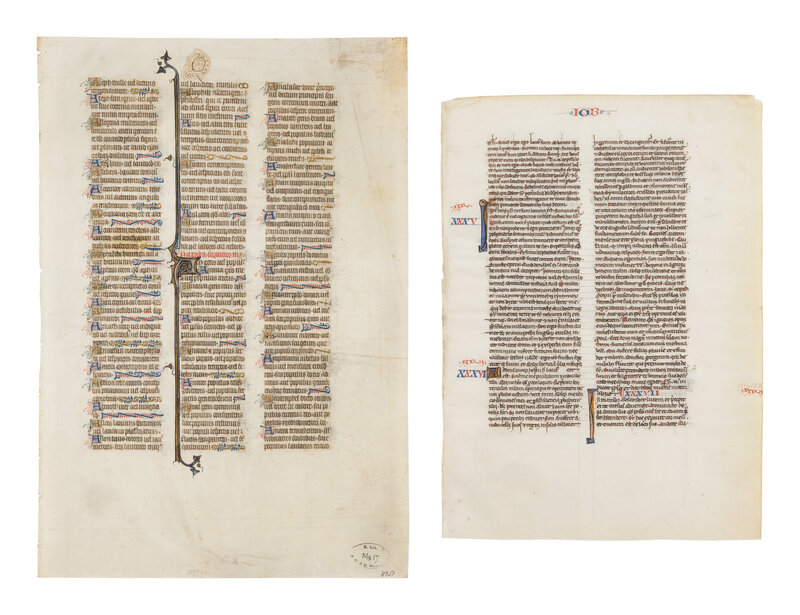
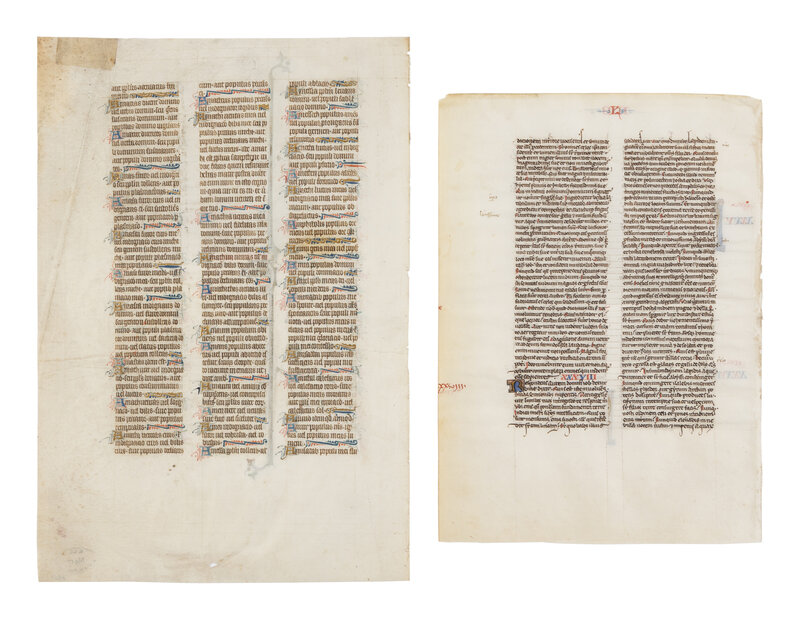
Two Bible leaves, one from the St. Alban's Bible, with illuminated initials, in Latin, illuminated manuscript on parchment [France, Paris, c. 1250 & c. 1320s-1330s]
Two Bible leaves, one from the St. Alban's Bible, with illuminated initials, in Latin, illuminated manuscript on parchment [France, Paris, c. 1250 & c. 1320s-1330s]
Two finely preserved Bible leaves—distinct in origin yet complementary in character—together exemplifying the evolution of Parisian manuscript production, from the refined scriptoria of the thirteenth-century university milieu to the continuing scholastic traditions of later Gothic glossaries.
(i) A leaf from the Book of Job, second half of the thirteenth century.
204 × 161 mm. Single leaf, ruled in plummet for two columns of fifty-two lines (justification: 145 × 100 mm), written in a precise gothic textualis in black ink, rubrics in red, with three chapter numbers in Roman numerals alternating red and blue, and marginal rubrication. Marginal red and blue Roman numerals mark chapter breaks (XXIV, XXV, XXVI); header in blue and red. Two large painted initials of six and eight lines in burnished gold, outlined in blue, descending along the left columns of text. Some minor marginal darkening and light cockling; overall, in excellent condition.
The layout and script are typical of mid- to late thirteenth-century Parisian Bible production, featuring a compact yet legible Gothic bookhand and a carefully articulated decorative hierarchy. The large burnished gold initial ‘I’ begins Job 1:1: Ish erat in terra Hus, nomine Job. Marginal Roman numerals in alternating red and blue mark chapter breaks (XXIV, XXV, XXVI), corresponding to chapters 24–26 of the Book of Job. Parisian Bibles of this period were pioneering in their adoption of a standardized, portable format—smaller in size, highly condensed in script, and often arranged in two columns of fifty or more lines. This innovation not only enhanced portability for scholars, mendicants, and students but effectively reinvented the Bible as a personal, functional object suited to the intellectual and devotional demands of the medieval university culture.
Provenance
(1)Private Collection.
(ii) A leaf from the St. Alban's Bible with the glossary of Hebrew names, c. 1320s-1330s.
273 × 185 mm. Single leaf, ruled in plummet for three columns of 46 lines per column (justification: 202 × 135 mm), written in a compact and highly regular gothic textualis in dark brown ink. Rubricated name headings in red, with alternating blue and gold paraphs, many with elaborate pen flourishing in red and blue. A three-line initial “Q” at the top of the recto in gold on pink and blue grounds with white filigree, opening the glossary entry “Qephthali interpretatur decoratus...” A decorative bar runs at center featuring leafy terminals and drolleries including a dragon and human figure. Minor edge wear; overall, clean and well-preserved.
This leaf comes from the St. Alban's Bible with the glossary (Interpretationes Hebraicorum Nominum) typically appended to the end of thirteenth-century Bibles. The text consists of Hebrew names from Scripture, alphabetically arranged and followed by brief Latin definitions. On this leaf, the entries begin under ‘Q’ and continue through ‘M’ in the middle of the verso, with cues such as Quis interpretatur homo, Raab interpretatur latitudo, etc. The decoration and script reflect Parisian book production of the late thirteenth century. Flourished initials and intricate vertical line fillers in black and red ornament the columns. The central bar, featuring leafy terminals and drolleries (including a dragon and human figure), separates the three columns with lively detail. The quality of the parchment, vibrancy of the pigments, and overall state of preservation indicate the manuscript was a deluxe production, possibly intended for university or ecclesiastical use.
Provenance
(1)Private Collection.
Parent manuscript and sister leaves
Discussed in Erik Kwakkel, “Breaking Bad: The Incomplete History of the St. Alban’s Bible”
https://medievalbooks.nl/2019/11/01/breaking-bad/; Peter Kidd, “The St. Alban’s Bible,” in Medieval Manuscript Provenance, 20 June 2021: https://mssprovenance.blogspot.com/2019/01/the-st-albans-bible-before-1964.html
For a sister leaf from the St. Alban’s Bible also with the glossary of Hebrew names, see Stanford, Stanford University Library, M1768:
LITERATURE
Unpublished; On Parisian Bibles see: Laura Light, “French Bibles c. 1200–1230: A New Look at the Origin of the Paris Bible,” in The Early Medieval Bible: Its Production, Decoration and Use, ed. Richard Gameson, Cambridge, 1994, pp. 155–176; Christopher de Hamel, The Book: A History of the Bible, London, 2001; Laura Light, “The Thirteenth Century and the Paris Bible,” in The New Cambridge History of the Bible, Vol. 2: From 600 to 1450, ed. Richard Marsden and E. Ann Matter, Cambridge, 2012, pp. 380–391; Chiara Ruzzier, “The Miniaturisation of Bible Manuscripts in the Thirteenth Century: A Comparative Study,” in Form and Function in the Late Medieval Bible, ed. Eyal Poleg and Laura Light, Leiden: Brill, 2013, pp. 105–125.
We thank Senior Consultant Sandra Hindman and Peter Bovenmyer for their assistance in preparing this sale and Peter Kidd for consultation on this entry.
This lot is located in Chicago.