Condition Report
Contact Information
Auction Specialists
Lot 23
Sale 6388 - Western Manuscripts and Miniatures
Jul 8, 2025
10:00AM CT
Live / Chicago
Own a similar item?
Estimate
$2,000 -
2,500
Lot Description
DOMINICAN PAINTER (active Paris, c. 1240–1260)
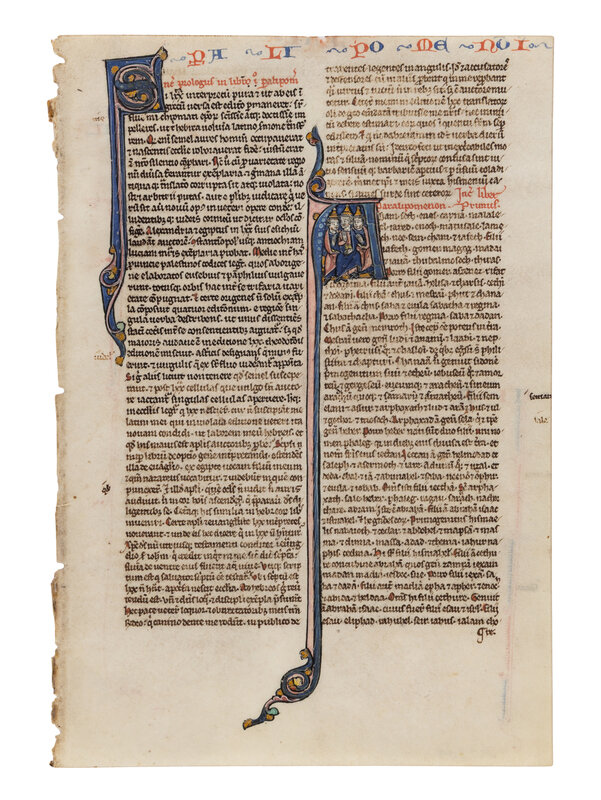
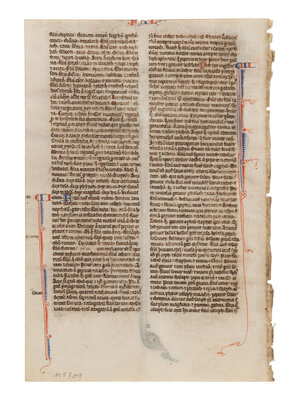
Leaf book containing a leaf from a Parisian Bible, with historiated initial ‘P’ of the Kings of Israel, in Latin, illuminated manuscript on parchment [France, Paris, ca. 1240–1250]
Leaf book containing a leaf from a Parisian Bible, with historiated initial ‘P’ of the Kings of Israel, in Latin, illuminated manuscript on parchment [France, Paris, ca. 1240–1250]
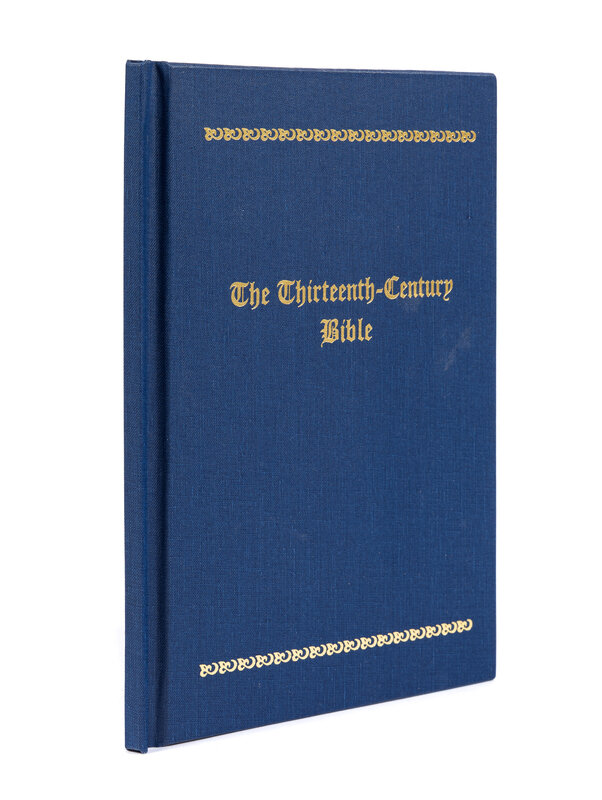
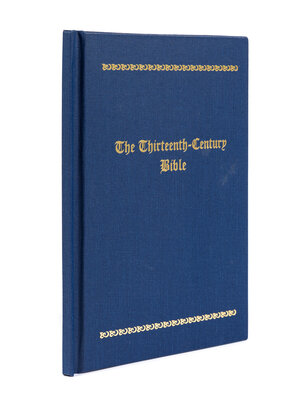
An example of a leaf book including a pocket Bible leaf, allegedly published in 1994 in 1,000 copies but now rare on the market.
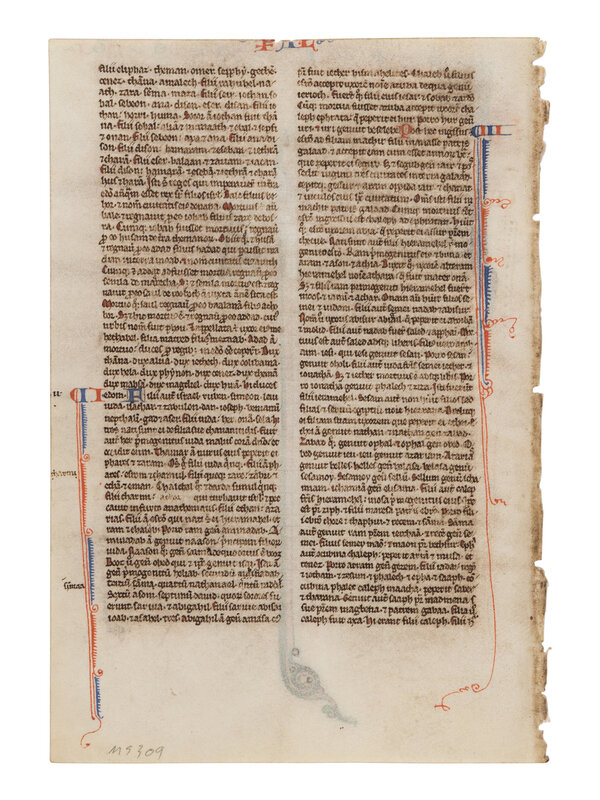
197 × 130 mm. Single leaf ruled in plummet for two columns of fifty-two lines (justification: 138 × 89 mm), written in gothic textualis, rubrics in red, with headings and chapter numbers in red and blue, verses indicated by tiny red strokes through letterforms, chapter initials in red or blue with fine pen flourishing in the opposite color, running headers in alternating red and blue, marginal notations and glosses added by contemporary hand on both recto and verso, one illuminated puzzle initial in left column introduces the Prologue, executed in blue and red, with contrasting filigree flourishes extending vertically into the margin, ONE HISTORIATED INITIAL of similar design on burnished gold ground with three Kings of Israel introducing 1 Chronicles (Paralipomenon), both initials with bifurcated letter stems filled with refined foliate motifs in white and ochre, framed by a delicate band of alternating pink and blue. The vertical and horizontal extensions terminating in trilobed finials. Trimming present with partial loss to header on verso, light wear to vellum, small abrasions to gutter, else in good condition with pigments and gold radiant.Accompanied by the original booklet and descriptive essay authored by Bruce Ferrini, providing historical context and commentary on thirteenth-century Bibles.
This illuminated leaf originates from a mid-thirteenth-century Parisian “pocket” Bible. The recto opens 1 Chronicles with a splendid historiated initial ‘P’, executed in lapis-blue and vermilion on a burnished gold ground. Within the initial are three crowned figures—likely the kings of Israel or Judah—gesturing toward an unfurled scroll, a visual reference to the royal genealogies that commence Chronicles. The figures are delineated in crisp ink outlines and clad in stylized, schematic drapery, their poses formalized yet expressive. Surrounding the letter, extensions of foliate ornament and gold punctuate the margins. The leaf’s fine disciplined textualis script and refined decoration typify the high-quality production of Parisian Bibles in the middle of the century, when even diminutive “pocket” Bibles were lavishly ornamented for scholarly and ecclesiastical use.
The illumination is attributed to the circle of the Dominican Painter, an anonymous master active in Paris in the mid-thirteenth century. This term often refers to a group of unidentified illuminators associated with the Dominican convent of Saint-Jacques in Paris and the manuscripts they helped to produce, especially Paris Bibles and theological works. Robert Branner (1977) lauds this artist(s) as “a rare and original painter,” noted for deep, rich colors and the delicate, stylized poses of his figures. The Dominican Painter’s style—evident in the crisp drawing and balanced ornament of this leaf—was influential in Parisian illumination, and he is associated with several fine Bibles and devotional manuscripts of the period, most notably the now dispersed Chester Beatty Bible.
Parent manuscript
Bruce P. Ferrini (1952–2010), a prominent American manuscript dealer, produced a limited-edition leaf book in 1994 titled The Thirteenth-Century Bible: An Essay, with an Original Leaf from a Latin Manuscript Bible. This edition, published in Akron, Ohio, consisted of 1,000 hand-numbered copies, each containing a circa thirteenth-century Bible leaf (typically from a “pocket” Latin Vulgate Bible) accompanied by a short scholarly essay by Ferrini. The leaves, sourced from a medieval Bible (or Bibles) that Ferrini had acquired and disbound, were mounted in a custom leather-bound portfolio produced in medieval style by professional binders (e.g. Thistle Bindery in Chicago). Each copy of the leaf book included Ferrini’s six-page essay discussing the thirteenth-century Bible and the specific manuscript’s context. This venture was one of Ferrini’s special projects (alongside a similar leaf book for a 1462 Latin Bible) and exemplified his controversial practice of “breaking” complete manuscripts to sell individual leaves. Sister leaves from this Bible are now held by Lewisburg, Pennsylvania, Bucknell University (Special Collections/University Archives, inv. no. LL1), Ithaca, New York, Cornell University (Division of Rare & Manuscript Collections, inv. no. 2B), Los Angeles, California, Loyola Marymount University (William H. Hannon Library, inv. no. 025) and numerous private collections. It is unlikely that Ferrini’s leaf book actually attained 1,000 copies because the number of leaves in the pocket Bible would have fallen far short of 1,000 folios.
On the phenomenon of leaf books, see the exhibition catalogue Disbound and Dispersed: The Leaf Book Considered, ed. Christopher de Hamel and Joel Silver, Chicago, Illinois, 2005 (with exhibition venues at the Newberry Library, the San Francisco Public Library, Houghton Library of Harvard University, and the Lilly Library.
Provenance
(1) Sold by Bruce Ferrini, Akron, Ohio, as part of The Thirteenth-Century Bible, a limited-edition publication issued in 1994. This leaf misidentified by Ferrini as belonging to the New Testament book of Philemon. Rather it opens the book of 1 Chronicles (Paralipomenon).
(2) Private Collection, California, USA
LITERATURE
Bruce Ferrini, The Thirteenth-Century Bible: An Essay, with an Original Leaf from a Latin Manuscript Bible, Akron, Ohio, 1994; on the Dominican Painter see: Nigel J. Morgan, “Dominican Influences on the Illustrations of the Speculum Humanae Salvationis,” Journal of the Warburg and Courtauld Institutes 28 (1965), pp. 112–141; Robert Branner, Manuscript Painting in Paris During the Reign of Saint Louis: A Study of Styles, Berkeley, 1977; Patricia Stirnemann, “Fils de couleur: la décoration des manuscrits à Paris au XIIIe siècle,” in Les Manuscrits à peintures en France, 1440–1520, Paris, 1993, pp. 39–56; Richard and Mary A. Rouse, Manuscripts and Their Makers: Commercial Book Producers in Medieval Paris, 1200–1500, 2 vols., Turnhout, 2000; C. de Hamel and Joel Silver, eds., Disbound and Dispersed: The Leaf Book Considered, ed. Christopher de Hamel and Joel Silver, Chicago, 2005; Jacqueline Tarrant, “The Dominican Order and the Production of Latin and Vernacular Books in Thirteenth-Century Paris,” in The Written Word in the Medieval Arabic Lands, Edinburgh, 2012, pp. 201–220.
We thank Senior Consultant Sandra Hindman and Peter Bovenmyer for their assistance in preparing this sale.
This lot is located in Chicago.