Condition Report
Contact Information
Auction Specialists
Lot 25
Sale 6388 - Western Manuscripts and Miniatures
Jul 8, 2025
10:00AM CT
Live / Chicago
Own a similar item?
Estimate
$1,800 -
2,200
Price Realized
$2,880
Sold prices are inclusive of Buyer’s Premium
Lot Description
JOHANNES GRUSCH ATELIER (active Paris, c. 1235–1270)
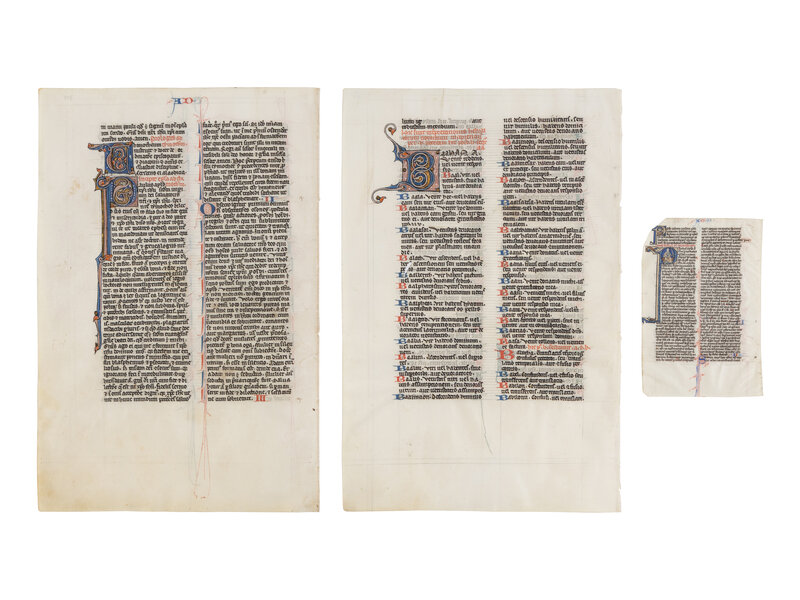
Two decorated leaves from the “Josephinum” Bible and one historiated leaf from a related Parisian pocket Bible, with an initial of Saint Paul, in Latin, illuminated manuscript on parchment [France, Paris, c. 1250]
Two decorated leaves from the “Josephinum” Bible and one historiated leaf from a related Parisian pocket Bible, with an initial of Saint Paul, in Latin, illuminated manuscript on parchment [France, Paris, c. 1250]
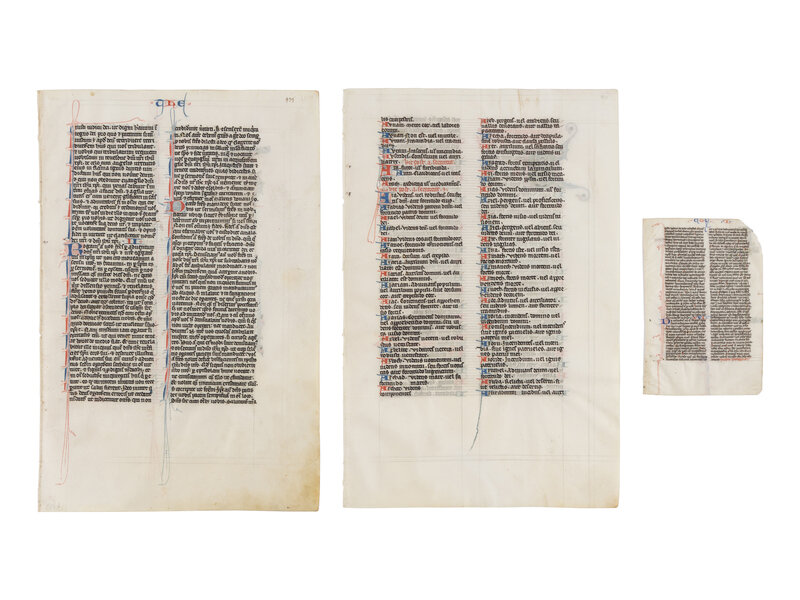
Ensemble of Bible leaves by the Johannes Grusch atelier, two decorated and one historiated.
(i-ii) Two decorated leaves from the “Josephinum” Bible
c. 290 × 190. Two leaves ruled in fine plummet for double columns of fifty lines (justification: 192 × 125 mm), faint pricking visible along the margins, later foliation in the upper margin “523” and “474,” written in a small Gothic textualis in black ink, highly abbreviated and precise, rubrics in red, verse initials, chapter numbers, and running headings are executed in alternating red and blue capitals. One leaf (f. 474) with two pen-flourished bar borders in alternating red and blue with extensions to upper and lower margins; minor initials of one and two lines with delicate pen-flourishes in the contrasting color, extending into margins. Three large painted initials of six and seven lines in pink and blue with white filigree on burnished gold ground, with foliate sprays extending into margins; one initial inhabited with a grotesque sprouting from coiling acanthus leaves and a second grotesque emanating from the letter tail extending the length of the margin. Minor smudging to margins and slight cockling, else in excellent condition.
Produced in Paris by the renowned atelier of Johannes Grusch, these two leaves derive from the same parent manuscript known as the “Josephinum” Bible (also associated with the so-called Saint-Geneviève Bible). This thirteenth-century Bible was dispersed following its sale at Christie’s on 26 June 1996 (lot 14). The parent volume contained 552 leaves and was once nearly complete; the core 73-leaf fragment now resides at the Pontifical College Josephinum in Ohio (MS1). Both leaves exhibit the fine execution and subtle flourished initials characteristic of Grusch’s atelier, known for its compact Parisian Gothic script, vibrant rubrication, and elegantly extended penwork in blue and red, including a pen-flourished bar border in alternating red and blue with extensions to upper and lower margins.
The first leaf (originally f. 523) derives from the Interpretationes nominum Hebraicorum originally appended to the end of this Bible. It consists of an alphabetized glossary of Hebrew names found in Scripture, accompanied by short Latin translations or etymologies. This page begins the index for ‘B’ with the large illuminated initial, followed by Latin glosses in alphabetical order: Balaam – absens populi sui vel devorans populum, then continuing entries for “Baladan,” “Balaath,” “Balaia,” “Balaan,” etc. The second leaf (originally f. 474) bears two initials: the first an ‘O’ beginning Omnes quidem homines volunt salvari, which begins a short Glossa ordinaria, a commentary text that often appears surrounding or interleaved with the biblical text. This is then followed by a second, even more impressive initial ‘P’ inhabited by twirling vines with a grotesque that begins the book for I Timothy: Paulus apostolus Christi Iesu secundum imperium Dei Salvatoris nostri.
Provenance
(1) Although traditionally linked to the Abbey of Saint Geneviève in Paris, recent research has cast doubt on this association. A document once pasted inside the front cover of the parent manuscript—addressed to the abbot and prior of the Abbey and dated 1224—was long thought to support the connection. However, analysis by Ohio State University, which holds the original binding and flyleaves, has revealed the document to be a modern facsimile. There is no direct evidence confirming that the Bible was ever associated with the Abbey. A fragment of another manuscript, pasted to the rear flyleaf, contains the word “volumine” and the date 1247. This date was also inscribed on the upper cover, likely in the nineteenth century.
(2) Additional nineteenth-century provenance in the parent manuscript includes an illegible library stamp and collation notes in Italian written inside the back cover.
(3) Parent manuscript sold at Christie’s London, June 26, 1996, lot 14.
(4) Charles Puckett, Akron (OH). Inventory numbers: IM 5486 and IM 2344.
(5) Private Collection, California, USA.
Parent manuscript and Sister leaves
These leaves are folios 523 and 474 from what was once a largely intact thirteenth-century Bible sold at Christie’s on 26 June 1996 (lot 14), described as comprising 552 leaves (lacking 24). The manuscript was broken up shortly after the Christie’s sale, most likely by the American manuscript dealer Bruce Ferrini. A substantial fragment of 73 leaves from this Bible is now housed at the Pontifical College Josephinum in Columbus, Ohio (Josephinum MS1). Additional leaves from the Bible are also dispersed across institutions and private collections worldwide. A comprehensive study by Rose McCandless (2021) documents the manuscript’s history and subsequent dispersal, identifying approximately fifty known leaves, with these leaves unlisted. Notably, additional leaves unidentified by McCandless with historiated initials surfaced at auction in Paris, May 2023, and Chicago, June 2024. Four additional leaves are in the McCarthy Collection (Kidd 2021, no. 36).
(iii) A historiated leaf from a Paris Pocket Bible
123 × 81 mm. Single leaf from a Parisian pocket Bible, ruled in plummet for two columns of forty-seven lines (justification: 91 × 58 mm), written in a minute Gothic textualis in dark brown ink. Rubrics in red, with versal initials and running headers alternating in red and blue, each accented with fine pen flourishing in the contrasting color that scrolls elegantly into the margins. One inhabited initial, six lines high, painted in rose and blue with a marginal extension terminating in a zoomorphic grotesque, likely a dragon. One historiated initial, ten lines high, painted in rose and blue on a burnished gold ground, featuring Saint Paul holding a sword and scroll, his traditional attributes. The gold ground is enriched with white filigree and marginal vine terminals. Trimmed with minor losses to the marginal spray below, upper left corner torn with partial loss to the zoomorphic initial; otherwise well preserved with vibrant pigment and strong text block.
This leaf is from an exceptionally small portable Bible. The illumination is characteristic of the first hand of the Johannes Grusch atelier, as defined by Robert Branner (1977). Notable features include the chalky white modeling of Paul’s face, crisp linear outlines, and restrained yet sophisticated decoration. These elements are consistent with the output of the Grusch workshop, active in Paris c. 1235–1270, renowned for producing both full-format and miniature Bibles. This leaf forms part of a Paris pocket Bible, a format developed in the early thirteenth century to meet the needs of clergy, friars, and scholars, particularly within the intellectual milieu of the University of Paris. These portable Bibles were prized for their compact format, thin parchment, and highly compressed scripts, often produced in workshops such as that of Johannes Grusch. Their durability and uniformity facilitated travel, preaching, and study. The leaf contains the opening of II Corinthians, with an initial ‘P’ opening: Paulus apostolus Christi Iesu secundum imperium Dei salvatoris nostri.
Provenance
(1) Private Collection
LITERATURE
On the parent manuscript (of nos. i-ii), Rose McCandless, “Seeing the Exceptional in the Unexceptional: Reconstructing the Josephinum Bible,” Undergraduate Thesis, Ohio State University, 2021; Peter Kidd, The McCarthy Collection, London, 2021, vol. 3, no. 36; Robert Branner, Manuscript Painting in Paris During the Reign of Saint Louis: A Study of Styles, Berkeley, 1977, pp. 82–93; Related Literature: Laura Light, “French Bibles c. 1200–1230: A New Look at the Origin of the Paris Bible,” in The Early Medieval Bible: Its Production, Decoration and Use, ed. Richard Gameson, Cambridge, 1994, pp. 155–76; Laura Light, “The Thirteenth Century and the Paris Bible,” in The New Cambridge History of the Bible, ed. Richard Marsden and E. Ann Matter, Cambridge, 2012 vol. 2, pp. 380–9; Chiara Ruzzier, “The Miniaturisation of Bible Manuscripts in the Thirteenth Century: A Comparative Study,” in Form and Function in the Late Medieval Bible, ed. Laura Light and Eyal Poleg, Leiden, 2013, pp. 105–25.
We thank Senior Consultant Sandra Hindman and Peter Bovenmyer for their assistance in preparing this sale.
This lot is located in Chicago.