Condition Report
Contact Information
Auction Specialists
Lot 22
Sale 6388 - Western Manuscripts and Miniatures
Jul 8, 2025
10:00AM CT
Live / Chicago
Own a similar item?
Estimate
$1,800 -
2,000
Price Realized
$1,664
Sold prices are inclusive of Buyer’s Premium
Lot Description
PARIS WORKSHOPS (DOMINICAN PAINTER active c. 1230–1250; JOHANNES GRUSCH ATELIER, active c. 1235–1270)
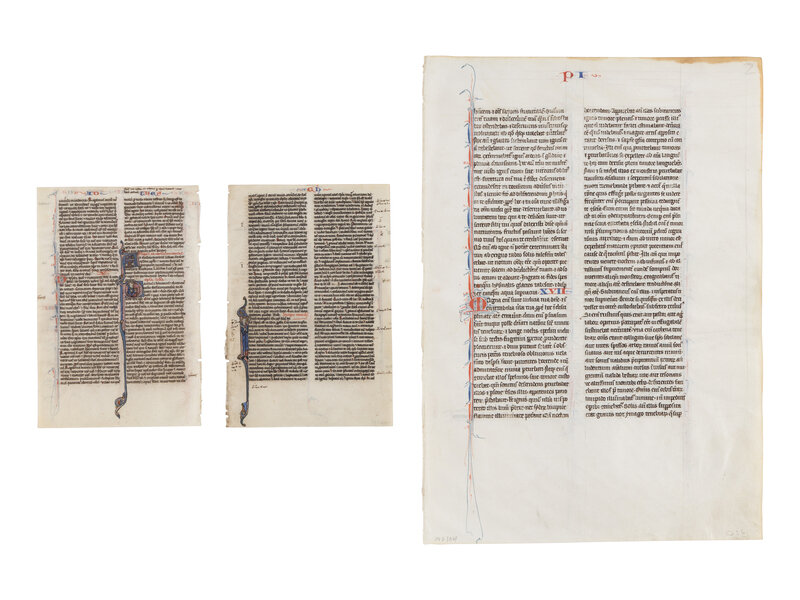
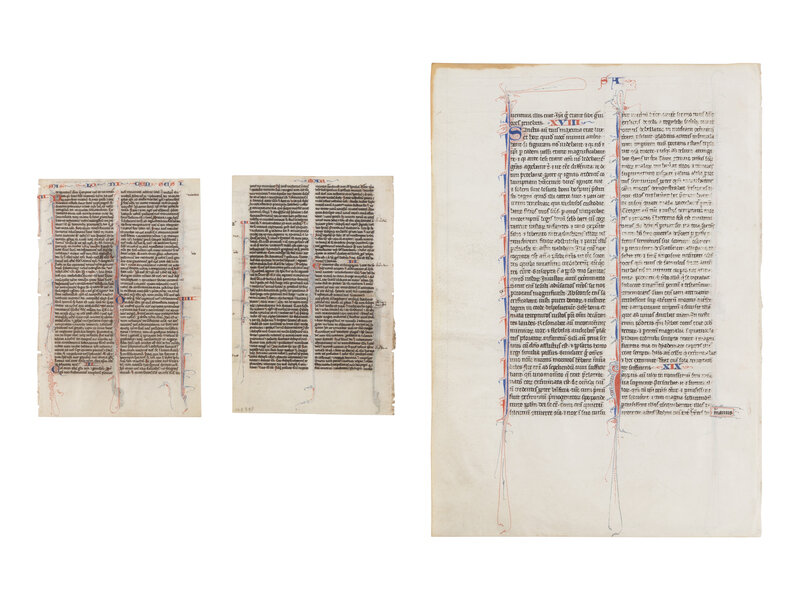
Three leaves from a Bible, with two historiated initials, Saints Paul and Saint Mark, in Latin, illuminated manuscript on vellum [France, Paris, c. 1240–1260]
Three leaves from a Bible, with two historiated initials, Saints Paul and Saint Mark, in Latin, illuminated manuscript on vellum [France, Paris, c. 1240–1260]
Showcases the refined visual and textual innovations of mid-thirteenth-century ateliers central to the production of deluxe Gothic Bibles for scholastic and monastic use.
(i)two leaves from the Johannes Grusch Atelier
151 × 103. Two leaves, ruled in plummet, written in two columns of fifty lines (justification: 117 × 78 mm) in a precise Gothic textura, with red and blue pen-flourished initials throughout, marginal glosses in contemporary hand, decoration includes marginal extensions of red and blue penwork terminating in fine tendrils and grotesques, decorative initials in contrasting tones of red, blue, and gold, and running headers in blue and red capitals. TWO HISTORIATED INITIALS with a portrait of Saint Paul holding a sword, enclosed in a columnar band of gold and blue acanthus with fine foliate terminals and the second with a portrait Saint Mark, and his lion symbol, both with letter forms trailing into lower margins and terminating in floral sprays with burnished gold. Minor stains and marginal repairs, but overall excellent condition with crisp vellum and strong ink.
The Johannes Grusch Atelier (active Paris, c. 1235–1270) was one of the leading Parisian workshops specializing in deluxe university-format Bibles, known for their elegant design, disciplined Gothic script, and vivid historiated initials with elongated vertical descenders. The historiated initials of Mark (initial ‘I’) and Paul (initial ‘P’) on these leaves exemplify the workshop’s refined figural style, ornamental play of text and image. These passages include the Opening of the Gospel of Mark (Mark 1–3:12) and Pauline second epistle to the Thessalonians with exegetical glosses, reflecting the scholastic use of such manuscripts.
(ii)one leaf by the Dominican Painter
302 × 210 mm. Single leaf from a substantially larger Bible, ruled in plummet for two columns of forty-one lines (justification: 195 × 128 mm), catchword present in lower margin of verso, additional double bounding lines and pricking marks faintly visible at the outer margin, written in Gothic textura in dark brown ink, red and blue initials (1–2 lines high) introducing chapter divisions and verse breaks, many with flourishing that extends into the margin in penwork of the contrasting color, marginal flourishes also incorporate vertical vines, finials, beaded scrollwork, chapter numbers in alternating red and blue Lombard capitals, headers in red and blue capitals. Parchment supple and of excellent quality, exhibiting only minor yellowing and darkening at the upper margin from earlier binding exposure.
The so-called Dominican Painter (active c. 1230–1250) is recognized for his lively linework, expressive faces, and inventive marginalia, and played a key role in shaping the visual language of Dominican-produced Parisian Bibles. This leaf contains an excerpt from Proverbs 10–12.
Provenance:
(1) Produced in Paris, likely in the vicinity of the Dominican studium on the Rue Saint-Jacques, mid-13th century.
(2) Bruce Ferrini, Akron, Ohio, sold individually as MS301, MS303, and MS304.
(3) Private Collection, California, USA.
Parent manuscript and sister leaves:
A parent manuscript has not been identified for these leaves.
LITERATURE:
Unpublished; for the ateliers of the Dominican Painter and Johannes Grusch see: Robert Branner, Manuscript Painting in Paris During the Reign of Saint Louis: A Study of Styles, Berkeley, 1977; Robert Branner, “The Johannes Grusch Atelier and the Continental Origins of the William of Devon Painter,” The Art Bulletin 54 (1972), pp. 24–30; Robert Branner, “The Grusch Atelier and Its Position in Parisian Book Illumination,” in Art the Ape of Nature: Studies in Honor of H. W. Janson, ed. Moshe Barasch and Lucy Freeman Sandler, New York, 1981, pp. 47–58; Michael A. Michael, “Urban Production of Manuscript Books and the Role of the University Towns,” in The Cambridge History of the Book in Britain, vol. 2, Cambridge, 2008, pp. 168–194; Laura Light, “The Thirteenth Century and the Paris Bible,” in The New Cambridge History of the Bible, vol. 2, Cambridge, 2012, pp. 380–391; Laura Light, “What Was a Bible For? Liturgical Texts in Thirteenth-Century Franciscan and Dominican Bibles,” Lusitania Sacra 34 (2016), pp. 165–182.
We thank Senior Consultant Sandra Hindman and Peter Bovenmyer for their assistance in preparing this sale.