To request further details about this lot, please email Fineart@freemansauction.com
Please email Fineart@freemansauction.com for any additional information or questions you may have
Sale 6500
| New York
| New York
To request further details about this lot, please email Fineart@freemansauction.com
Please email Fineart@freemansauction.com for any additional information or questions you may have
Estimate$100,000 – $150,000
Provenance:
The Estate of Andy Warhol
The Andy Warhol Foundation for the Visual Arts, Inc., New York
Sold: Christie's, New York, 2012
Acquired from the above auction by the present owner
Literature:
"Church is a fun place to go” (A. Warhol, quoted in P. Taylor, "Andy Warhol: The Last Interview," reprinted in Andy Warhol: The Late Work, exh. cat., Düsseldorf, 2004, p. 121).
Lot note:
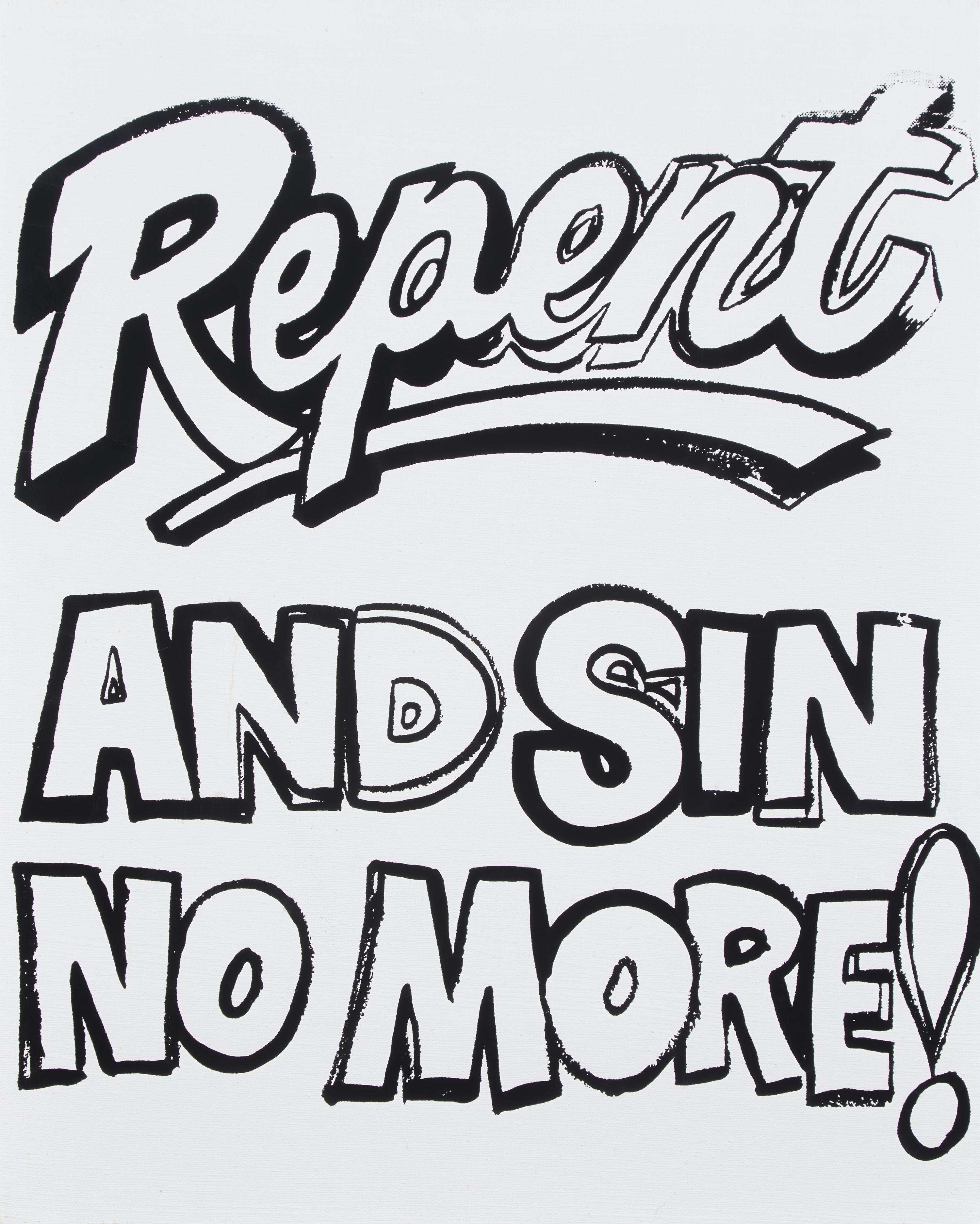
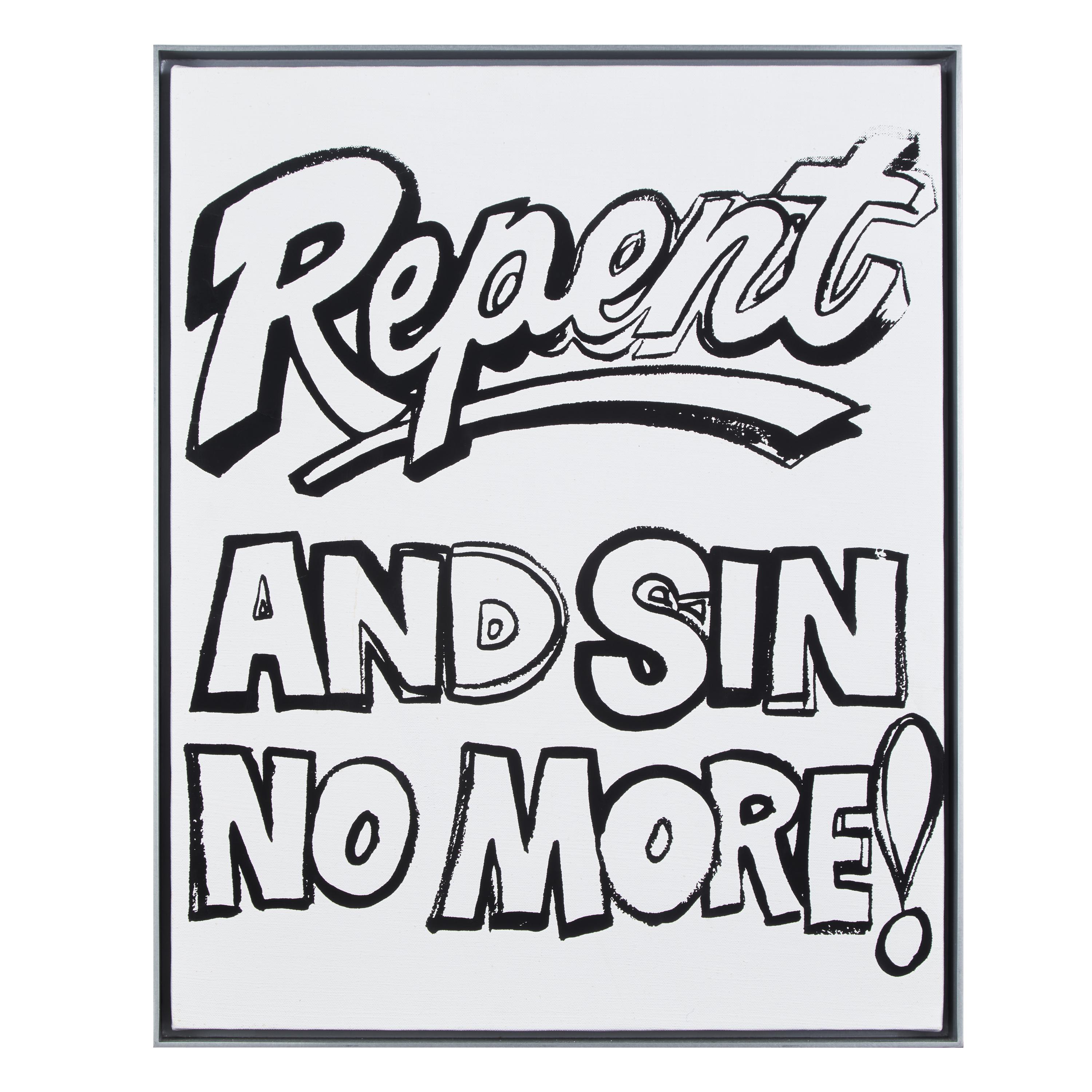
Andy Warhol's Repent and Sin No More (Positive) demonstrates the artist's ability to transform religious subject matter into iconic Pop Art. Employing his signature silkscreen technique, Warhol treats biblical language with the same mechanical reproduction process applied to commercial imagery and mass advertising, creating a provocative tension between the sacred and secular.
Indeed, the title's religious imperative—Repent and Sin No More—evokes moral instruction, while the designation (Positive) refers to Warhol's photographic process, emphasizing the industrial nature of the work's production. Moreover, silkscreening was originally used for industrial labeling and advertisements. This technical language and semantics reflect Warhol’s broader aim of revealing the commercial techniques that shape visual culture at large, particularly in America.
Warhol's engagement with religious themes reflected his complicated personal faith. He approached spiritual subjects with characteristic duality. His observation that "Church is a fun place to go" reveals both genuine attraction to religious spaces and his tendency to frame sacred experiences through entertainment and pleasure (A. Warhol, quoted in P. Taylor, "Andy Warhol: The Last Interview," reprinted in Andy Warhol: The Late Work, exh. cat., Düsseldorf, 2004, p. 121). This perspective illuminates how Repent and Sin No More (Positive) treats religious language with both reverence and ironic distance.
The work demonstrates Warhol's prescient understanding of the ways in which moral messages circulate in a media-saturated society. By presenting the imperative to "repent" through mass reproduction techniques, Warhol anticipated how spiritual discourse would operate through the same channels as advertising and entertainment in American popular culture.
Repent and Sin No More (Positive) reveals how Warhol employed Pop Art strategies to explore fundamental human concerns: morality, spirituality, and redemption—through visual language. The result is a work that functions simultaneously as pop artifact and spiritual meditation, embodying the contradictions that make Warhol's art so compelling, enduring, and impactful.
Framed: 20 3/4 x 16 3/4 inches.
Please contact fineart@freemansauction.com for a detailed condition report.
The physical condition of lots in our auctions can vary due to age, normal wear and tear, previous damage, and restoration/repair. All lots are sold "AS IS," in the condition they are in at the time of the auction, and we and the seller make no representation or warranty and assume no liability of any kind as to a lot's condition. Any reference to condition in a catalogue description or a condition report shall not amount to a full accounting of condition. Condition reports prepared by Freeman's staff are provided as a convenience and may be requested from the Department prior to bidding.
The absence of a posted condition report on the Freeman's website or in our catalogues should not be interpreted as commentary on an item's condition. Prospective buyers are responsible for inspecting a lot or sending their agent or conservator to inspect the lot on their behalf, and for ensuring that they have requested, received and understood any condition report provided by Freeman's.
Please email Fineart@freemansauction.com for any additional information or questions you may have regarding this lot.