To request further details about this lot, please email Fineart@freemansauction.com
Please email Fineart@freemansauction.com for any additional information or questions you may have
Sale 6500
| New York
| New York
To request further details about this lot, please email Fineart@freemansauction.com
Please email Fineart@freemansauction.com for any additional information or questions you may have
Estimate$150,000 – $250,000
Provenance:
ACA Galleries, New York
G.R. N’Namdi Gallery, Chicago
Acquired from the above by the present owner
Lot note:
In his one hundred years on this Earth and eight decades devoted to art making, Richard Mayhew (American, 1924-2024) left an indelible mark on the world he represented so beautifully in his lyrically colored, ethereal landscapes, which uniquely synthesized the painterly languages of abstraction and objectivity. Born in Amityville, New York, in 1924 to parents of Native and African American ancestry, Mayhew fittingly and foreshadowing his future output first drew artistic inspiration from the moody atmospheric canvases of Tonalist George Inness, the figurative father of American landscape painting, during boyhood trips to New York City museums with his mother. As a teenager, Mayhew honed his artistic skills, specifically his observational draftsmanship, training as a medical illustrator, before having his educational journey interrupted by service in the Marines during World War II. Mayhew’s immediate Post War years saw him return to his studies, enrolling in academic courses at Columbia University and studio classes at the Art Students League of New York and the Brooklyn Museum Art School, while supporting himself with work as a jazz singer and painting decorative patterns on porcelain China. Mayhew entirely turned his attentions to the visual arts as his primary mode of expression following his first solo exhibition in 1955 and a return to Europe, this time for enlightening scholarship, on a John Hay Whitney Fellowship in 1958. After returning stateside, Mayhew impactfully became a foundational member of Spiral, a creative collective of African American artists that included Romare Bearden, Norman Lewis, Charles White, and Hale Woodruff, among others, and became a forum for exploring the Civil Rights Movement’s impact on the respective artists and the role their art practices could play in promoting the cause.
Inspired by the socially conscious concerns of his work with Spiral, Mayhew came to believe that art could serve as the great unifier, with true equality achieved through the shared emotion expressed and observed in the beauty of pigment and shapes composed on the surface of an artwork. Using the literal common ground of the landscape as an anchoring framework, Mayhew established a visionary visual language that distills the diverse, essential experiences of both his historically oppressed heritages through sublimely saturated, abstractly rendered liminal natural spaces, in hopes of achieving a greater understanding and equitable empathy for all aspects of individual and universal humanity. These painted environments, poignantly devoid of figural subjects, demonstrate a ubiquitous dichotomy of hope and pain, with the emptiness displayed ambiguously open to interpretation, either reflecting the potential for progressive occupation or the loss of those removed from the static scene. In content and concept, we see that the sky, fields, and trees were here before us and will remain after us, and the knowledge of this reality is so powerfully human; it is this that Mayhew meaningfully captures in his poetically transcendent paintings.
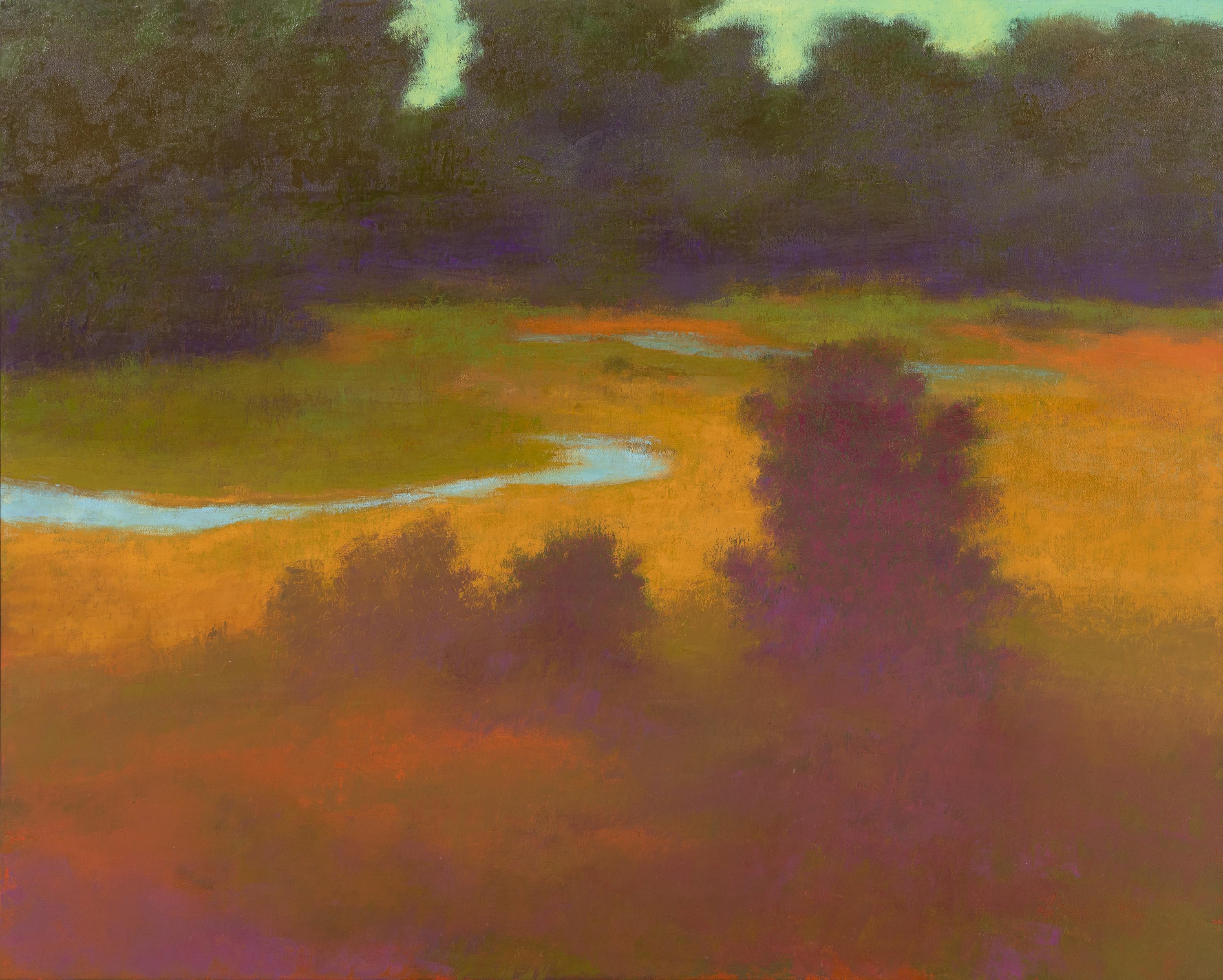
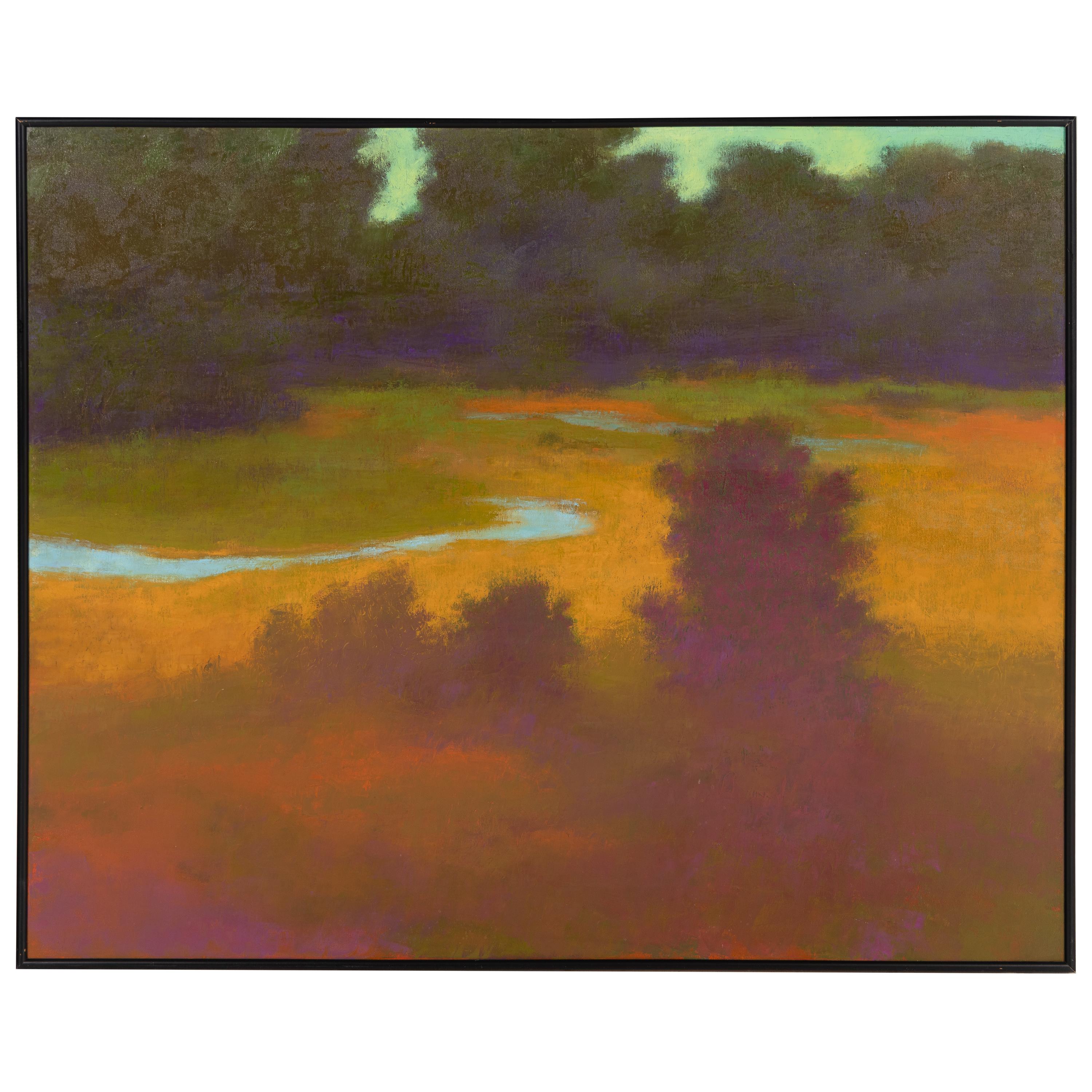
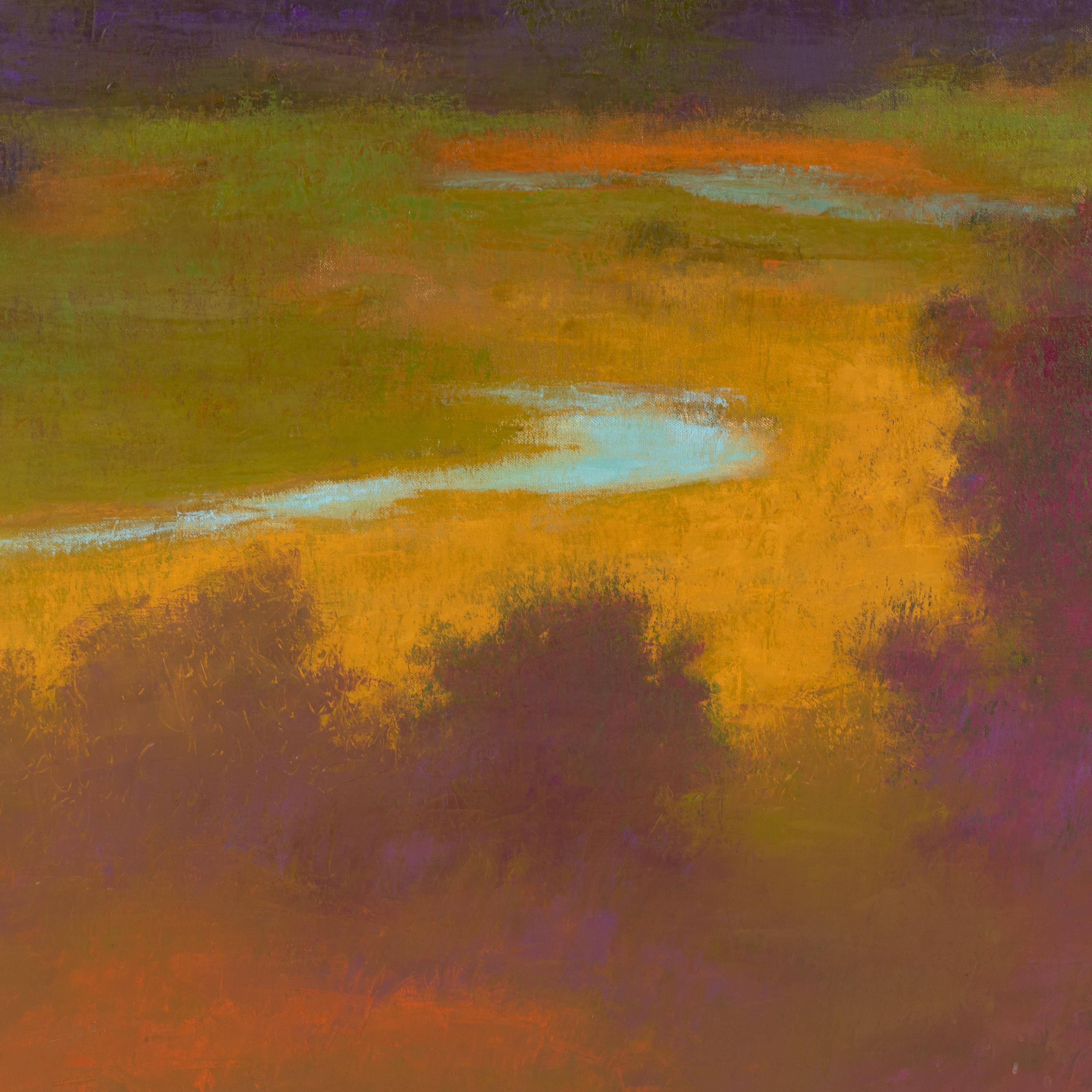
Painted at the dawn of a new millennium and amid the autumn of Mayhew’s life, in Finale, 2001, we see a mature artist at the peak of his powers, flexing his creative muscles while employing his full repertoire of painterly tricks. This dazzling work depicts a hazy mirage, the fuzzy frequency of memory, a vivid otherworldly dancing dreamscape, at once invitingly comfortable and unsettlingly ominous, either way a magnetically attractive place to be, all set for the final act, as the title would suggest. In the frontstage foreground, fiery foliage in orange, magenta, and purple blazes vibrantly, rhythmically vibrating against a soft landing of buttery yellow pillows and smudgy smears of pale green; a spotlit playfield, an open arena poised for a punctuating performance. A seductive ribbon of a sultry blue stream winds through the central plane, tracing a path and drawing the viewer’s gaze deeper into the hypnotic hues of the introspective created realm. Providing a tethering backdrop is a weighty wall of trees, deeply toned and gestural, giving gravitas to the scene as the transportive gloaming of the magic hour blue punctures the dark leaves, both lightening the mood and lighting the stage, signaling that soon the curtain will close. Planted firmly in naturalistic painterly perfection, Finale is a standalone class act, a masterwork and testament that there is truth in Mayhew’s belief that we can all come together as one to behold the magnificence of the collective conscious landscapes we all inhabit.
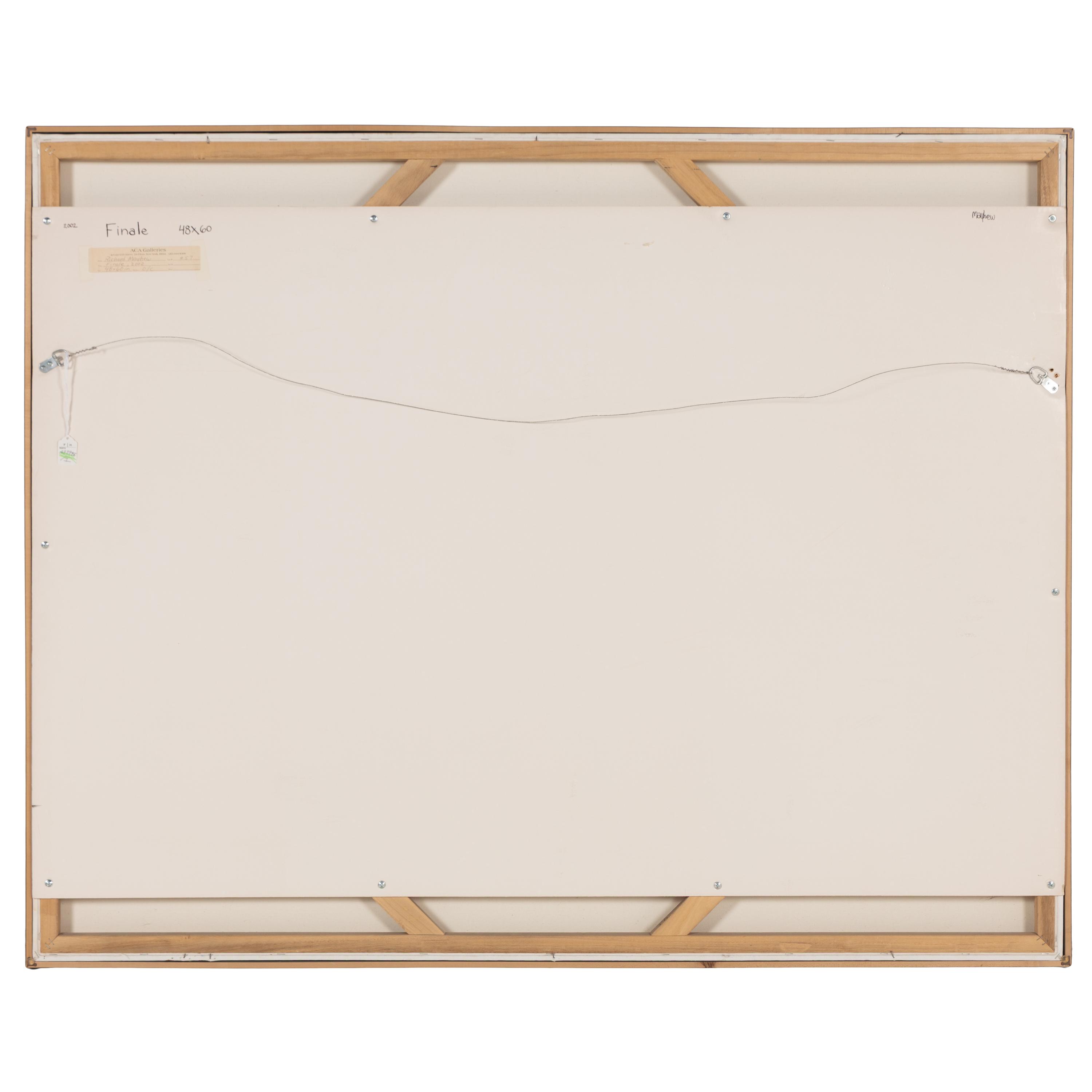
Framed: 49 x 61 inches.
Please contact fineart@freemansauction.com for a detailed condition report.
The physical condition of lots in our auctions can vary due to age, normal wear and tear, previous damage, and restoration/repair. All lots are sold "AS IS," in the condition they are in at the time of the auction, and we and the seller make no representation or warranty and assume no liability of any kind as to a lot's condition. Any reference to condition in a catalogue description or a condition report shall not amount to a full accounting of condition. Condition reports prepared by Freeman's staff are provided as a convenience and may be requested from the Department prior to bidding.
The absence of a posted condition report on the Freeman's website or in our catalogues should not be interpreted as commentary on an item's condition. Prospective buyers are responsible for inspecting a lot or sending their agent or conservator to inspect the lot on their behalf, and for ensuring that they have requested, received and understood any condition report provided by Freeman's.
Please email Fineart@freemansauction.com for any additional information or questions you may have regarding this lot.