To request further details about this lot, please email davidweiss@freemansauction.com
Please email davidweiss@freemansauction.com for any additional information or questions you may have
Sale 6484
| New York
| New York
To request further details about this lot, please email davidweiss@freemansauction.com
Please email davidweiss@freemansauction.com for any additional information or questions you may have
Estimate$50,000 – $70,000
The present Lot will be on view at Freeman's Upper East Side galleries located at 32 E. 67th St in New York, May 6-11, 10am-5pm weekdays; 11am-5pm Saturday, May 9; closed Sunday, May 10.
Provenance:
Sold: Christie's, New York, October 30, 2002, Lot 39
Acquired from the above sale by the present owner
Lot Essay:
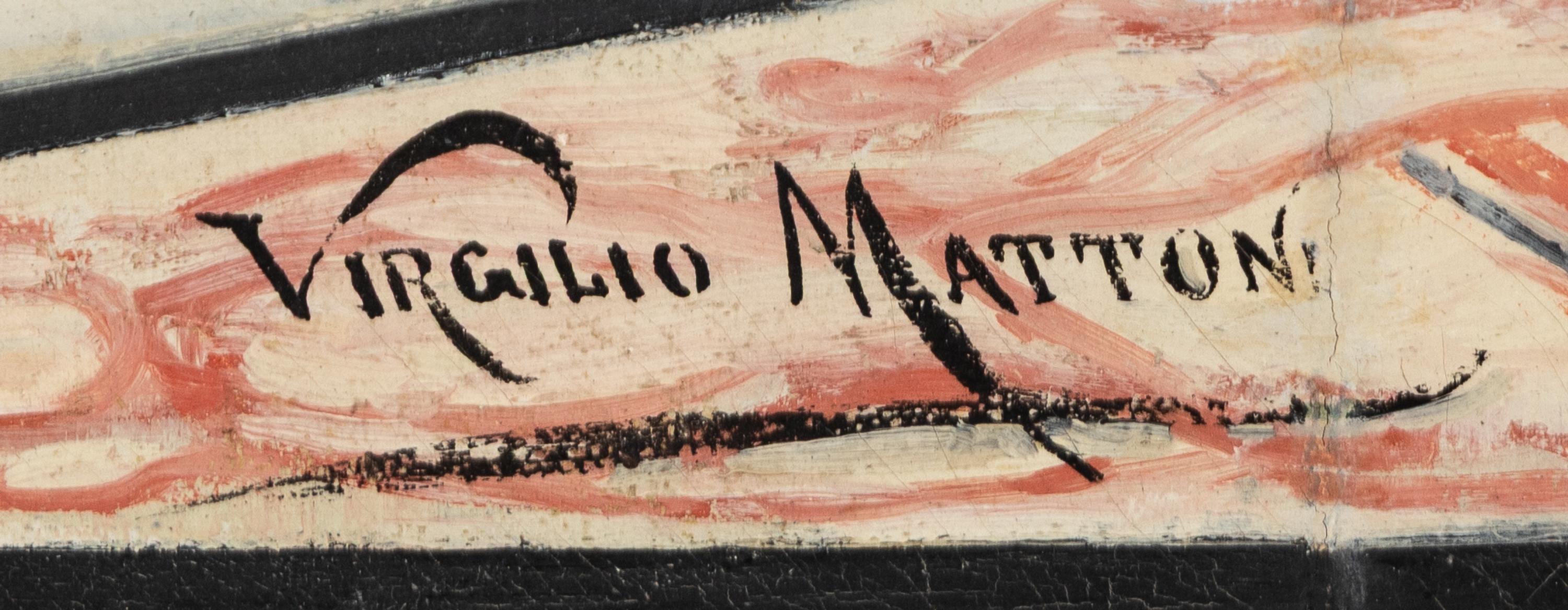
Born in Sevilla in 1842, Virgilio Mattoni was central figure in the modern Andalusian school of painters. He received his artistic training from 1856-68 at the Escuela de Bellas Artes under the tutelage of Joaquín Becquer and Eduardo Cano. After his graduation from the school, Mattoni took a two-year sabbatical in Rome, a trip that would prove influential to the rest of his career. Upon his return to Seville in 1874, he settled in a studio near the Alcazar and in 1886 he was made a member of the San Fernando Academy. Until about 1906, the artist taught drawing locally and was made Director of the Academy of the Applied Arts in 1917. In addition to a successful artistic career that embraced historical and religious scenes, as well as genre and portraiture, Mattoni was also recognized as a gifted writer and poet.
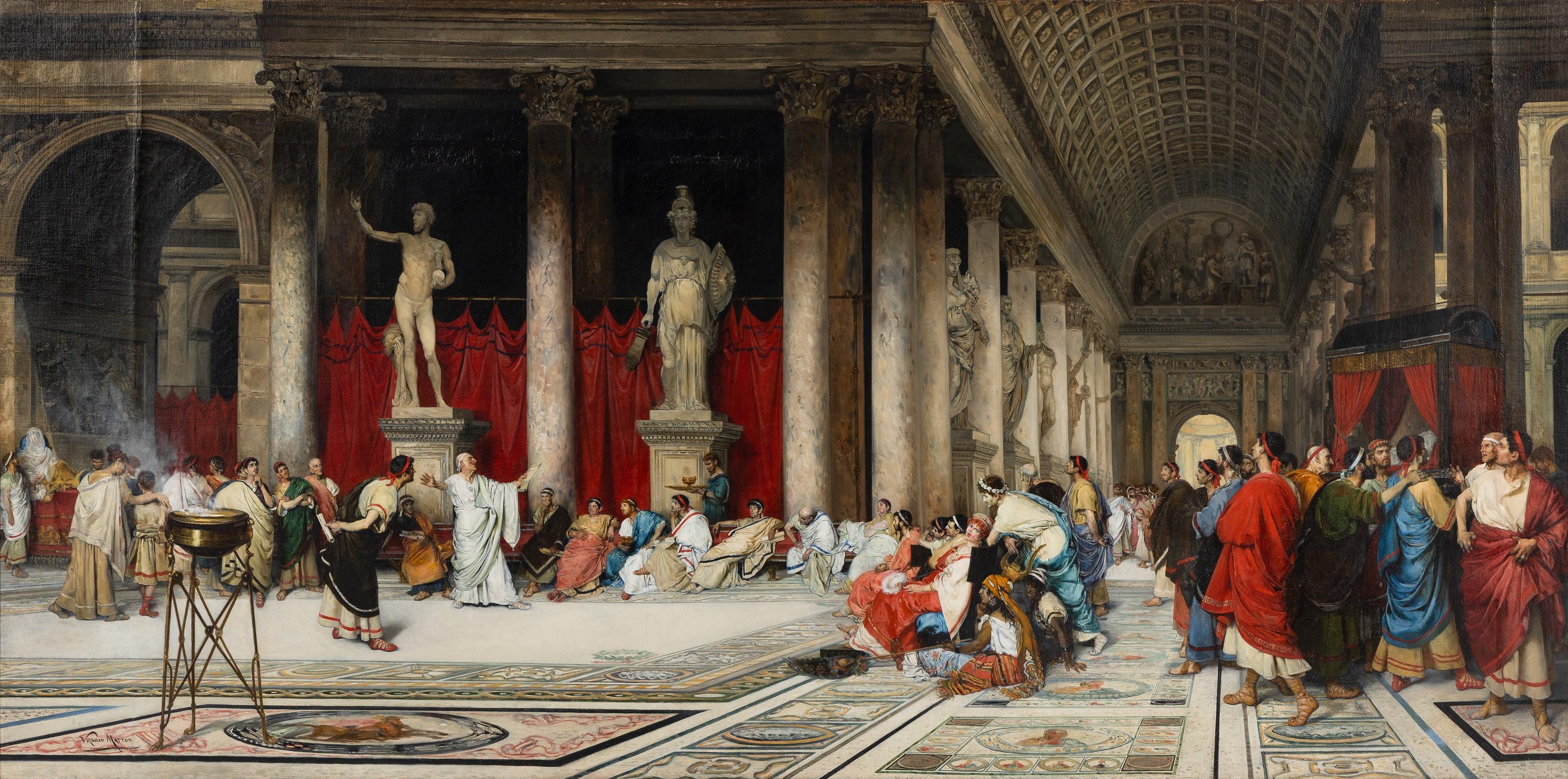
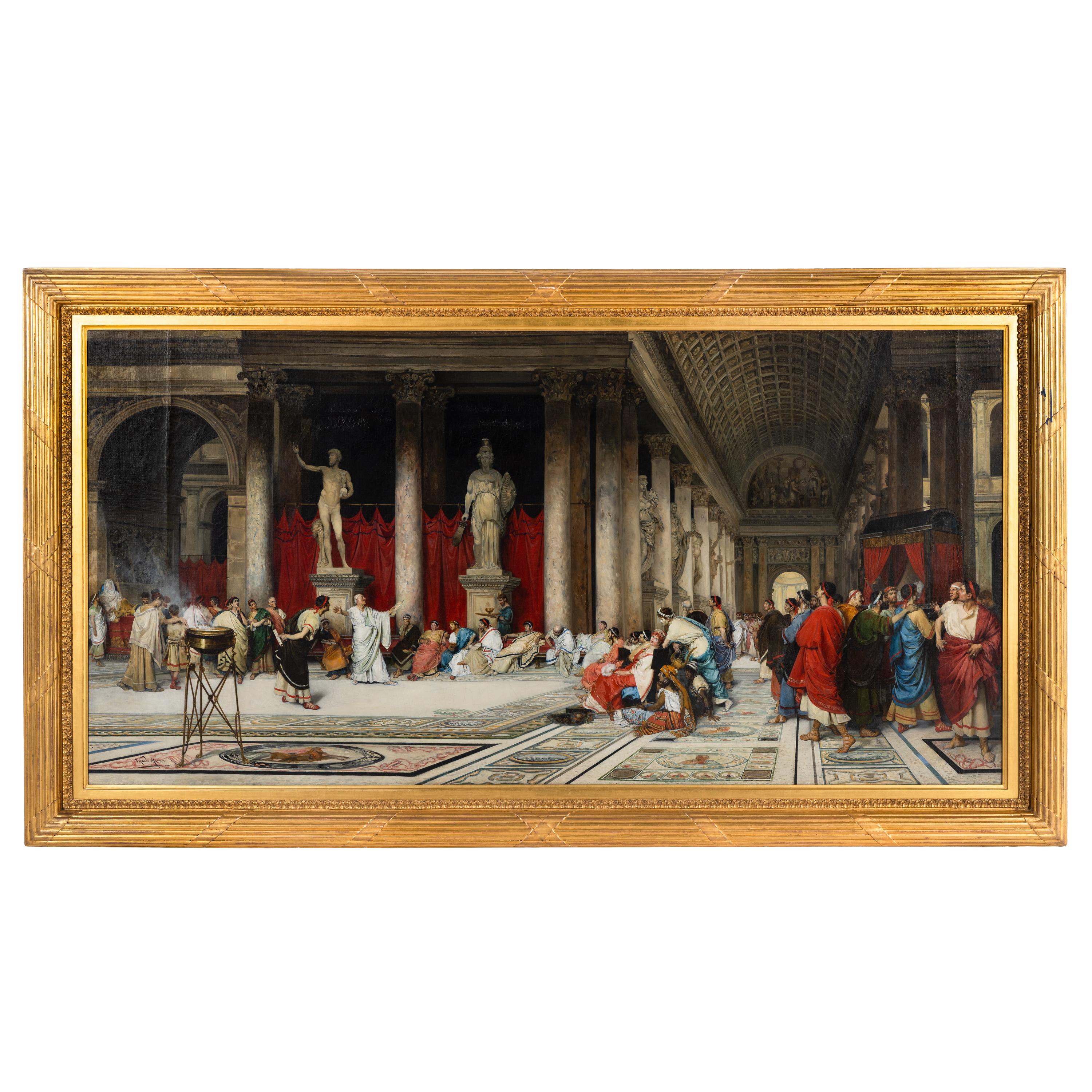
In the latter half of the 19th Century, artists aspired to visually recreate and revive the world of ancient Greece and Rome, which was in stark contrast to the depictions of crumbling ruins of ancient Greece and Rome which were en vogue in the late 18th and early 19th Century. The sumptuous interior of the present work represents this goal and it is certainly Mattoni's most important work. Although painted many years after his return from Rome, the present composition was likely inspired by his time in that city. An oil sketch of the present work, dated 1902, helps to place the dating of this work around the same period (sold Sotheby's, New York, March 18, 1998, lot 192).
Although efforts have been made to reconstruct the interior of the Roman Baths of Caracalla based on floor plans and contemporary descriptions, the information in Mattoni's day was extremely incomplete and his depiction does not match with any archeological data from the existing ruins. Nevertheless, the scene offers a highly embellished perspective of one of the most significant structures of Roman Imperial architecture. Built at the end of the short and turbulent reign of Emporer Caracalla in AD 217, which ended with his assassination, the Baths of Caracalla or Thermae Antoninianae was a sumptuously decorated complex, enclosed by gardens and open-air gymnasia. In addition to the facilities, it featured an art collection that included the famous Belvedere Torso and the Farnese Hercules. Up to 1,600 bathers could be accommodated under its huge domes and massive vaults. Ancient sources comment that while the baths were the main attraction, bathing was just one of many activities a visitor could engage in. The complex also doubled as an intellectual center with its library and gardens, and it functioned as an entertainment hall that hosted theatrical, musical, and sporting events.
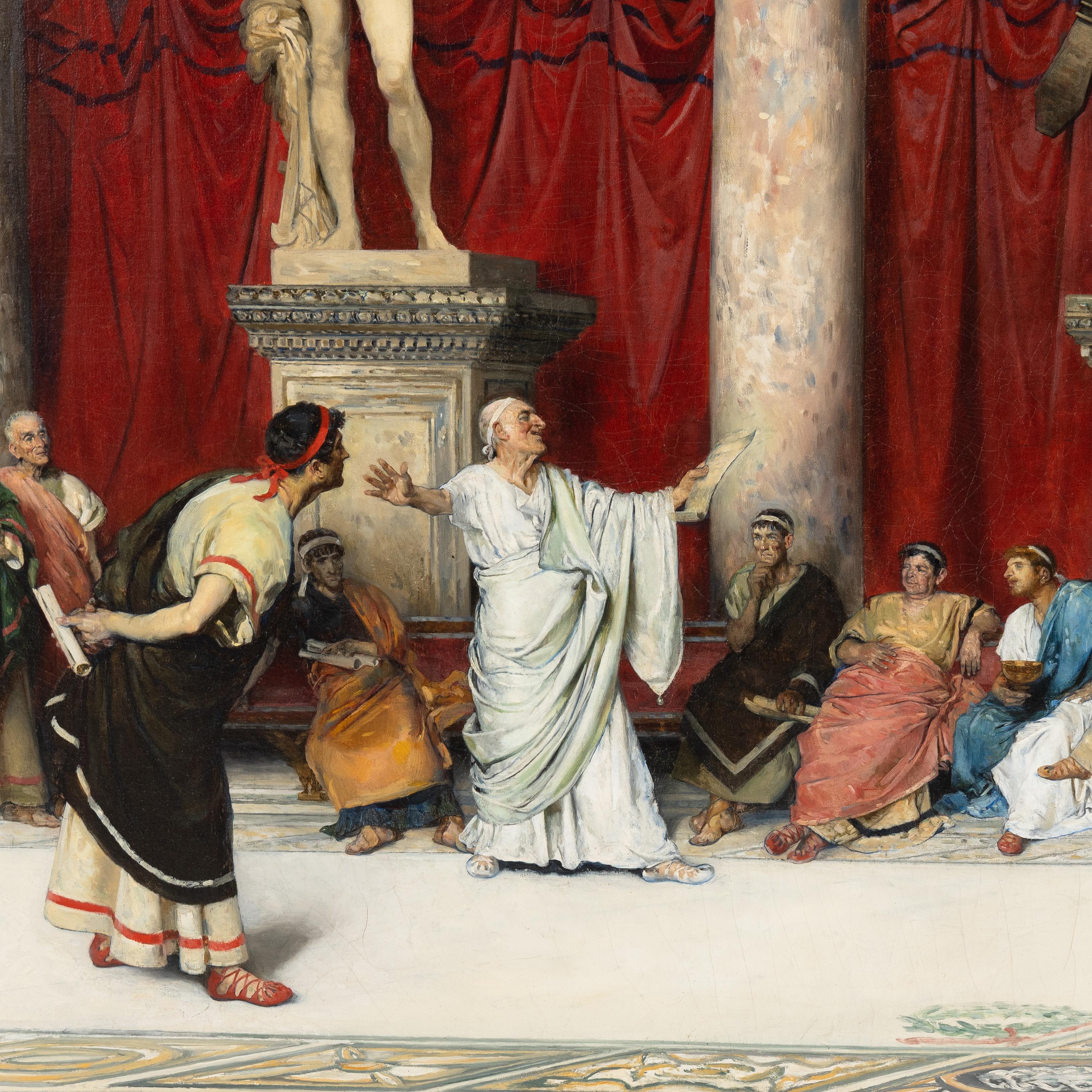
In the present work, Mattoni focuses on a group of figures who are either engaging in a lively debate or acting out roles in a dramatic play, attracting the attention of a curious audience. Although the majority of the characters are dressed liked upper class patricians, they do not make reference to any known individuals. These individuals seem altogether secondary, however, when compared to the artist's architectural fantastical recreation of the astounding interior. The commanding size of the cavernous hall, with its mosaic floor lined with giant statues from which Minerva and Flora can be recognized, is further emphasized by the addition of the long barrel vault that leads down another corridor to the right of the composition. Although it is not clear what specific archeological sources Mattoni may have consulted, apart from his visits to the ruins and ancient monuments of Rome, the artist probably had access to numerous publications, prints, and possibly photographs from which to draw inspiration.
Framed: 57 5/8 x 103 3/4 x 3 1/4 in.
The physical condition of lots in our auctions can vary due to age, normal wear and tear, previous damage, and restoration/repair. All lots are sold "AS IS," in the condition they are in at the time of the auction, and we and the seller make no representation or warranty and assume no liability of any kind as to a lot's condition. Any reference to condition in a catalogue description or a condition report shall not amount to a full accounting of condition. Condition reports prepared by Freeman's staff are provided as a convenience and may be requested from the Department prior to bidding.
The absence of a posted condition report on the Freeman's website or in our catalogues should not be interpreted as commentary on an item's condition. Prospective buyers are responsible for inspecting a lot or sending their agent or conservator to inspect the lot on their behalf, and for ensuring that they have requested, received and understood any condition report provided by Freeman's.
Please email davidweiss@freemansauction.com for any additional information or questions you may have regarding this lot.