To request further details about this lot, please email conditionreports@freemansauction.com
Please email conditionreports@freemansauction.com for any additional information or questions you may have
Sale 2720
| Philadelphia
| Philadelphia
To request further details about this lot, please email conditionreports@freemansauction.com
Please email conditionreports@freemansauction.com for any additional information or questions you may have
Estimate$25,000 – $40,000
After having laid down his internal torments by summoning strange creatures in charcoal on hundreds of sheets which he referred to as his Noirs (blacks), Odilon Redon initiated a shift in his career around the 1890s and started to add color to his palette. While color appeared in a very light and punctual manner in his early pastels, it became more solid, luminous, and poignant in his oils, particularly those from the turn of the 20th century. Becoming entirely devoted to oil painting, the artist never reconnected with his haunting Noirs, as if this chromatic transition from darkness to color symbolized a new aspiration for life, and happiness. Once a secretive, melancholic figure preoccupied by mankind's demise, Redon pivoted towards a warmer glow, a hopeful and broader horizon. This journey went with the incorporation of more classical subjects in his œuvre, such as characters and themes borrowed from ancient Greek and Roman mythology.
Among the Master's favorite subjects were Apollo, Pandora, Bellerophon and his winged companion Pegasus, as well as Orpheus, whom Redon adopted as a sort of alter-ego and represented many times. The present work features another literary hero, Oedipus, whose tragic adventures were narrated by the tragedian Sophocles (498-406 BC). At the time, to represent the Greek hero who killed his father and married his mother was, if not a bold, at least a significant choice. Aside from early Hellenistic art, the myth of Oedipus was very rarely depicted in fine painting. It was not until the late 18th century that the first depictions of the hero appeared in Europe, and especially in France. Even in the 19th century, which otherwise openly loved ancient mythology, Oedipus was not a common subject: there was too much incompatibility between the darkness of the hero's journey and the virtue and moral elevation that history painting–the noble genre under which all mythological subjects ranked–was supposed to convey.
Disregarded as a model of ancient virtue, Oedipus embodied an archaic Greece which the 19th century dismayed, and which therefore had no place in fine art. It took Ingres and the showing of his Oedipe Résout l’Énigme du Sphinx at the 1824 French Salon to officially coin the first portrayal of a proud, handsome and heroic Oedipus standing up to the monster blocking his access to the city of Thebes. Although Redon knew of this model, which entered the Louvre in 1878, another version made an even stronger impression on him, and to an extent inspired our painting: Œdipe et le Sphinx by Gustave Moreau, executed in 1864. As he confided to his friend Madame Holstein in 1900: “When I saw, for the first time, L'Œdipe et le Sphinx, when I was young; we were in full naturalism then, and how the work lulled me! I kept the memory of this first impression for a long time; perhaps it had the power to give me the strength to pursue a path alone.”
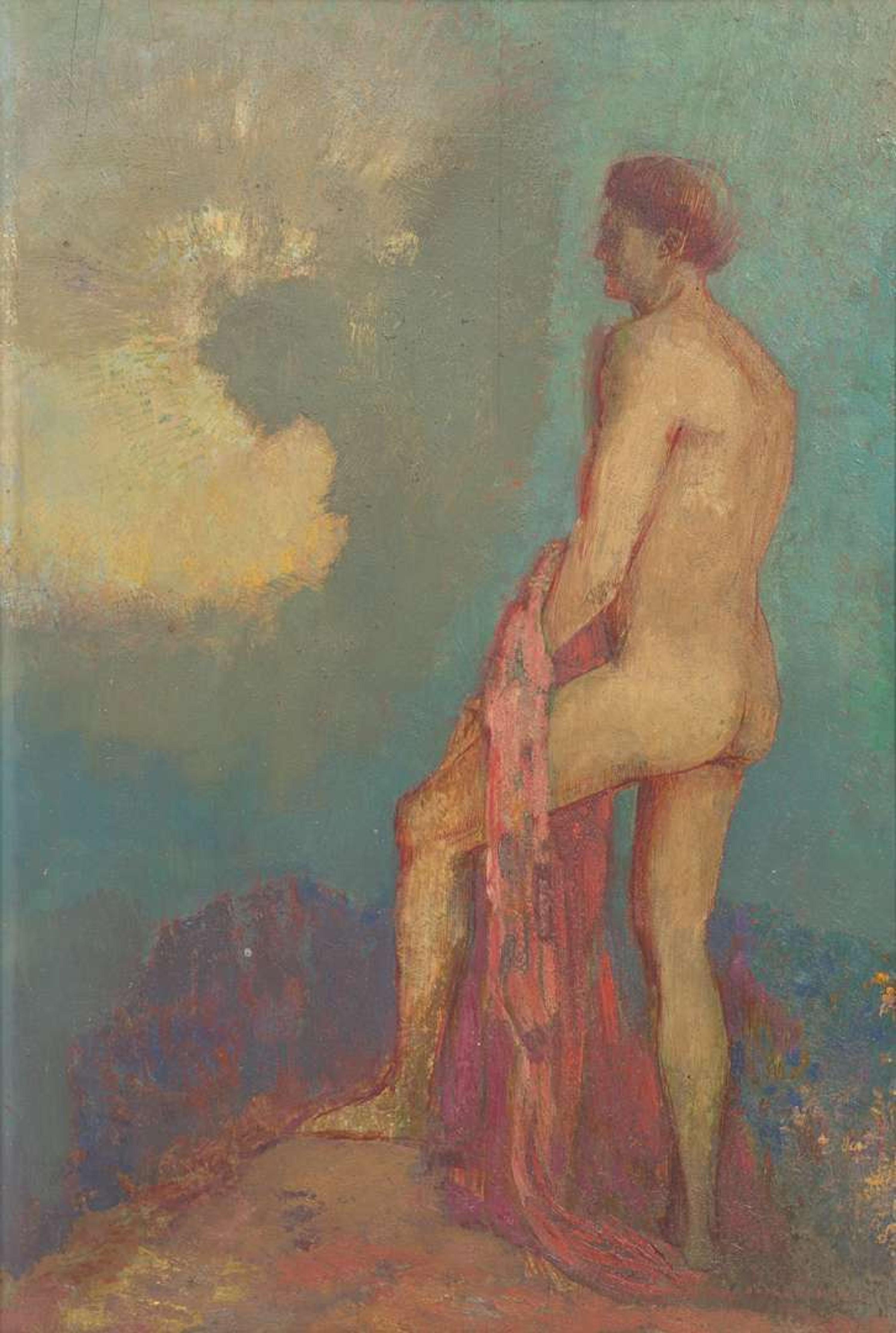
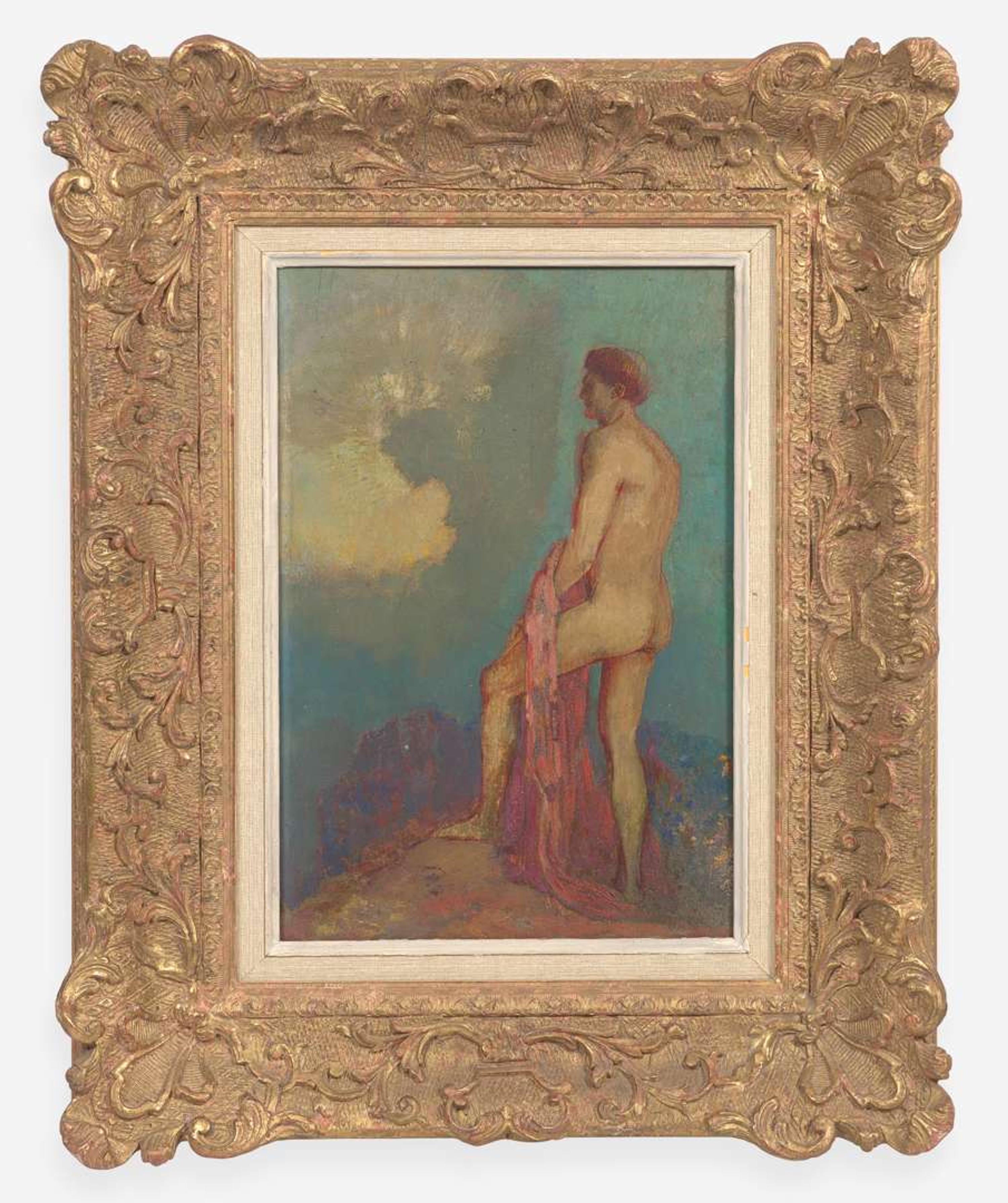
Unlike Ingres and Moreau, whose respective versions of the myth were replete with details, both in the decor and in the depiction of the characters, Redon strips his subject from any explicit reference to the myth. As described by the authors of Redon's Catalogue Raisonné, the present work only shows Oedipus, “standing in front of a luminous background... contemplating the world.” Without knowing its title, the subject would not be easily recognizable, and one could argue that the painting in fact depicts an academic nude standing against a colorful background. The setting gives us no clue: the mountainous landscape previously chosen by both Ingres and Moreau, and which was meant to show the arduous and dangerous entry into Thebes, here has disappeared. It has been replaced by an ambiguous landscape dominated by an immense azure sky, as well as a rocky platform dotted with strange, shapeless flora with underwater accents, which is reminiscent of Redon's obsession with the aquatic world. Here, the viewer finds himself trapped in a world that combines air, earth, and sea into one undetermined space which further confuses the viewer’s bearings.
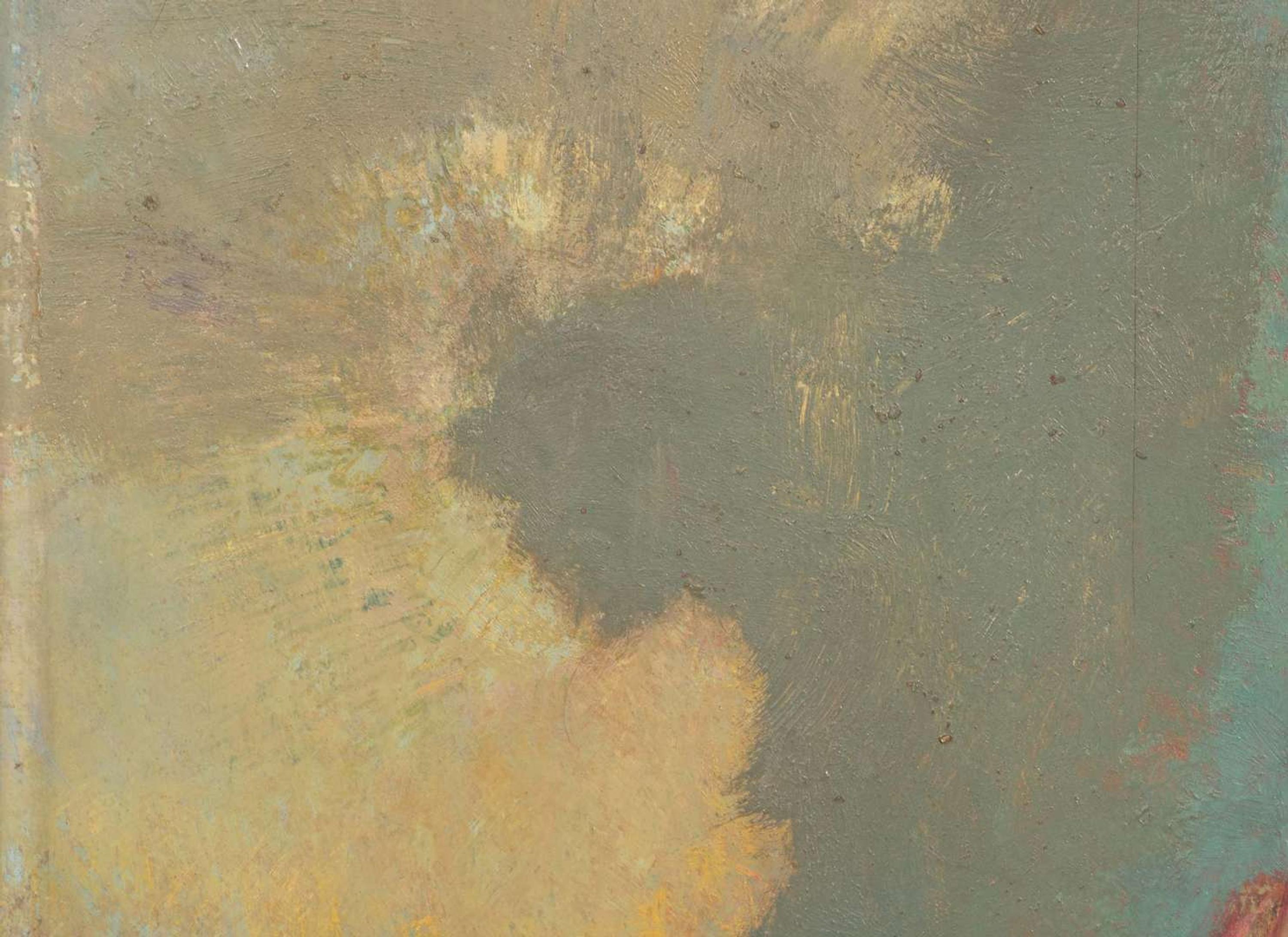
Judging from Oedipus’ demeanor however (he is firmly anchored to the ground in a very classicizing contrapposto), it seems that Redon in fact represents the Greek hero in the same critical moment chosen by Ingres and Moreau, that of the confrontation between Oedipus and the Sphinx, who asks any traveler crossing his path the famous riddle: What creature walks on four legs in the morning, two legs at noon, and three legs in the evening?, and who kills them if the answer is wrong (the answer to the riddle is the man, who–as a baby–crawls on four feet, walks as an adult on two, and limps as an elder on three, with the help of a cane). If that is the case however, one might wonder where the Sphinx lays? On closer inspection, his profile stands out to the left of the hero. Against a halo of golden light, a female silhouette stands out, which recalls the human part of the creature, including its bosom. The monster is nothing more than a shadow, a tenuous apparition ready to plunge into darkness: it has been defeated, Oedipus just answered the enigma, signaling the death of the beast, which according to myth throws itself from a rock.
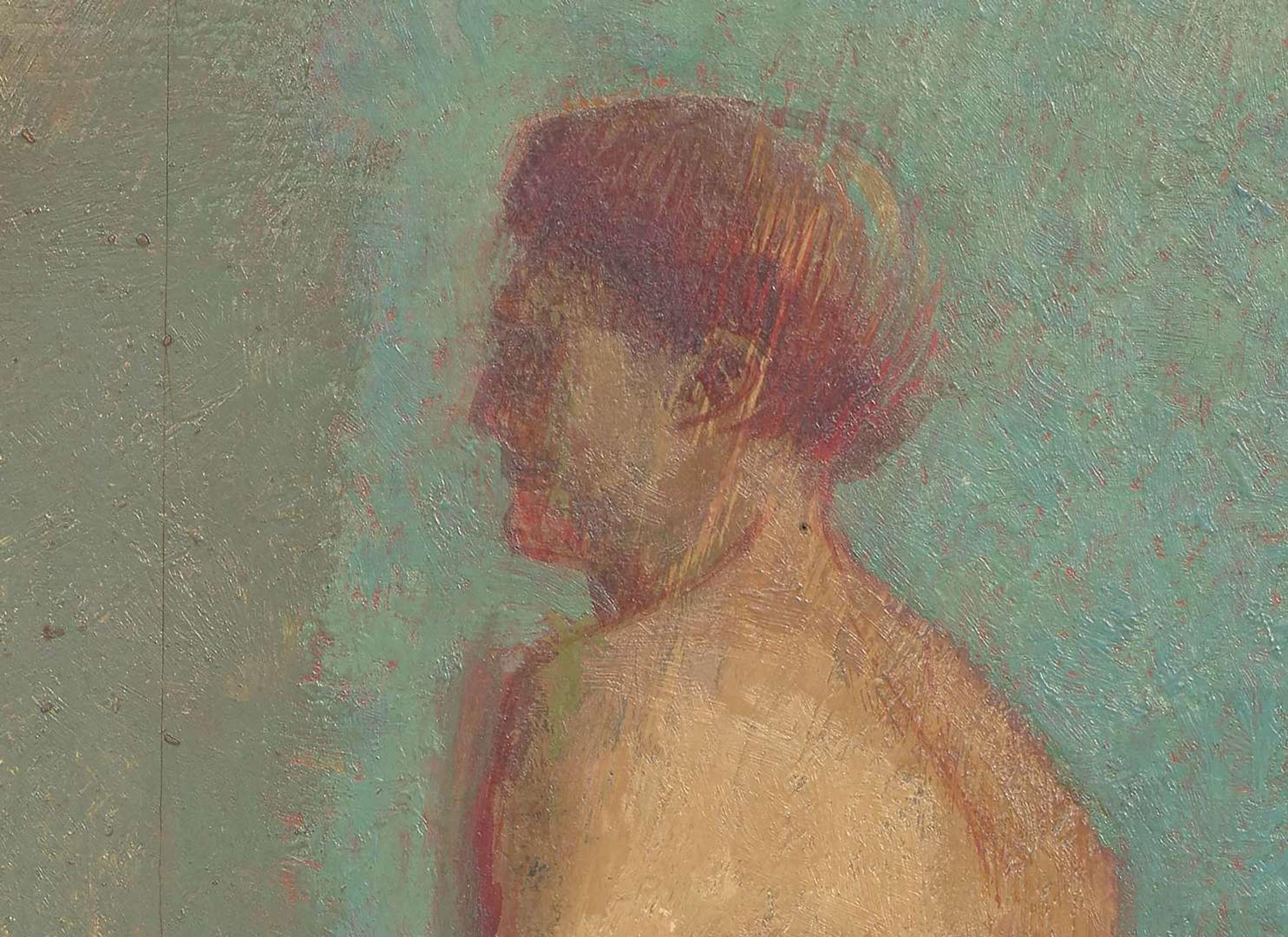
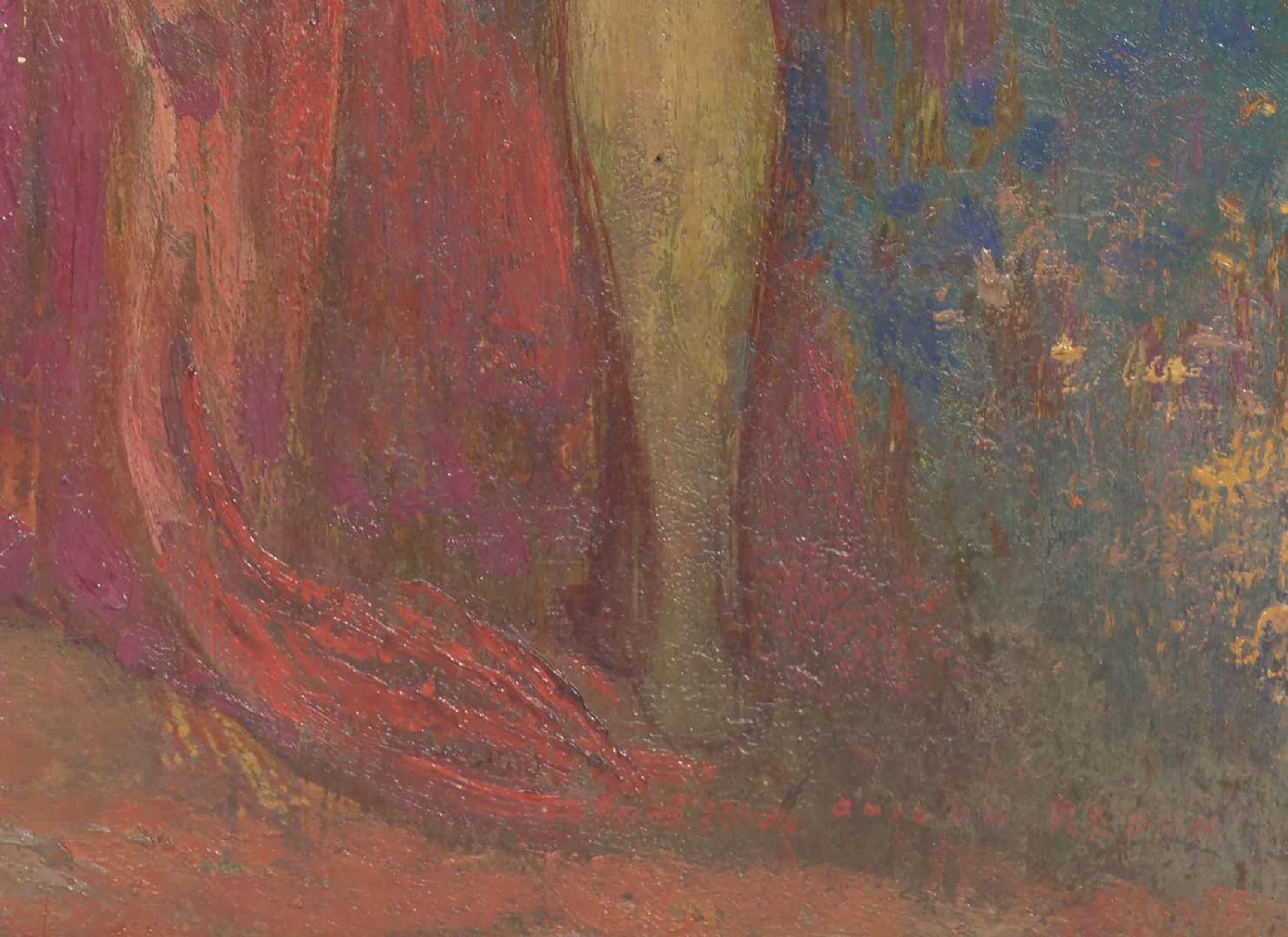
Stylistically, the work fits perfectly into this innovative period for the artist, who consciously blurs the pictorial space to create a playground without limits, free of classical perspective and identifiable contours. Through his love of floating and transient shapes, Redon takes from Paul Gauguin’s and the Nabis’ philosophy, as they also broke the rules of traditional perspective and mixed all grounds into a single pictorial plane. Technically, this synthetism comes through with a generous impasto, particularly visible in the semblances of flowers at the bottom of the composition, to the right, as well as in the large swaths of bright and pure colors, which sensuously wash over the wooden panel.
Although Redon depicted the myth of Oedipus several times throughout his career, focusing on a different aspect each time (see Oedipus and the Sphinx, also called The Mystical Knight, now at the Musée des Beaux-Arts de Bordeaux; Sphinx in a Private Collection, or The Old Angel, in the Petit Palais, Paris), the present painting undoubtedly stands out as the most abstract of the series; it evokes Oedipus without presenting itself as the explicit representation of the myth, or of a particular moment. By approaching the myth in a roundabout way, Redon seeks to grasp what the underlying force of the story, thus starting a "journey towards the mysterious center of thought." The so-called "Prince of Dreams" invites his viewer to a game of interpretation, giving him an active role into the perception of the painting’s message: what is there to see, or understand here?
The key to understanding this charming oil might lie in its title itself, Œdipe au Jardin des Illusions. Indeed, however poetic and existentialist it might be–no such garden is ever mentioned in Sophocles' myth. Instead, as it often does in Greek mythology, it becomes a pretext for imagination, a symbol of mystery, and an ambiguous space halfway between Nature and Mind, where everything is possible. As it is also the place where Oedipus solves the sphinx's riddle, the garden also becomes a metaphor for the mind, the seat of thought, which Redon reuses for his own purpose. By using such a floating image, arguably hard to read at first glance, Redon questions the idea of vision, which he replaces by that of the interpretation, thus making subjectivity more important than reality.
Stripped of context, Oedipus becomes an image more than a subject, which does not impose itself to us, but instead makes us wonder. In a very powerful way, the hero becomes the ideal of a Symbolist painting itself, which no longer seeks to carefully depict the outside world, but instead invites us to see with our minds rather than our eyes. Stéphane Mallarmé, a close friend of Redon's, described this idea very well: “To name an object is to remove three quarters of the enjoyment of the poem which is made up of the joy of guessing little by little; suggest it: that’s the dream. It is the perfect use of this mystery which constitutes the symbol.” By looking at Œdipe au Jardin des Illusions, let us guess, wonder, and enter the dream.
The Artist.
The Artist's son, Ari Redon.
Acquired directly from the above.
Private Collection, Bordeaux, circa 1930.
Hôtel des ventes de Chartrons, Bordeaux, sale of November 27, 1991.
Sotheby's, London, sale of July 1, 1992, lot 104.
Acquired directly from the above sale.
Collection of Sidney Rothberg, Philadelphia, Pennsylvania.
To receive more information about this Lot, or request a condition report please email either Raphael Chatroux (rchatroux@freemansauction.com) or Adam Veil (aveil@freemansauction.com)
The physical condition of lots in our auctions can vary due to age, normal wear and tear, previous damage, and restoration/repair. All lots are sold "AS IS," in the condition they are in at the time of the auction, and we and the seller make no representation or warranty and assume no liability of any kind as to a lot's condition. Any reference to condition in a catalogue description or a condition report shall not amount to a full accounting of condition. Condition reports prepared by Freeman's staff are provided as a convenience and may be requested from the Department prior to bidding.
The absence of a posted condition report on the Freeman's website or in our catalogues should not be interpreted as commentary on an item's condition. Prospective buyers are responsible for inspecting a lot or sending their agent or conservator to inspect the lot on their behalf, and for ensuring that they have requested, received and understood any condition report provided by Freeman's.
Please email for any additional information or questions you may have regarding this lot.