Condition Report
Contact Information
Auction Specialist
Lot 516
Sale 960 - American Historical Ephemera & Photography
Nov 15, 2021
11:00AM ET
Live / Cincinnati
Own a similar item?
Estimate
$1,500 -
2,500
Price Realized
$4,688
Sold prices are inclusive of Buyer’s Premium
Lot Description
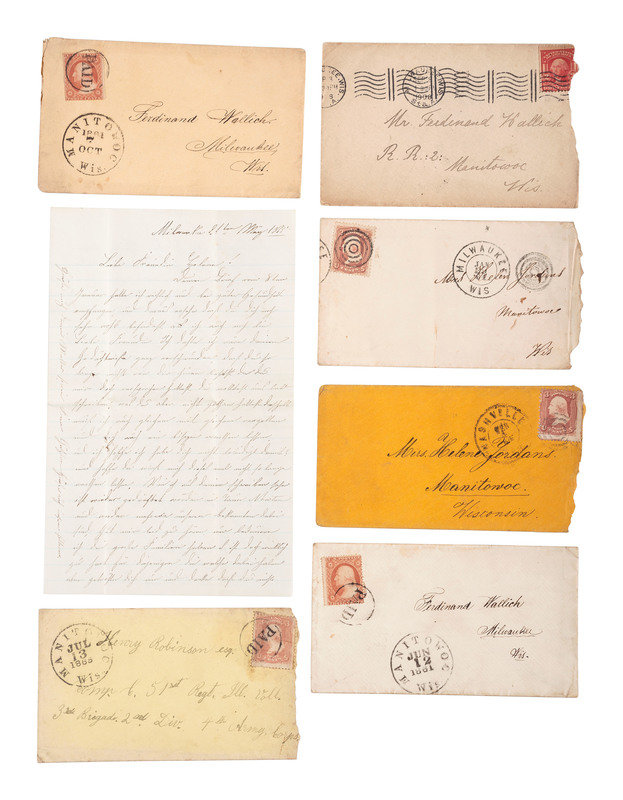
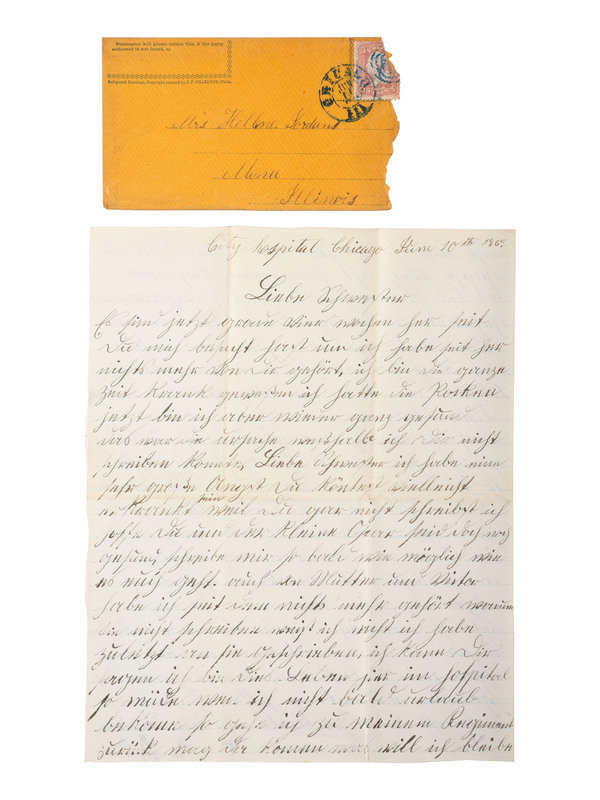
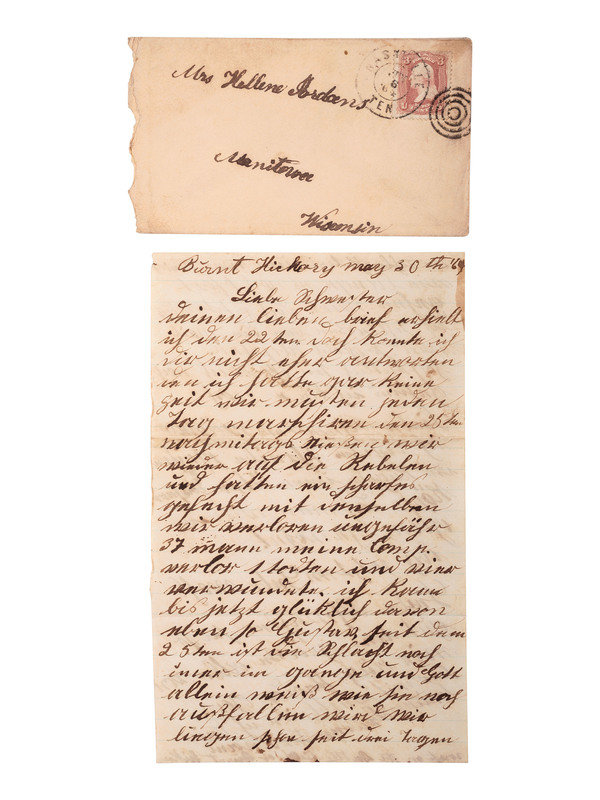
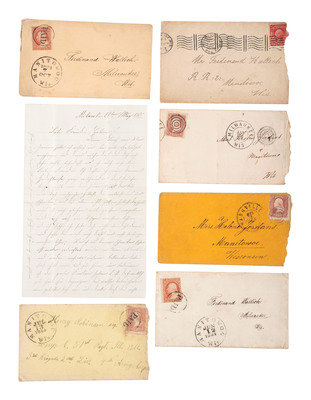
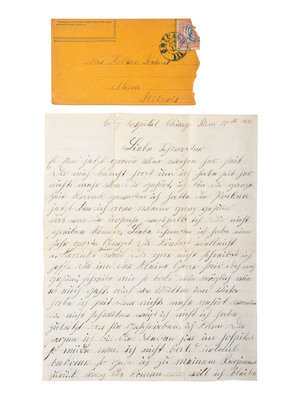
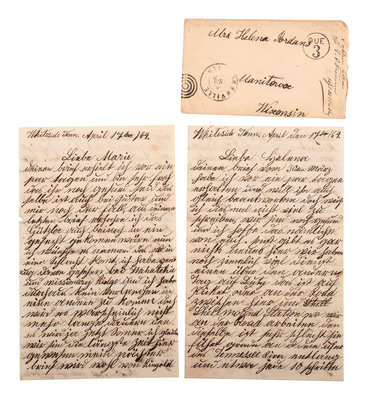
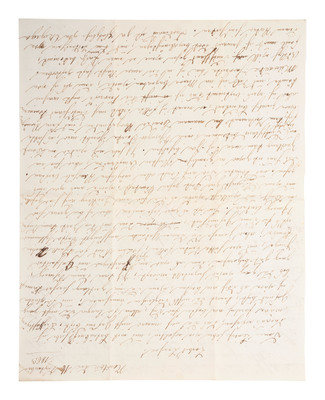
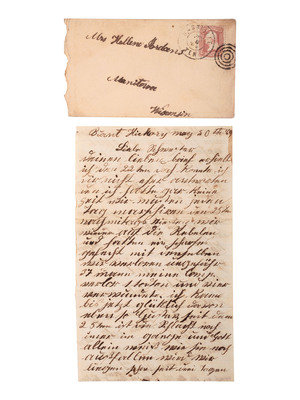
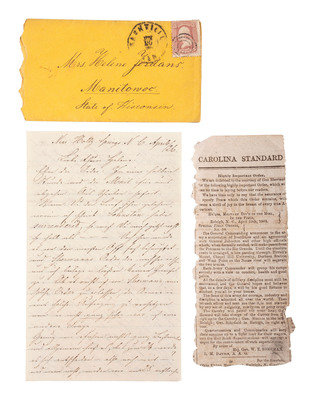
[CIVIL WAR]. A group of 27 letters addressed to Helene Wallich Jordans from husband and brothers serving with the 82nd Illinois and the 26th Wisconsin Infantries. January 1863-June 1865.
Born in Germany 1 Aug. 1830, Gustav Jordans immigrated to America arriving in New York 10 Aug. 1849. On 15 May 1860 he married Helene Wallich, nine years his junior (he often addresses her as “child”), in Milwaukee, Wisconsin. In mid-August 1862 he enlisted in the 82nd Illinois Infantry as a member of the band and mustered in at Camp Butler on 26 Sept. 1862. He was promoted to Principal Musician in 1864. Whiteside, Tenn. March 7, 1864: “[I] was added to the Regt. noncom staff as a principal musician and as such I receive orderly pay and rank.” Later he notes that he acquired two violins, but one had already been lost.
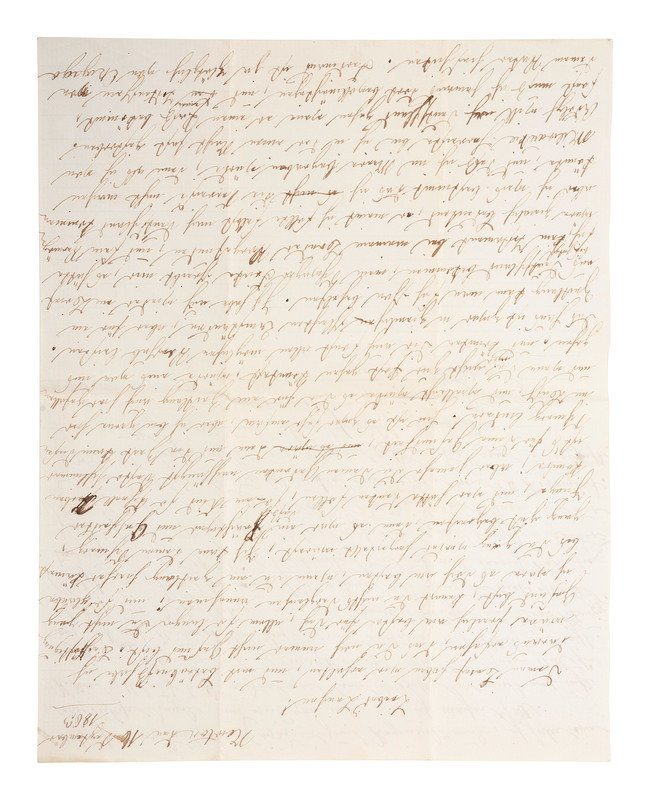
The unit was mustered out 9 June 1865 in Washington, DC. This group of 27 plus letters were addressed to Helene between Jan. 1863 and June 1865 from her brothers, mother and husband. All are in German and have been transcribed by a previous owner except for the one post-war letter (#28).
The Wallich family was also an immigrant group. Helene had a number of brothers, at least four(?) of whom wrote to her during the war. Helene received four letters from Ferdinand, and one each from John, Frank and Dallmar(?), as well as one from her mother. The other 19 (plus 1) were from her husband, Gustav. Ferdinand mustered into Co. C, 26th Wisconsin Infantry on 20 August 1862 and mustered out on 13 June 1865. Both Gustav’s unit, the 82nd IL and Ferdinand’s unit, the 26th WI, were predominantly German regiments. The letters from John, Frank and Dallmar all appear to be soldiers’ letters. The one from Frank has “soldier’s letter” on the end of the cover. Dallmar’s letter sounds like a typical soldier’s missive, written “near Chattahoochee River” and he mentions when he has seen Gustav. John’s letter also sounds like a typical soldier’s letter. He sounds like he might be in the same unit as Gustav, as he mentions at one point “Gustav and I are healthy,” and the letter is from Atlanta, GA in October 1864. However, we have been unable to find any of these three in the databases (civilwardata and Soldiers and Sailors system).
Gustav writes from Stafford Courthouse, April 11, 1863: “…At 11 o’clock we had to line up again [after an earlier inspection]. Then we marched for two miles to Brigg Station, where the entire 11th Army Corps was assembled and where President Lincoln made an inspection of the troops…The President was accompanied by his family. While our troops were marching by he was continuously talking to G.M. Carl Schurz, who was standing to his right, while G.M. Hooker Howard was standing to his left. Lincoln appears to face the future with optimism. He does not stoop forward, (as people say), and he does not at all make the appearance of the Old Abe.”
Unfortunately, just two months later his son, Oskar, died (18 June). Gustav laments “…I am not a father anymore… I am a nobody.” And, of course, he cannot get a furlough to go home to help his wife.
Boonesboro, July 8, 1863: “Everything seems to go our way, and I am happy, because I hope that the war will soon come to an end. Up to now we seem to be winning, the I and II Corps are together and also the 6-8 Corps. From all sides they hit Lees Army…. G.M. Meade gives the enemy no rest. That I have to live like this is in words hard to describe.” Much of the rest is about the death of Oskar.
Letter from mother mentions Ferdinand, their regiments fight together on occasion. (Newton, Sept. 16, 1863)
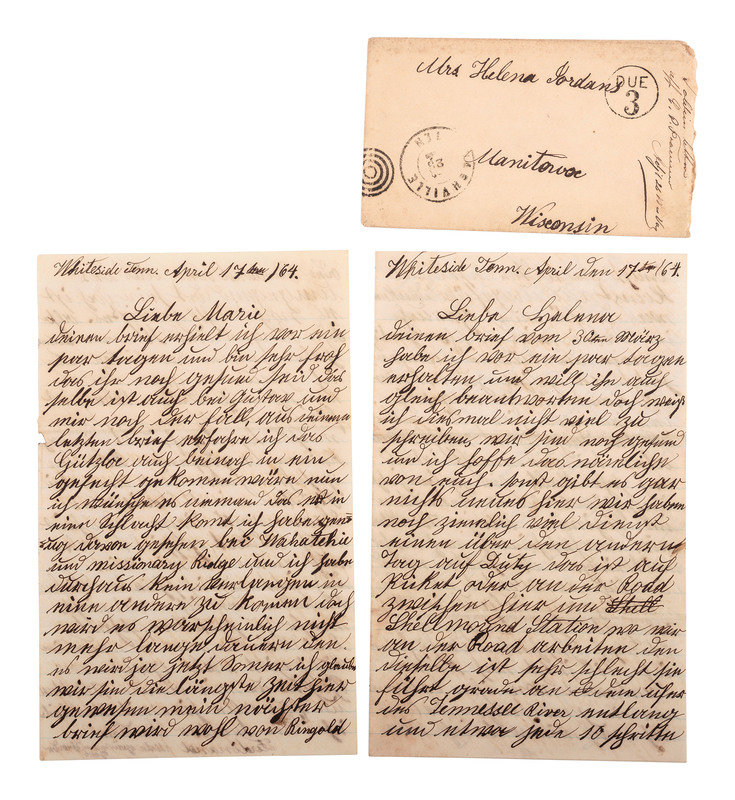
Ferdinand to Marie (sister) Whiteside, Tenn., April 17, 1864. “From your letter I learned that Gutzloe almost got into a battle. I wish it to no one to get into battle. I saw enough of it at Wachatchee and Missionary Ridge and I have no desire to partake in another one, but most likely it will not be long because summer is near…” (referring to the “fighting season”). Indeed, a month later (Burnt Hickory, May 30, 1864) he tells Helene that they are on the front line and don’t know how long it will go on.
Georgia, July 8, ’64: Gustav talks about the destruction of houses caused by cannon fire. “We again walked through more woods and found another pit like a fortress but we learned a lesson appr. ½ ahead we found another pit and every 50 steps we found pieces of lumber sticking a little out of the ground with a very sharp tip on it, another 30 steps we found felled trees with carefully arranged logs also with sharp ends in every direction. Every 3 – 4 feet more the same, and it was great danger, but that is what their troops did to slow us down. …Behind that we found a lot of pits full of ???. We found bombs they left behind, evidently the Rebs had not planned on a retreat.” He then goes on to describe a rout of the rebels, taking prisoners, etc.
Atlanta, Oct, Nov. 4, 1864. Gustav to Helene: “[W]e got marching orders, but who knows where to? …rumor has it we will go direct to Savannah….Everything points to it that Atlanta will be given up…. I believe other plans are being made. We accomplished our goal – Atlanta, the biggest city of the south – will not exist anymore – the rebels will have been destroyed, the lands – forts, arsenals, will be wrecked… [J]ust think the end of such a city – because of the war. A part of the Army most likely will fall back to Chattanooga, and then try to meet the rebels in Tennessee. The other part of the Army and that includes our Corps (anyhow everything points to it) will probably march direct to the heart of the south either Savanna or Mobile?”
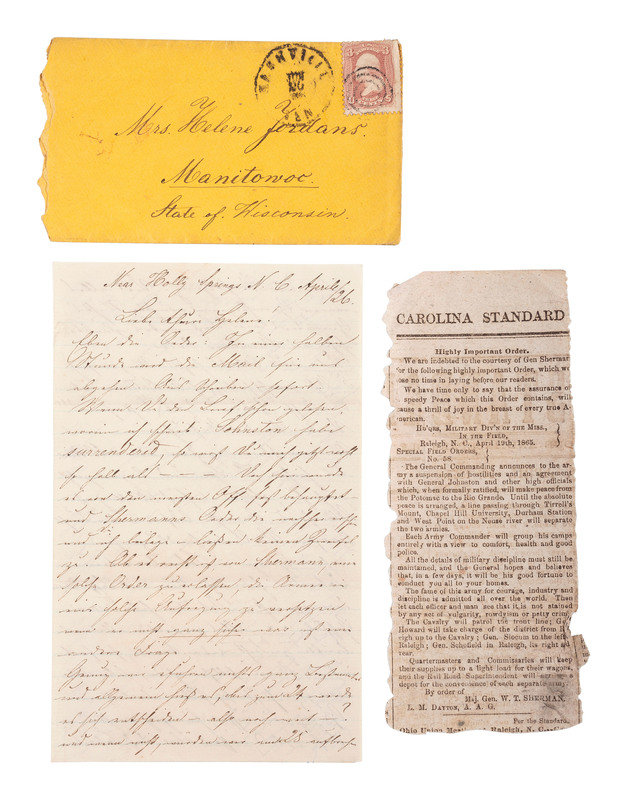
Raleigh. NC, 16 March 1865. “…[W]e reached Raleigh, G. Johnston was gone. He surrendered the city early in the morning to our cavalry. It was a tough march from Goldsborough to here, humid day, with fog and constant rain. Raleigh was very much fortified and we thought Johnston might be able to hold it, but no – we kept going to places named Greensboro – Danville - …we got strict orders to demolish everything. All rations will be from now on delivered and we are to respect all citizens. It is being said Hardee and Johnston surrendered April 17th….[in the midst of the celebrating he describes]…And now suddenly the terrible news that Lincoln was murdered…”
In his letter Near Holy Springs, NC, April 26 [1865], Gustav mentions lots of rumors - such as Johnston being on the run with Jefferson Davis - most of which were not true (and he acknowledges that they are unlikely to be true).
Mostly personal letters with battle content showing up occasionally. Gustav in particular seems reluctant to relay a lot of military news since he recognizes that it is likely a product of the “rumor mill.” He notes that she has probably gotten the correct information from the newspapers by the time he is sure what information is true.
Property from the Estate of Henry G. Lamont, Racine, Wisconsin