Condition Report
Contact Information
Lot 9
Sale 6465 - Printed and Manuscript Americana
Jan 29, 2026
10:00AM ET
Live / Philadelphia
Own a similar item?
Estimate
$1,200 -
1,800
Price Realized
$1,280
Sold prices are inclusive of Buyer’s Premium
Lot Description
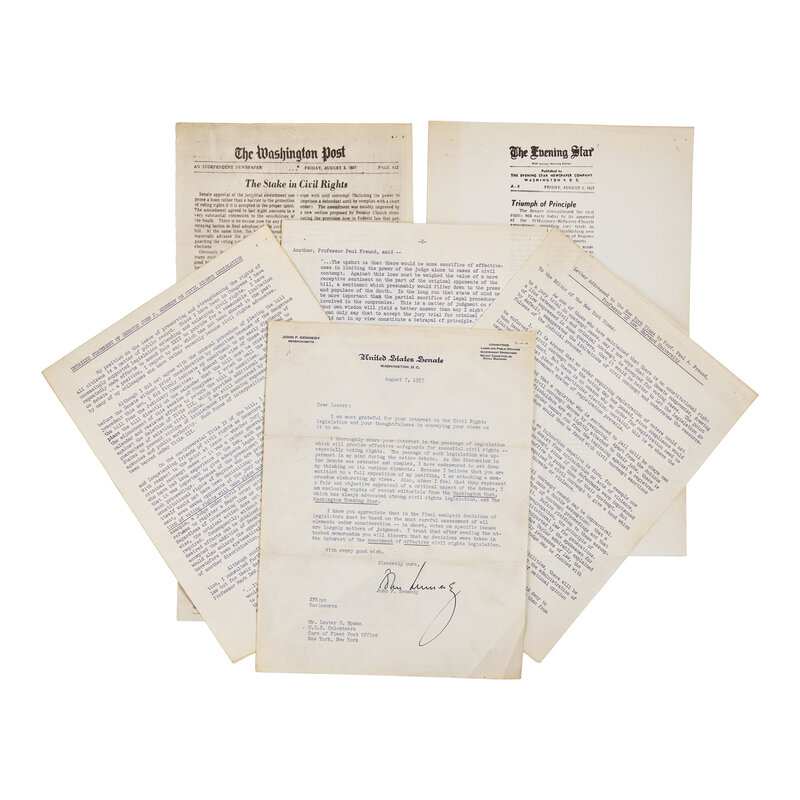
[African-Americana] Kennedy, John F. Typed Document and Three Mimeographed Sheets
John F. Kennedy on the Civil Rights Act of 1957
Washington, D.C., August 7, 1957. Comprising six sheets, including: one one-page typed letter, signed secretarially by Senator John F. Kennedy to Lester S. Hyman, thanking him for his interest in the Civil Rights legislation and writing that he is "entitled to a full exposition of my position, I am attaching a memorandum elaborating my views..."; two mimeographed sheets of the aforesaid memorandum titled, "Detailed Statement of Senator John F. Kennedy on Civil Rights Legislation"; three sheets of copies of newspaper articles, etc., regarding the Civil Rights Act of 1957, dated from August 2-5, 1957. Measuring 10 1/2 x 8 in. (267 x 203 mm) to 15 x 7 1/4 in. (381 x 184 mm). Creasing from old folds; some sheets with wear in corners from removed staples. Published and partially illustrated in Hyman's 2020 memoir, JFK, The Kennedys and Me. Lot also includes a 6 1/2 x 4 1/ 2in. black and white photograph of Hyman with Kennedy, in mat and frame, 10 1/4 x 7 3/4 in.
John F. Kennedy explains his positions on aspects of the Civil Rights Act of 1957, the first major attempt to advance Black civil rights since Reconstruction.
Proposed by President Eisenhower following the landmark Supreme Court decision Brown v. Board of Education and the South's heated resistance to desegregation, the Civil Rights Act sought to strengthen voting rights, especially for Southern Blacks, and address rampant voter suppression. The proposed Act placed a burden on Democratic Senator Kennedy, a political moderate, whose cool reception to the bill was met with criticism from Civil Rights leaders and liberal members of his own party.
As the bill advanced, Kennedy sided with Southern Democrats to have it first go through the Judiciary Committee, chaired by segregationist Senator James Eastland of Mississippi, and voted no on a measure that would have circumvented the Committee putting it directly to a vote. As Kennedy explains in the above document, while he "did not agree with the unusual procedure of placing the bill before the Senate without prior consideration by committee because of the dangerous precedent this set, I did firmly indicate my commitment to an early discharge of the bill from the Judiciary Committee." Kennedy earned further opprobrium in regards to his support for the controversial Title IV of the bill, the so-called "Jury Trial Amendment", which provided that in cases of criminal contempt, a conviction by jury was required--thus ensuring that those engaging in voter suppression in the South would be acquitted by all white juries. Kennedy explains above that "there is almost universal agreement, even among opponents of the jury trial amendment, that the primary protection of voting rights will take place under the civil power of the courts..." Although Kennedy voted for Title III of the bill, which would have granted injunctive powers to the Attorney General over civil rights violators and school desegregation, this provision was allowed to die by Senate majority leader Lyndon B. Johnson in order to secure the bill's passage. Kennedy states in the above of his "regret that it did not carry," but that "it would be a heavy blow to free government to exchange a bill of real merit for the doubtful satisfaction of standing dogmatically by a provision which does not preserve a genuine principle or add significantly to the substantive effect of the measure."
The bill passed the House of Representatives in a vote of 286-126, and then in the Senate in a vote of 72-18. President Eisenhower signed the bill into law on September 9, 1957. Despite being watered down, the bill established the Civil Rights Section of the Justice Department and empowered federal prosecutors to obtain court injunctions against interference with the right to vote, while also establishing a federal Civil Rights Commission with the authority to investigate discriminatory conditions and recommend corrective measures. While the bill had little immediate effect for Southern Blacks, it helped pave the way for further Civil Rights bills in 1960, and especially the Civil Rights Act of 1964, the Voting Rights Act of 1965, and the Civil Rights Act of 1968.
Kennedy concludes with a defense of his actions, stating that, "there is now consensus on a reasonable and effective civil rights program. Those who would block its enactment by spurious arguments do no service to the cause of civil rights. Enactment of this bill marks the end of an era during which it has been impossible to get effective legislation to insure the protection of basic human and civil rights. Therefore, action on legislation now is as important in terms of future protections of civil rights as it is for the substantial immediate effect which it will have."
Rare, we cannot find another copy of this statement in the available auction record. Furthermore, we can locate only one other copy, in the JFK Presidential Library.