Condition Report
Contact Information
Lot 64
Sale 6465 - Printed and Manuscript Americana
Jan 29, 2026
10:00AM ET
Live / Philadelphia
Own a similar item?
Estimate
$500 -
800
Price Realized
$1,792
Sold prices are inclusive of Buyer’s Premium
Lot Description
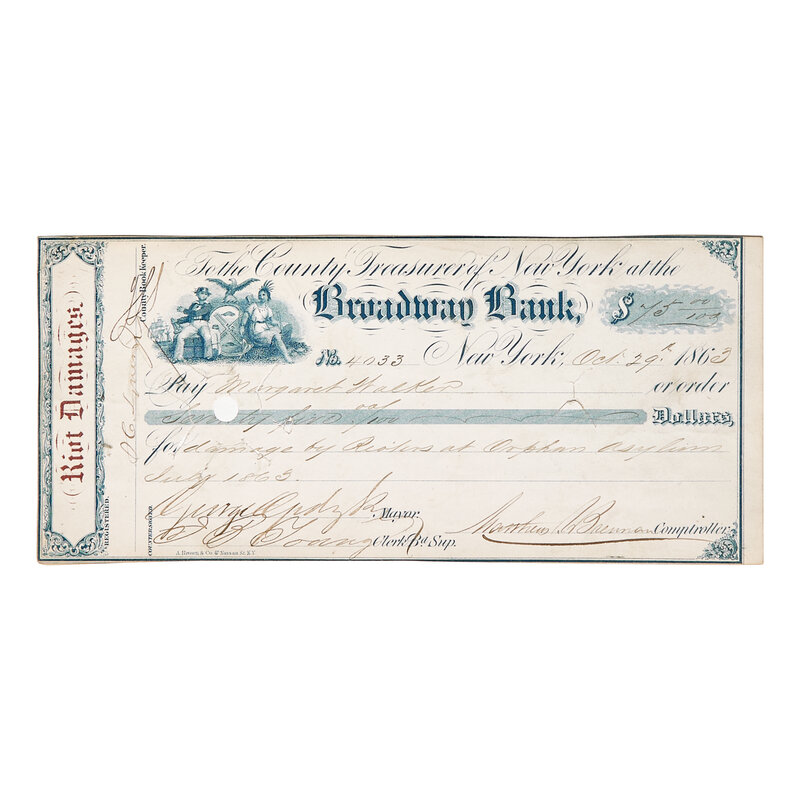
[Civil War] New York Draft Riot Damages Check Issued for Losses at the Colored Orphan Asylum
Damages Check Paid to a Victim of the Infamous New York Draft Riots For Losses Incurred From the Burning of the Colored Orphan Asylum
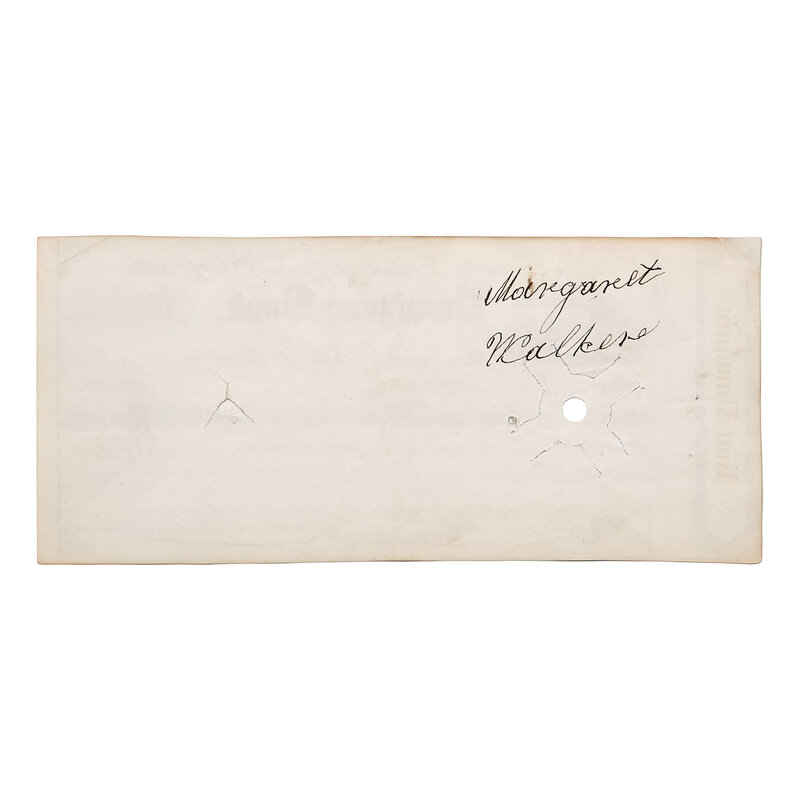
New York, October 29, 1863. Single oblong sheet, 3 5/8 x 8 1/8 in. (92 x 206 mm). Partially-printed Broadway Bank of New York check, issued to Margaret Walker for $75 dollars for "damage by Rioters at Orphan Asylum July 1863". Signed by Mayor George Opdyke at bottom; counter-signed by New York Comptroller Matthew T. Brennan, County Book Keeper S.C. Lynes Jr., as well as a city Clerk; endorsed by Walker on verso. Perforated cancellation stamp in left side.
The four-day rioting that broke out in Lower Manhattan from July 13-16, 1863 was one of the most violent and deadly insurrections in the history of the United States, and one of the most serious challenges to President Abraham Lincoln's authority in the North. By 1863, after two long years of intense bloodshed, enthusiasm in the North for the War had declined, and the Union Army struggled to recruit and maintain its troop numbers. In New York, simmering tensions within the Irish and German working-class communities over opposition to the Emancipation Proclamation (issued on January 1, 1863), and its egalitarian and competitive implications, came to a boiling point with the passage of the first federal conscription law in March of 1863. This draft forced all men between the ages of 20-35, and all unmarried men between 35-45, to enlist in the Union Army. Exceptions were made for African-Americans (as they were not considered citizens) and those who could hire a substitute or pay a $300 exemption fee (the equivalent of one year's salary for the average American worker).
These class and racial antagonisms were goaded by anti-abolitionist and anti-war publications written by Confederate and Democratic sympathizers, and which came to a head the day after the first draft lottery, on July 12. Largely led by a mob of Irish laborers, rioters attacked military and government buildings, abolitionist offices, and then Black men and women, their homes, and their businesses. It is estimated that over 100 people were killed during the riots, many of whom were free Blacks, and that over 1.5 million dollars in damages occurred.
One of the most morally repugnant acts during the rioting occurred on the afternoon of the first day, when a mob of nearly 500 stormed and then burned down the Colored Orphan Asylum located on Fifth Avenue between 42nd and 43rd Streets. Managed by the Association for the Benefit of Colored Orphans, the large four-story building housed anywhere between 600-800 children during peak times. While the mob of men, women, and children ransacked the building, the Asylum's superintendent, William E. Davis, and the head matron, Jane McClellan, bravely helped the children and workers escape out of the rear of the building. The children then residing in the Asylum were first safely removed to the Twentieth Precinct building, then located on 35th Street near 7th Avenue, for the remainder of the rioting. It was finally quelled three days later by returning Union troops from the Battle of Gettysburg. The children were then removed to what is now Roosevelt Island. An estimated 1.4 million dollars in damages occurred. In 1867, the Asylum was rebuilt at 143rd Street and Amsterdam Avenue in Upper Manhattan.
An August 4, 1863 article in the New York Times reported damages from the rioting and lists the above sum paid to Margaret Walker for the loss of furniture.
Estate of David O'Reilly, Old Bridge, New Jersey
This lot is located in Philadelphia.