Condition Report
Contact Information
Lot 11
Sale 6465 - Printed and Manuscript Americana
Jan 29, 2026
10:00AM ET
Live / Philadelphia
Own a similar item?
Estimate
$2,000 -
3,000
Price Realized
$8,960
Sold prices are inclusive of Buyer’s Premium
Lot Description
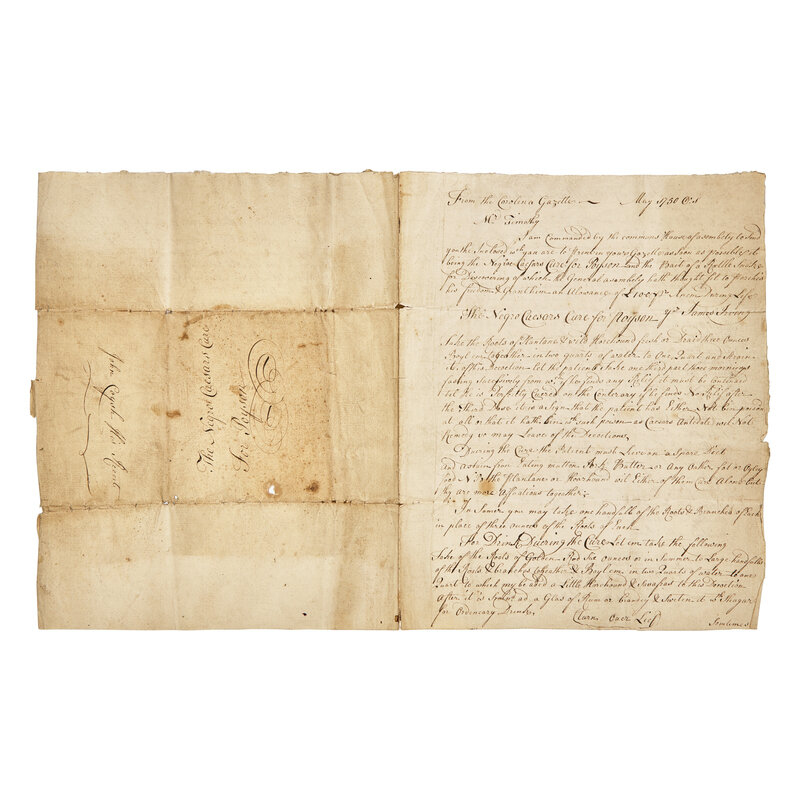
[African-Americana] The Negro Caesars Cure for Poyson
A Prominent Charleston Merchant Forwards Caesar's Famous Cure for Poison
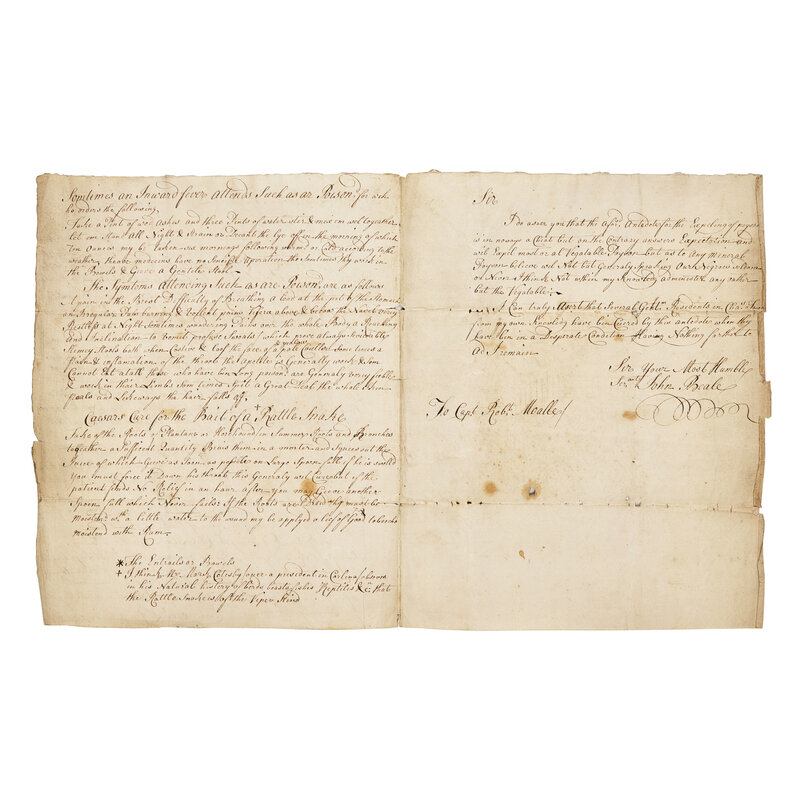
Charleston, South Carolina, ca. 1750s-60s. Bifolium, 10 3/8 x 8 1/2 in. (263 x 216 mm). Three-page autograph letter, signed by merchant John Beale to Capt. Robert Moalle, transcribing for him "The Negro Caesars Cure for Poyson", copied from an issue of the South-Carolina Gazette. Beale adds following the article, "Too asner you that the aforsd. Antedotes for the Expeling of poyson is in noways a Cheat but on the Contrary answers Expectation and wil Expel most or al Vegatable Poyson but as to Any Mineral Poyson believe wil Not but Generaly Speaking Our Negroes seldom or Never I think Not within my knowledg administer any oather but the Vegatables. I can truly Asert that Several Gentm. Residents in Chas. Town from my own knowledg have bin cuered by this antedote when thy have bin in a Desperate Condition Having Nothing farther to...and I remain...John Beale" Docketed on verso, and inscribed "John Coysh His Receit". Creasing from old folds, small holes and separations along same; wear and creasing along edges.
In November 1749 the South Carolina Assembly received a report about an enslaved Beach Hill man by the name of Caesar who had purportedly cured numerous individuals afflicted by poison. Believed to be in his late 60s, little is known about Caesar's (ca. 1682-1754) early life, but it is thought that he was born in either Africa or the Caribbean and transported to South Carolina as a slave, and where he became locally regarded for his herbal remedies and medical knowledge. Caesar communicated to the Assembly that he would divulge his antidote in return for his emancipation and moderate financial compensation. However, before agreeing to his proposal, the Assembly appointed a committee to investigate Caesar's claims, and several prominent individuals and physicians, including Caesar's own master, John Norman, attested to their effectiveness. Satisfied, the Assembly granted Caesar his freedom and rewarded him an annual annuity of £100 for the remainder of his life.
Once the Assembly procured the recipes they ordered them to be published, and they were first printed on the front page of the May 7-14, 1750 issue of the South-Carolina Gazette. It is now believed that Caesar was the first African American to have his medical findings published. Following this publication demand for Caesar's remedies soared, and over the following decades they were frequently reprinted across the American colonies, as well as in England and in Scotland, where they appeared in newspapers, journals, and medical and apothecary texts. As seen here, it was also disseminated through letters, in this case from Charleston merchant John Beale, to a Capt. Robert Moalle, a ship's captain presumably employed by Beale. Beale transcribes the entire Gazette article which included instructions for the preparation of the antidote ("Take the Roots of Plantane & wild horehound fresh or dried three ounces Boyl em togeather in two quarts of water to One Quart and strain it...let the patient take one third part three mornings fasting successively..."), how to care for the patient ("Duering the Cure the Patient must Lieve on a Spare Diet..."), how to recognize the symptoms of poisoning ("pain in the Brest Difficulty of Breathing a load at the pit of the Stomach..."), and the cure for rattle snake bites ("Take of the Roots of Plantane or Hoarehound...Bruis them in a morter and Squees out ther Juice of which gieve...on Large Spoon ful...").
John Beale (1737-1807) was the son of prominent Marblehead-born Charleston merchant, engineer, and politician, Othniel Beale (1689-1773). John followed his father into the merchant trade and worked at his firm, Othniel & Son, which he inherited upon his father's death. During the American Revolution Beale served as a captain in Major James Bentham's regiment of the Charleston militia (although another account states he was a Tory who fled to England in 1775; see Heckscher, American Rococo, pp. 171-172).
OCLC locates only one other contemporary manuscript copy of Caesar's antidote, in a medical compendium produced in Scotland in 1751, and now held at Washington University, in St. Louis.
This lot is located in Philadelphia.