
Condition Report
Contact Information
Auction Specialist
Lot 12
Sale 6425 - American Historical Ephemera and Early Photography, including The Larry Ness Collection of Native American Photography
Part I - Lots 1-222
Oct 23, 2025
10:00AM ET
Part II - Lots 223-376
Oct 24, 2025
10:00AM ET
Live / Cincinnati
Own a similar item?
Estimate
$3,000 -
5,000
Price Realized
$4,500
Sold prices are inclusive of Buyer’s Premium
Lot Description
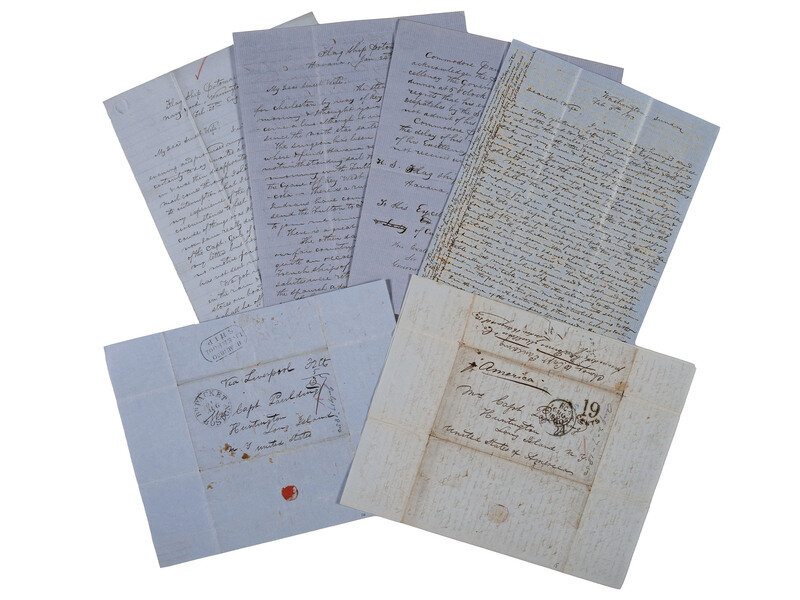
[US NAVY]. PAULDING, Commodore Hiram (1797-1878). Personal correspondence of Paulding to his wife Ann Marie Paulding, and other family members, incl. discussion of naval activity, encounters with heads of state, and more.
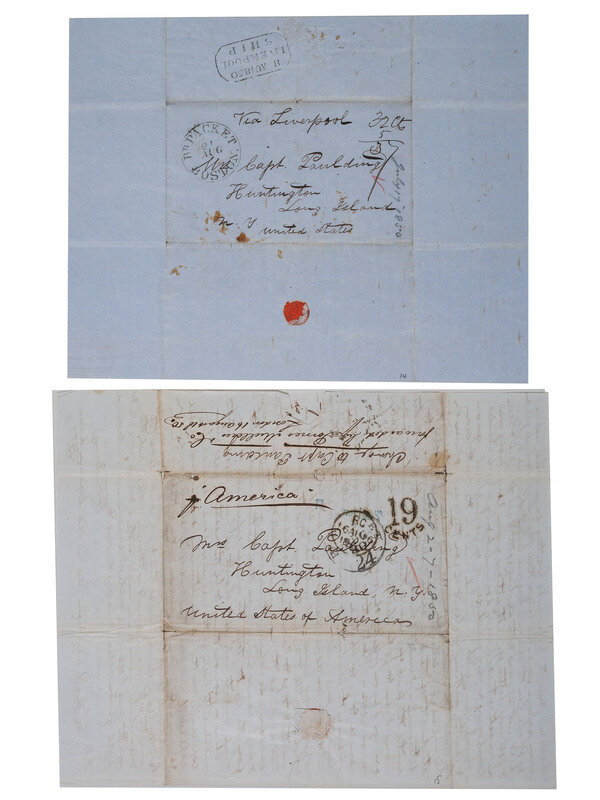
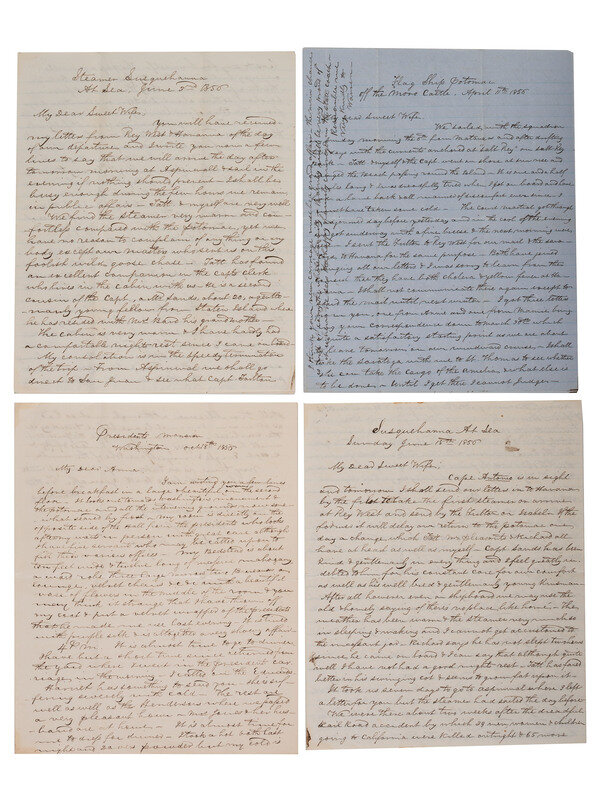
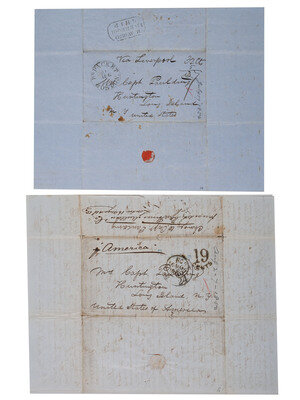
Group of 56 letters written by United States Naval officer Hiram Paulding to family members, including 49 letters to his wife Ann Marie Kellogg Paulding (1807-1894), one letter to his daughter Anna Marie Paulding (1832-1906), and six letters to his son Tattnall Paulding (1840-1907). Additional family correspondence includes four letters to Hiram Paulding from his children, one each from Anna, Tattnall, Hiram Jr. (1846-1924), and Mary Paulding (1842-1912), and a letter from Tattnall Paulding to his sister Anna. Paulding's family correspondence demonstrates not only his implacable sense of duty to the United States Navy and commitment to the nation he served, but also his deep, abiding affection for his family. Correspondence spans 1849-1876 (bulk 1850-1856). Letters generally 2-3+pp, some with integral address leaf and associated postal markings. Various places incl. "At Sea," Lisbon, Bay of Palermo, Navy Yard Washington, Key West, Havana, Matanzas, and Long Island, and aboard the "Flag Ship Potomac," "US Frigate St. Lawrence," and "Steamer Susquehanna."
The earliest letter in the archive was written by Hiram Paulding in March 1849 to eight-year-old Tattnall Paulding, the namesake of Hiram Paulding's close friend Commodore Josiah Tattnall, USN. (See Lot 13: Personal correspondence of Commodore Josiah Tattnall to Commodore Hiram Paulding.) Serving at the time aboard the U.S. Frigate St. Lawrence in the Mediterranean Sea, Paulding was a seasoned sailor of nearly four decades who had often endured long separations from family. His letter to Tattnall provides guidance and encouragement along with an anecdote about young sons of the King and Queen of Portugal who he had met a few evenings prior. In just a few years from the date of this letter Tattnall would join his father at sea. Multiple letters in the archive from Hiram Paulding to his wife make reference to Tattnall's shipboard presence and activities. Tattnall would go on to serve with distinction in the Civil War and spent nine months confined in Libby Prison. (See Lot 59: War-date letters and diary of Lt. Tattnall Paulding, 6th US Cavalry, POW Battle of Fairfield, incl. Gettysburg Campaign and Libby Prison content.)
Paulding's letters to his wife reflect a close relationship, and contain discussion of naval news, ship movements, diplomacy, frustrations related to the US government and fellow officers, as well as travel stories, advice, and news associated with family, friends, and health matters. Notable content includes, in small part: 19 December 1852 letter in which Paulding describes a meeting in D.C. with Sec. of the Navy John P. Kennedy (1795-1870) and Kennedy's plans for Paulding to serve as second in command to Commodore Matthew C. Perry during his Japan expedition of 1852-1854. -- 24 January 1856, Paulding tells his wife about a diplomatic faux pas in which he was excluded from a Havana dinner hosted by Jose Gutierrez de la Concha, Governor & Captain General of Cuba, only to receive a last minute invitation to the event. A draft of Paulding's letter politely declining the last-minute invitation is included with the letter, and later correspondence describes the elaborate ceremonial honors Paulding received when he did finally have dinner with the Captain General. -- Paulding frequently expressed frustration with the Department of the Navy, as in 10 February 1856 when he told his wife about the poor accommodations on the Cyane which meant that the sailors were "consequently disposed of like dogs about the deck. The navy is not only, not what it was, but will not be until some very important changes take place & those are not likely to come about until the experience of calamity. An old fellow with a pride in the past may thank his stars that his race is almost run." -- Paulding notes the concerning activity of the Naval Retiring Board, stating on 24 March 1856: "Some of the officers kept in are positively worthless & some left out are good officers with perhaps a foible - [Commodore Josiah] Tattnall truly says the misfortune was that the Board being composed in a great measure of members of temperance & the church, who although considerate if individually concerned, ...they were doubtless in a great degree intolerant, judging officers by a standard that in all its hearings was not calculated to secure the highest professional merit...." -- 26 March 1856, Paulding writes from Havana of the ships needing repairs after summer exposure to Hurricanes, and indicates he has written to the Department "a long letter on the subject of importing Chinese into this island...They came here ostensibly as labourers and after great suffering and mortality on the passage are sold & treated as slaves - There are twelve thousand & it is said from the contracts made there will be sixty thousand before the end of summer."
In June 1856, Paulding arrived in Aspinwall, Panama (present-day Colon) with the Home Squadron, a naval presence which demonstrated the U.S. concerns over the Filibuster War in Nicaragua. Paulding writes on 3 June 1856 of initial reports related to the Panama Railroad accident in which dozens of California-bound passengers lost their lives. On 15 June 1856 he provides his own assessment of the tragedy: "We were there [Aspinwall] about two weeks after the dreadful railroad accident ... it was doubtless from sheer mismanagement. The engineer Mr. Totten was unwilling to speak of it saying it was not known exactly how it occurred." He then continues with a detailed explanation of a meeting with British Captain John Tarleton who had supposedly interfered with the landing of American passengers - supporters of filibuster William Walker - and insulted the American flag. "...I had listened to Capt. Tarlton's explanation and examined some papers which he exhibited I saw that the truth had been perverted and that Capt. Tarlton instead of having insulted the American flag had been fairly victimized by our countrymen." Paulding continues with a summation of the tumultuous happenings related to Walker and Cornelius Vanderbilt's Accessory Transit Company.
Returning to the United States in October 1856, Paulding writes to his daughter Anna from the "Presidents Mansion," describing a visit to the White House. The last letters in the archive are from Paulding to his son Tattnall, and date to 1876.
Hiram Paulding was a career naval officer who served with distinction from the War of 1812 through the American Civil War. Born in Westchester County, New York, he was appointed Midshipman on September 1, 1811. During the War of 1812, he served on Lakes Ontario and Champlain, commanding the second division from Ticonderoga during the Battle of Lake Champlain. In the ensuing decades he commanded ships in regions around the world. After a promotion to commodore, Paulding took command of the Home Squadron in the 1850s. The squadron was instrumental in foiling the expedition against Nicaragua underway by the American filibuster William Walker. Just before the outbreak of the Civil War, Paulding was appointed by President Lincoln to head the Bureau of Detail, where he worked to clear the naval ranks of Confederates and build the U.S. Navy's wartime fleet. In April 1861, he was ordered to reinforce the Norfolk Navy Yard, and months later was named by Gideon Welles to the Ironclad Board which was responsible for approving designs of ironclad ships. Paulding retired in December 1861 having risen to the rank of rear admiral, but continued to serve as the commandant of the New York Navy Yard until the end of the war. After the Civil War, Paulding was assigned command of the Brooklyn Navy Yard. He died at Huntington, Long Island, 1878.
See also Lot 11: Manuscript journal containing "Remarks and observations of Lt. Paulding of the U.S. Frigate Macedonian Commanded by John Downes, Esq. And bound on a Cruise in the Pacific Ocean." Ca. 1818-1828.
Property from the James Milgram, M.D., Collection of Ephemeral Americana and Historical Documents
This lot is located in Cincinnati.