
Condition Report
Contact Information
Auction Specialist
Lot 11
Sale 6425 - American Historical Ephemera and Early Photography, including The Larry Ness Collection of Native American Photography
Part I - Lots 1-222
Oct 23, 2025
10:00AM ET
Part II - Lots 223-376
Oct 24, 2025
10:00AM ET
Live / Cincinnati
Own a similar item?
Estimate
$2,000 -
3,000
Price Realized
$11,400
Sold prices are inclusive of Buyer’s Premium
Lot Description
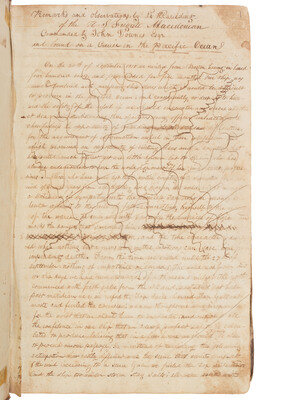
[US NAVY] -- [MARITIME]. Manuscript journal containing "Remarks and observations of Lt. Paulding of the U.S. Frigate Macedonian Commanded by John Downes, Esq. And bound on a Cruise in the Pacific Ocean." Illustrated. Ca. 1818-1828.
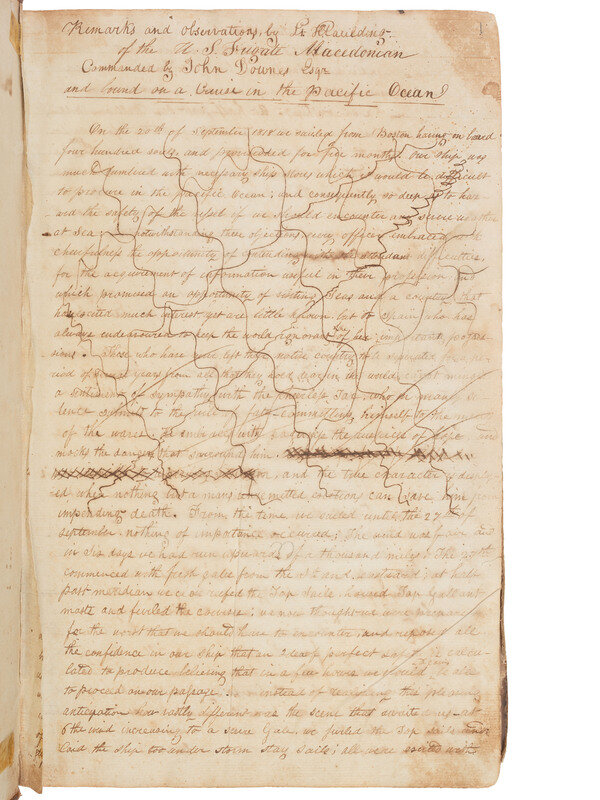
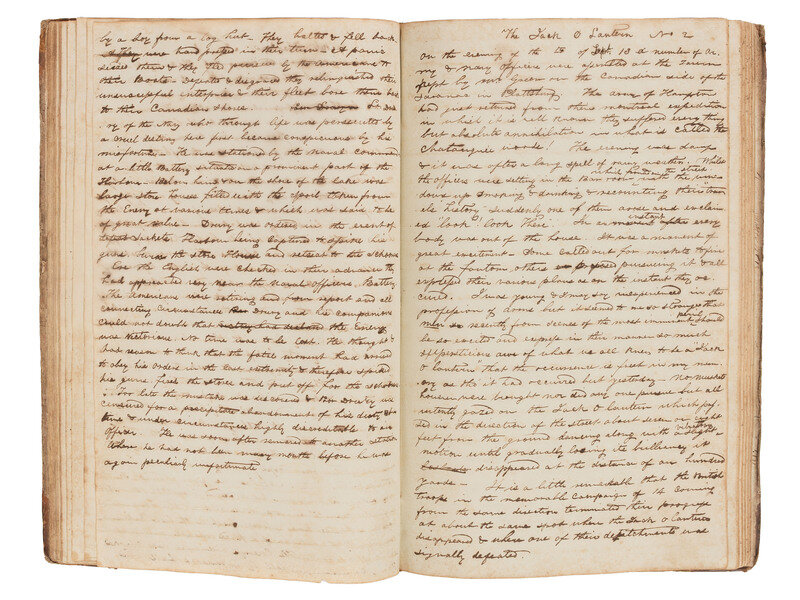
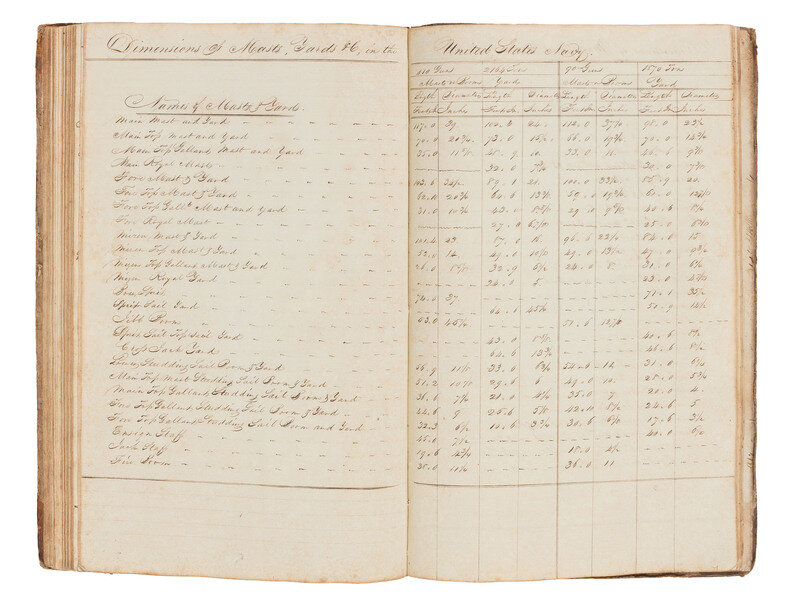
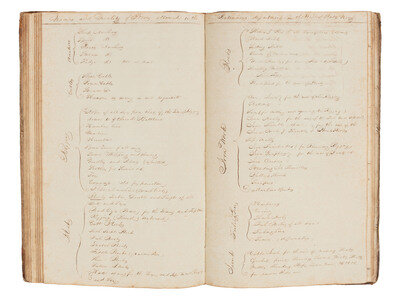
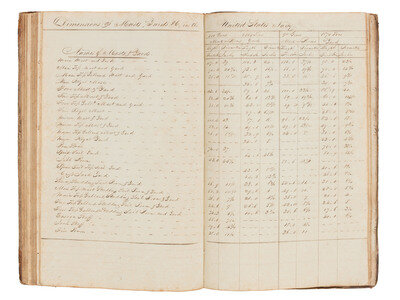
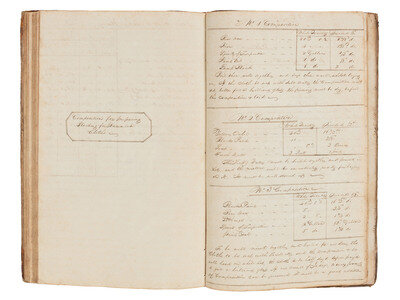
PAULDING, Hiram (1797-1878). Autograph manuscript journal, "Remarks and observations of Lt. Paulding of the U.S. Frigate Macedonian Commanded by John Downes, Esq. And bound on a Cruise in the Pacific Ocean." 8 1/4 x 13 in., 49pp. An engaging account from Paulding's cruise aboard the frigate as it operated off the Pacific coast of South America under the command of a controversial captain, and in international waters and ports full of smugglers, thieves, whalers, diplomats, and deserters. Text illustrated with 4 ink and pencil sketches. Additional autograph entries unrelated to the cruise of the Macedonian added after Paulding's "Remarks and observations," and include: two incomplete letter drafts, 2pp each, both dated Philadelphia, 1828; seven brief anecdotes from Paulding's service during the War of 1812, each individually titled, 8pp, ca 1828; dimensions of masts, decks, sails, and other features of the US Frigate United States, 4pp, ca 1828; and an undated 103pp reference section with details related to all aspects of United States Navy ships, including masts, rigging, stores, and more. Marbled boards, with front board bearing adhesive titled "Macedonian / 1818-" seemingly a later addition in a different hand. Boards worn, scattered dampstaining, several pages removed, but overall condition generally good and pages legible.
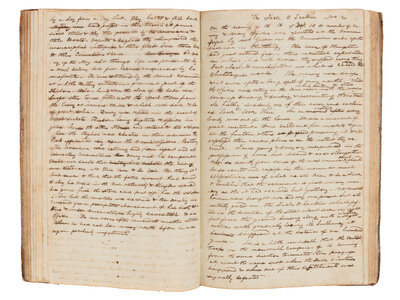
Paulding's journal opens in a manner consistent with a descriptive style utilized throughout the description of the Macedonian's voyage: "On the 20th of September 1818 we sailed from Boston having on board four hundred souls, and provisions for five months. Our ship was much lumbered with necessary ship stores which it would be difficult to procure in the Pacific Ocean; and consequently so deep as to hazard the safety of the vessel if we should encounter any severe weather at sea; notwithstanding these objections every officer embracing with cheerfulness the opportunity of contending with the attendant difficulties." Paulding's journal continues to share anecdotes typical of a naval ship experience, such the loss of a well-liked young sailor who was thrown overboard, the hazards faced in the midst of a fierce storm, encounters with other vessels, shipboard entertainment, port arrivals and departures, the characteristics of the towns visited and their peoples, and descriptions of native inhabitants. Paulding writes of indigenous Chileans: "The descendants of the native Chilians [sic] are generally poor, the wealth being generally in the possession of the Chilian [sic] Spaniards, who possess the richest of the soil and consequently can at all times command the services of the Indians." Frequently, Paulding names specific sailors or individuals in his accounts. Upon arriving in Valparaiso, Chile, in 1819 he recounts a meeting with Lord and Lady Cochrane [former British Admiral Lord Thomas Cochrane, then serving as Vice Admiral and Commander-in-Chief of the newly formed Chilean navy], and later describes an incident in which Lord Cochrane "had taken possession of small towns along the coast and all public property that he found in them, and that he had also taken 80,000 dollars at a small town called Guama which was intended for the American Brig Macedonian...".
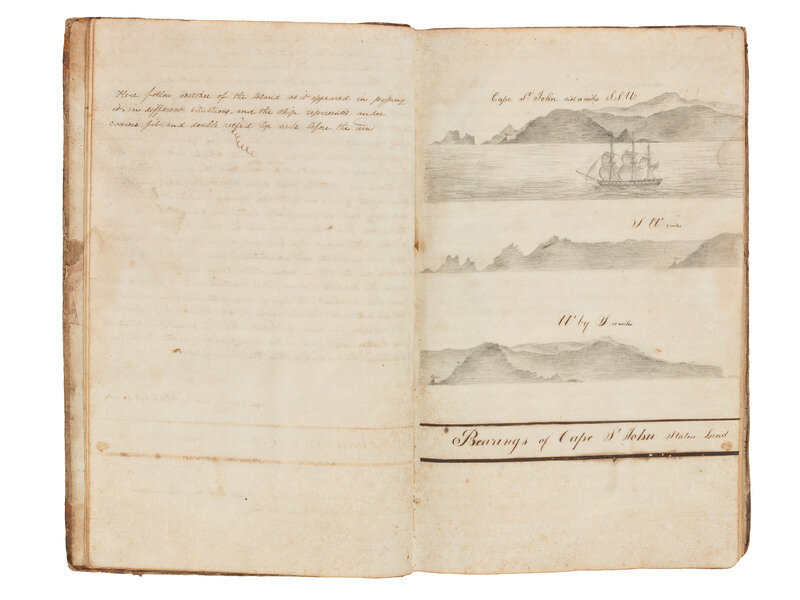
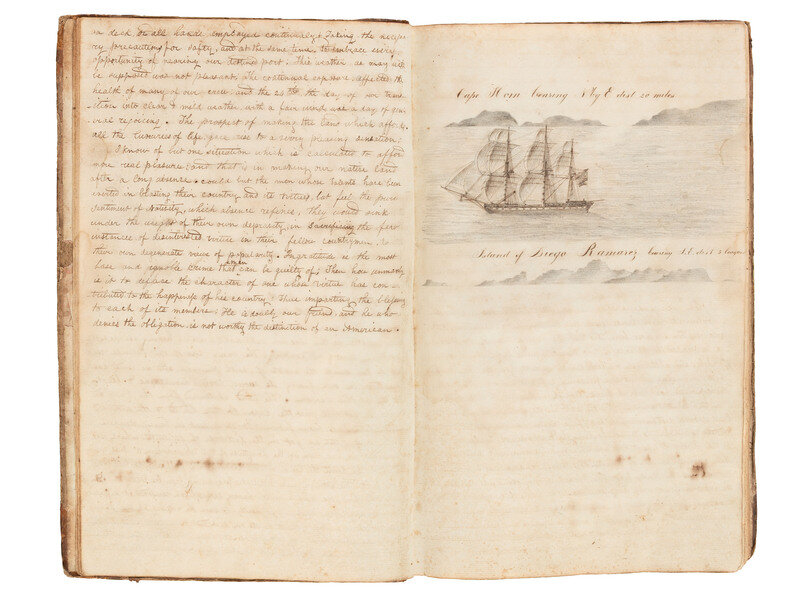
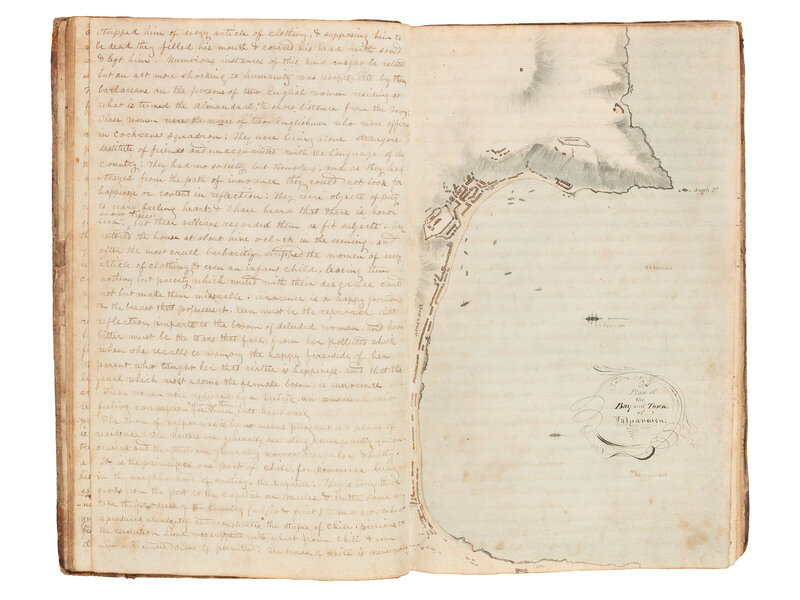
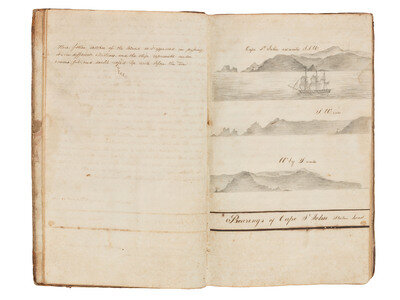
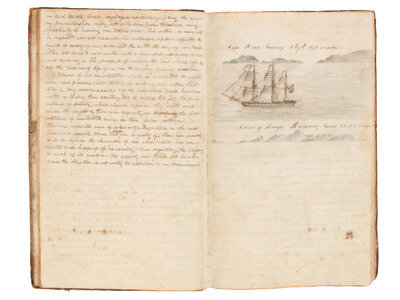
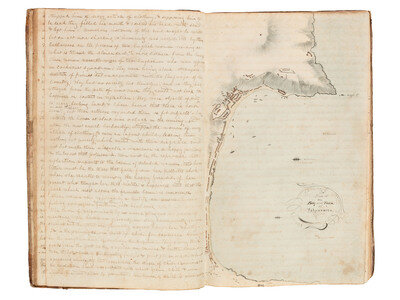
Paulding writes too about the passing South American landscape on shore and the islands, with his sketches providing a visual enhancement to his own descriptive writings. His first drawings depict "Bearings of Cape St. John Staten Island" [present-day Isla de los Estados, an Argentine Island off the eastern extremity of Tierra del Fuego, or "End of the World"] as it "appeared in passing it in different situations, and the ship represented under courses, jib, and double reefed Top sails before the wind." After describing an unexpectedly calm passing around Cape Horn, he sketches "Cape Horn bearing N by E dist [ance] 20 miles," a drawing featuring a wonderfully rendered view of the Macedonia at sea and with an American flag unfurled. A full page sketch entitled "A Plan of the Bay and Town of Valparaiso" provides a detailed rendering of the port city and the buildings dotting its coastline, with one of the larger vessels in the harbor identified as the Macedonian.
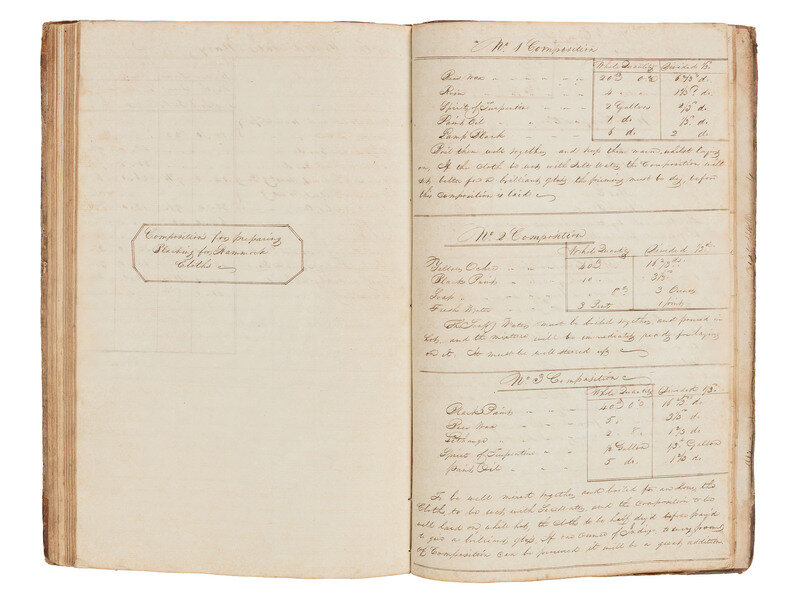
Paulding appears to have ceased journaling about his cruise ca 1820. The journal then is utilized to recount seven anecdotes from Paulding's War of 1812 service, numbered sequentially and titled "Sacket's Harbour," "The Jack O Lantern," "The Coward," "Gun Boat Fight," "British Gallantry & American Magnanimity," "Not So British," and "The Bee Hive." Following these stories are lengths and dimensions related to the U.S. Frigate United States, and then a series of sections which appear to be U.S. naval regulations, titled before each section, including "Running Rigging in the United States Navy," "Standing Rigging in the United States Navy," and "Compositions for Preparing Blacking for Hammock Cloths," and more.
Hiram Paulding was a career naval officer who served with distinction from the War of 1812 through the American Civil War. Born in Westchester County, New York, he was appointed Midshipman on September 1, 1811. During the War of 1812, he served on Lakes Ontario and Champlain, commanding the second division from Ticonderoga during the Battle of Lake Champlain. After his three-year tour on the Macedonian, Paulding returned to the US before embarking again on various assignments. While serving aboard the United States in the Pacific he was chosen to carry Commodore Hull's dispatches from Callou, Peru, to the mountain headquarters of General Simon Bolivar in the Andes. In the ensuing decades he commanded ships in regions around the world. After a promotion to commodore, Paulding took command of the Home Squadron in the 1850s. Just before the outbreak of the Civil War, Paulding was appointed by President Lincoln to head the Bureau of Detail, where he worked to clear the naval ranks of Confederates and build the U.S. Navy's wartime fleet. In April 1861, he was ordered to reinforce the Norfolk Navy Yard, and months later was named by Gideon Welles to the Ironclad Board which was responsible for approving designs of ironclad ships. Paulding retired in December 1861 having risen to the rank of rear admiral, but continued to serve as the commandant of the New York Navy Yard until the end of the war. After the Civil War, Paulding was assigned command of the Brooklyn Navy Yard. He died at Huntington, Long Island, 1878.
See Lot 13, TATTNALL, Commodore Josiah (1795-1871). Correspondence from Josiah Tattnall III to his longtime friend Commodore Hiram Paulding, 1830s-1850s, incl. Paulding's manuscript account of their friendship. Hiram Paulding served onboard the Macedonia with Josiah Tattnall. See also Lot 12, PAULDING, Commodore Hiram (1797-1878). Personal correspondence of Paulding to his wife Ann Marie Paulding, and Lot 10, MADISON, James (1751-1836). Partly-printed appointment signed ("James Madison"), as President, appointing Hiram Paulding a lieutenant in the United States Navy.
Property from the James Milgram, M.D., Collection of Ephemeral Americana and Historical Documents
This lot is located in Cincinnati.