

Condition Report
Contact Information
Auction Specialists
Lot 57
Sale 6388 - Western Manuscripts and Miniatures
Jul 8, 2025
10:00AM CT
Live / Chicago
Own a similar item?
Estimate
$1,000 -
1,200
Price Realized
$1,280
Sold prices are inclusive of Buyer’s Premium
Lot Description
GEOFFREY CHAUCER (1343–1400)
The Prioress’s Tale, in Middle English, modern illuminated manuscript on seven leaves of thin board, unbound [England, c. 1900].
The Prioress’s Tale, in Middle English, modern illuminated manuscript on seven leaves of thin board, unbound [England, c. 1900].
A finely executed revival of Chaucer’s Prioress’s Tale exemplifying the Victorian fascination with medieval manuscripts.
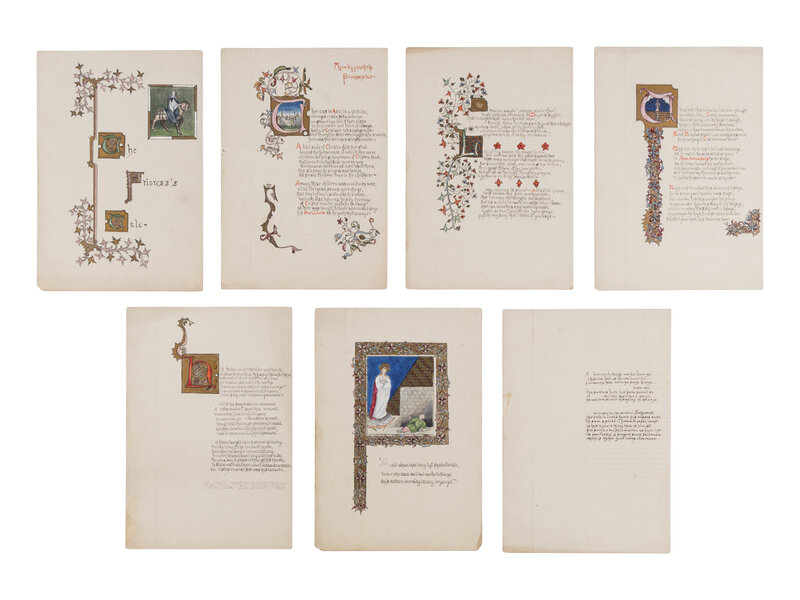
251 × 171 mm. Fascicle of seven leaves, on thick paper, each leaf ruled in pencil for a single column of variable line count (c. 20–28 lines), no foliation, text written in black ink in a pseudo-textura script with a single rubrication executed in red, two decorative initials in red on gold ground, and white on a diapered pattern, with ivy vine marginal extensions, TWO HISTORIATED INITIALS in pink with white filigree decoration: on fol. 2 with cityscape and foliate extensions inhabited by grotesques; on fol. 4 with a child in prayer on a tiled floor before a saint, TWO MINIATURES of quarter and half page in decorative frames: on f. 1 depicting the Prioress on horseback; on f. 7 depicting the Virgin appearing to the youth, in a full gilt floral border. Unfinished, text breaks off after verse 00 on f. 6, text block outlined in pencil and rubrication omitted; ink fresh throughout, colors vivid.
This set of seven unbound leaves contains a neo-medieval presentation of The Prioress’s Tale from Geoffrey Chaucer’s Canterbury Tales. It opens with a decorative title page, framed by gold initials and foliate ornament, and features a miniature of the Prioress on horseback. The tale begins on the second leaf with a rubric in red, Heere bigynneth the Prioresses Tale, followed by a historiated initial ‘T’ introducing the line “Ther was in Asie, in a greet citee...” The tale itself is a pious miracle narrative recounting the martyrdom of a young Christian schoolboy who miraculously continues to sing the Alma Redemptoris Mater after death, prompting the Virgin Mary’s divine intervention. The manuscript includes most of the narrative and the central miracle but omits both the opening of the prologue and the tale’s concluding stanzas (from verse 565 on), including the Host’s response. The unfinished seventh leaf suggests the project was left incomplete.
Produced during the Neo-gothic manuscript revival, this manuscript reflects the era’s antiquarian interests and its idealized, moralizing vision of the medieval past. In Victorian England, this cultural current fostered a renewed interest in manuscript illumination, particularly among artists and calligraphers who embraced medieval models as an antidote to industrial modernity. Figures such as William Morris championed the return to handcrafted book arts, drawing on facsimile editions and antiquarian studies to emulate Gothic script, ornament, and page design. The present manuscript, although unfinished, exemplifies this revivalist ethos: its decorative initials, stylized floral borders, and precise calligraphy reflect both historical fidelity and the personal devotion of its anonymous scribe. Likely intended as a collector’s piece or private commission, it stands among the many one-of-a-kind neo-medieval works produced in this period, which were celebrated for their craftsmanship.
Text
f. 1, Title page, “The Prioress’s Tale,” with a square illustration of the prioress in the upper right;
f. 2, rubric in red, “Heere begynneth the/ Prioresses Tale,” incipit |Ther was in Asie a grete cite …,” with a miniature of a walled city with towers and turrets and various drolleries in the border decoration (includes text verses 488-508);
f. 3, [prologue beginning incomplete]; incipit “ O mooder Mayde, O mayde mooder free!” (verses 467-487), leaf out of order, should precede f. 2;
f. 4, incipit, “Thus hath this wydwe hir litel sone ytaught,” with historiated initial ‘T’ of the youth praying before St. Nicolas (verses 509-522);
f. 5, incipit, “His felawe, wich that elder was than he,” with a decorated initial ‘H’ (verses 530-550);
f. 6, incipit, “As I have seyd, thurghout the Juerie,” (verses 551-564),
f. 7, incipit, “And whan that I my lyf sholde forlete,” full-page miniature of the youth prostrate before the Virgin, depicting the moment when she appears to the dying youth instructing him to sing. (verses 658-660).
Missing the first part of the Prologue, as well as the conclusion of the tale (missing verses 565 to 690, except for 658-660).
Illustration
The subjects of the illuminations are: f. 1, The Prioress on Horseback; f. 2, A walled city in an initial ‘T’; f. 4, the Youth Praying before Saint Nicholas in an initial ‘T’; f. 7, the Miraculous Appearance of the Virgin to the Youth.
Provenance
(1) Likely executed in England by an unknown artist for a private collector, circa 1900.
(2) By descent in the family of the original owner, mid-20th century.
(3) Acquired from a UK estate by the present owner in the late twentieth century.
LITERATURE
Unpublished; for manuscript illumination in the nineteenth and twentieth centuries see especially: Sandra Hindman, et al., Manuscript Illumination in the Modern Age: Recovery and Reconstruction, Evanston, IL, 2001; Thomas Coomans and Jan De Maeyer, eds., The Revival of Medieval Illumination: Nineteenth-Century Belgian Manuscripts and Illuminations from a European Perspective, Louvain, 2007; for the text of the Prioress’s Tale see https://chaucer.fas.harvard.edu/pages/prioress-prologue-and-tale (accessed 6/12/25).
We thank Senior Consultant Sandra Hindman and Peter Bovenmyer for their assistance in preparing this sale.
This lot is located in Chicago.