
Condition Report
Contact Information
Auction Specialists
Lot 56
Sale 6388 - Western Manuscripts and Miniatures
Jul 8, 2025
10:00AM CT
Live / Chicago
Own a similar item?
Estimate
$300 -
500
Price Realized
$512
Sold prices are inclusive of Buyer’s Premium
Lot Description
GERMAN ARTIST (Kleinmeister School?)
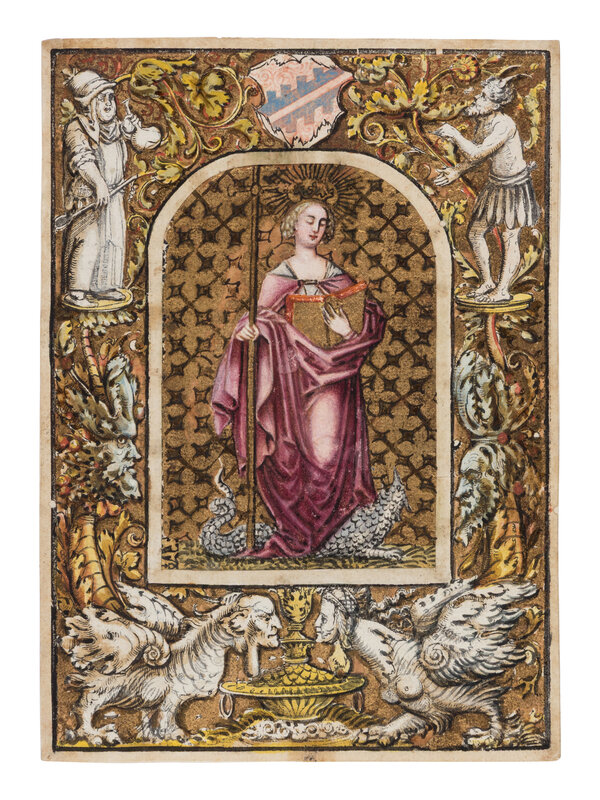
Sixteenth-century woodcut on paper, with borders of grotesques, later heightened with nineteenth-century hand illumination depicting Saint Margaret [Germany? 16th and 19th century]
Sixteenth-century woodcut on paper, with borders of grotesques, later heightened with nineteenth-century hand illumination depicting Saint Margaret [Germany? 16th and 19th century]
Rare sixteenth-century devotional woodcut—possibly by a follower of the Kleinmeister School—transformed in the nineteenth century into a richly illuminated Gothic Revival leaf depicting Saint Margaret.
174 × 125 mm. Single leaf from a sixteenth-century woodcut on paper, later enhanced with nineteenth-century hand illumination depicting Saint Margaret of Antioch, identified by the dragon at her feet and the slender staff and book she holds. The saint is rendered in a vivid magenta-pink robe with a gilded halo, set against a lavishly painted gold ground laid over the original print—perhaps replacing a damaged or earlier image of Saint Margaret or another saint, surrounding the central image are intricately decorated borders featuring vibrant floral arabesques, fantastical grotesques, and figures framed within architectural niches, these painted expertly in an earthy palette of browns and greens. An unidentified heraldic shield appears at the top, possibly indicating a patron’s arms.
The composition represents a compelling synthesis of Renaissance printmaking and Victorian medievalism: a sixteenth-century devotional woodcut reimagined in the nineteenth century as a richly illuminated “manuscript” leaf. Saint Margaret’s traditional iconography—the dragon subdued beneath her feet, the cross-staff, and the book—remains intact, its symbolic resonance (the triumph of faith over evil, the embodiment of wisdom) enhanced by a revivalist decorative vocabulary characteristic of the Gothic Revival.
The original woodcut, though still unidentified, bears stylistic affinities with the work of Sebald Beham and the so-called Kleinmeister School (“Little Masters” School of Engravers), known for their finely detailed devotional prints. Its anonymity suggests it may have been produced in very limited numbers, and its rarity today further underscores its value as a scarce example of early modern devotional print culture. The nineteenth-century interventions, far from merely restorative, elevate the sheet into a romantic pastiche of late-medieval piety and printmaking, blending historical fidelity with revivalist flourish.
Provenance
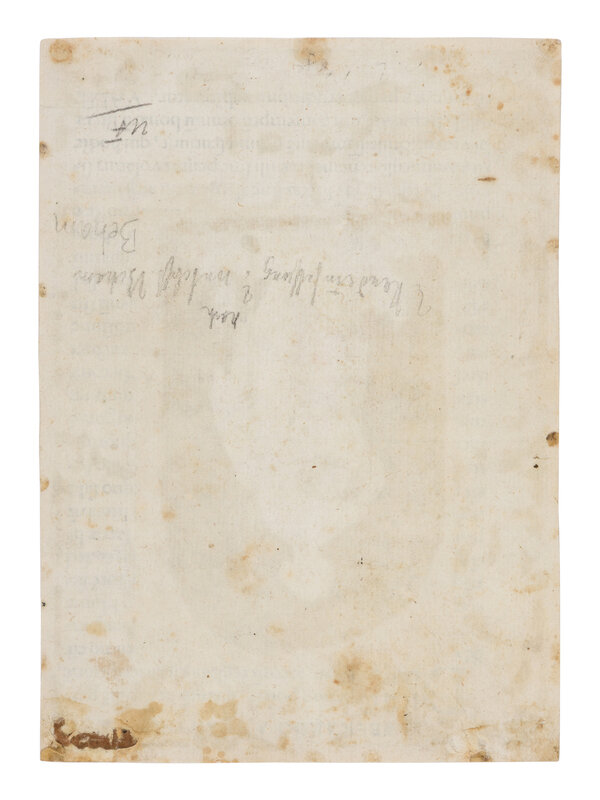
(1) Unidentified source, Munich – Recorded only as “Munich, ohn,” on reverse, likely indicating purchase in Munich from an unspecified dealer or owner (ohn prob. abbreviating ohne nähere Angaben, i.e. no further details available).
(2) Private Collection, California, USA.
LITERATURE
Unpublished. For related literature see: Roger Wieck, “Folia Fugitiva: The Pursuit of the Illuminated Manuscript Leaf,” Journal of the Walters Art Gallery 54 (1996), pp. 233–54; Alison G. Stewart, “Sebald Beham: Entrepreneur, Printmaker, Painter,” Journal of Historians of Netherlandish Art (2012), pp. 1–25.
We thank Senior Consultant Sandra Hindman and Peter Bovenmyer for their assistance in preparing this sale.
This lot is located in Chicago.