Condition Report
Contact Information
Auction Specialists
Lot 16
Sale 6388 - Western Manuscripts and Miniatures
Jul 8, 2025
10:00AM CT
Live / Chicago
Own a similar item?
Estimate
$4,000 -
5,000
Price Realized
$4,800
Sold prices are inclusive of Buyer’s Premium
Lot Description
PARIS WORKSHOP
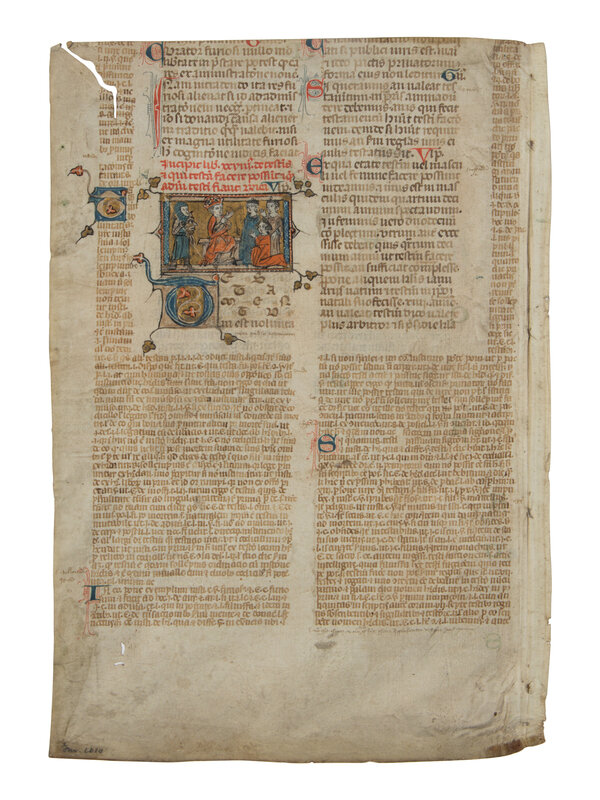
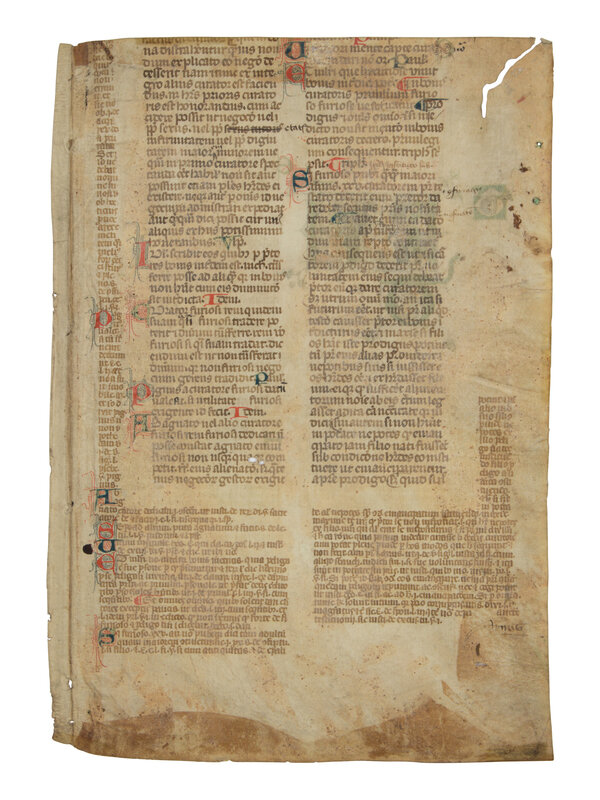
Leaf from an illuminated manuscript of Civil Law, with miniature of a witness cross-examined in court, in Latin, illuminated manuscript on parchment [France, probably Paris, c. 1300]
Leaf from an illuminated manuscript of Civil Law, with miniature of a witness cross-examined in court, in Latin, illuminated manuscript on parchment [France, probably Paris, c. 1300]
Illuminated single leaves of legal manuscripts are uncommon on the market.
c. 300 × 205 mm. Single cropped leaf, ruled in brown ink for two columns of variable line count (40 lines survive on recto, 25 on verso), text written in a well-spaced, rounded Gothic book hand, surrounded by gloss in a similar but slightly smaller script, with additional glosses added to the margins. Rubrics in red, two-line initials for paragraph marks alternate in red and blue, five-line initials in red begin textual units, one decorated initial ‘D’ of five lines, in blue on a rose ground with vegetal infill, marks the chapter incipit, ONE ILLUMINATED MINIATURE, occupying seven lines, depicting a juridical scene on a gold ground, set within a stylized frame of red, blue, and rose with burnished gold corners, and surrounded by marginal flourishes extending vertically and into the gutter, with terminals incorporating gold bezants and vegetal motifs. Recovered from use as a pastedown, staining caused by the turn-ins of a tanned leather binding, parchment torn at the upper left margin and trimmed with the loss of approximately five lines at the top, else in fair condition.
Recovered from binding material, this leaf illustrates the opening of Book XXVIII of the Corpus Iuris Civilis (Digest), specifically De testamentis et qui testamenta facere possunt (“On wills and those who can make them”), a foundational section of Justinian’s legal code. The miniature depicts a woman appealing to a seated judge, crowned as an emperor, who gestures toward his open left palm—symbolizing legal judgment or claim. Behind him stands a soldier bearing a lance and a shield adorned with a demonic face, while two clerics and the kneeling woman appear before the bench, dramatizing the legal plea. The scene likely represents a widow appealing for her inheritance rights, a central concern in Book XXVIII, which governs the making, revocation, and execution of wills, disinheritance, and succession.
Compiled in the sixth century under the Byzantine Emperor Justinian I, the Corpus Iuris Civilis formed the backbone of Roman law and remained influential throughout the medieval and modern periods. In the twelfth century, especially in France and northern Italy, the text experienced a major revival within the emerging university culture, particularly at Bologna and later in Paris. Its systematic treatment of civil law became the foundation for canon law, secular jurisprudence, and the development of the European legal tradition. This leaf, with its refined script, extensive gloss, and narrative miniature, reflects both the textual authority and visual pedagogy of law books used in academic and judicial settings during the high Middle Ages.
Provenance
(1) Unidentified French owner; inscribed in pencil “Inv. 1010” (recto, lower left corner).
(2) Sold anonymously at Sotheby’s London, 23 June 1999, lot 24.
(3) Robert McCarthy, London, MS BM 1231.
Sister leaves
Presently unknown.
LITERATURE
Sotheby's, London, Western Manuscripts and Miniatures, 23 June 1999, lot 24; Peter Kidd, The McCarthy Collection, Vol. 3, French Miniatures, London, 2021, no. 64.
We are grateful to Peter Kidd for permission to quote from his catalogue in this entry, and we thank Senior Consultant Sandra Hindman and Peter Bovenmyer for their assistance in the preparation of this sale.
The Collection of Robert McCarthy
This lot is located in Chicago.