Condition Report
Contact Information
Auction Specialists
Lot 15
Sale 6388 - Western Manuscripts and Miniatures
Jul 8, 2025
10:00AM CT
Live / Chicago
Own a similar item?
Estimate
$3,500 -
4,500
Price Realized
$5,120
Sold prices are inclusive of Buyer’s Premium
Lot Description
ANONYMOUS SOUTHERN FRENCH ILLUMINATOR
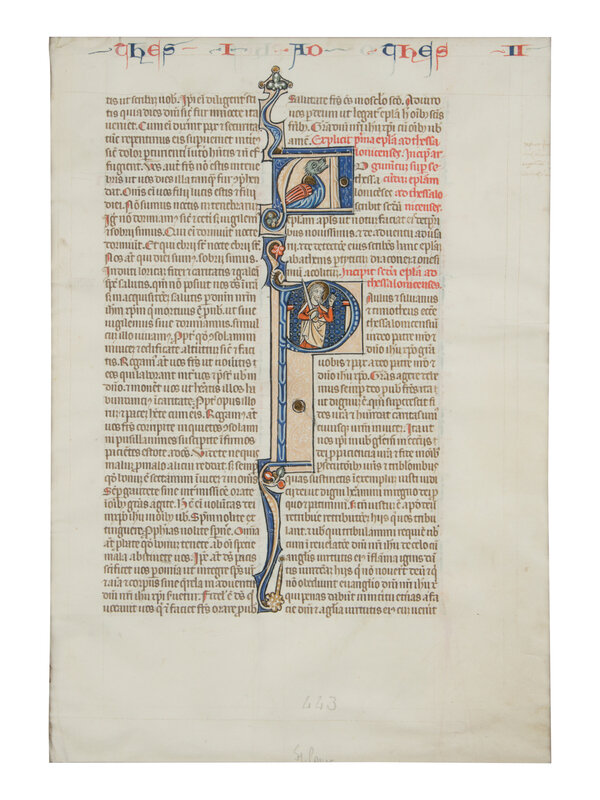
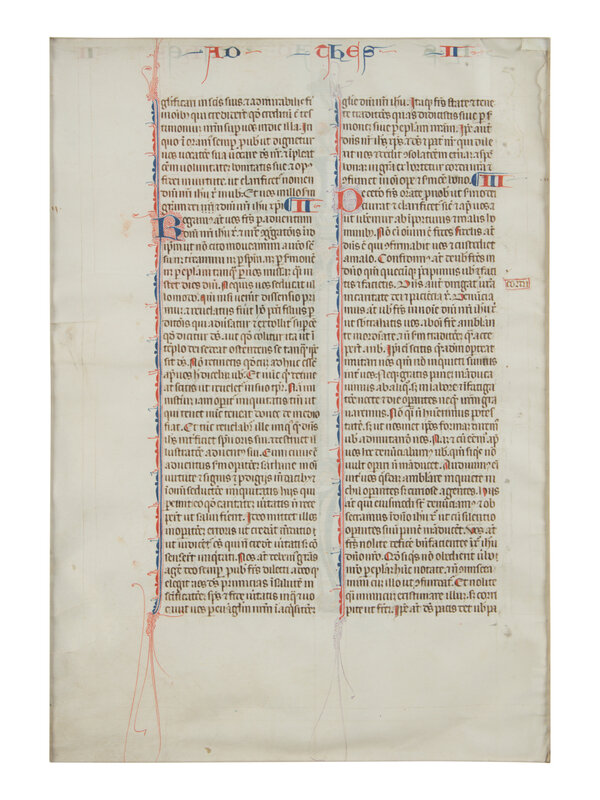
Single leaf with an illuminated initial ‘A’ and a historiated initial ‘P’ depicting St. Paul standing between two pillars, from the Mailhac-Faber Bible, in Latin, illuminated manuscript on parchment [southern France, late thirteenth or early fourteenth century]
Single leaf with an illuminated initial ‘A’ and a historiated initial ‘P’ depicting St. Paul standing between two pillars, from the Mailhac-Faber Bible, in Latin, illuminated manuscript on parchment [southern France, late thirteenth or early fourteenth century]
Once owned by Chester Beatty, the Mailhac-Faber Bible was a grand and majestic example of a late thirteenth-century Bible.
c. 335 × 235 mm. Single leaf, ruled in plummet and written below top line in two columns of forty lines, with catchwords typically enclosed in decorative cartouches featuring a T-shaped ornament, rubricator’s notes survive, cropped at all three outer edges, with prickings visible at the upper and lower margins, each leaf paginated in pencil by a 19th- or 20th-century Continental hand in the lower margin of the recto, ONE DECORATED INITIAL ‘A’ containing a bird, for the prologue to I Timothy, ONE HISTORIATED INITIAL ‘P’ of Saint Paul holding a sword. Wear to parchment in gutters, else in excellent condition.
This leaf comes from the so-called Mailhac-Faber Bible, a richly illuminated and still understudied manuscript whose origins have long been associated with southern France. Though the identities of its illuminators and workshop remain uncertain, the parchment, script, and notably brown ink suggest a regional production, likely in the southwest, and possibly near Bordeaux—a view echoed in several catalogues following the manuscript’s appearance at Sotheby’s in 1969. This attribution, however, is based largely on one of two sixteenth-century ownership inscriptions; the other points much farther southeast, leaving the precise place of origin unresolved.
The style of illumination is consistent with southern French book production of the late thirteenth century as recently surveyed by Alison Stones, and it is marked by a number of distinctive features. Most notably, initials incorporate a pair of vertical columns or plinths flanking the central figure—which in some sister leaves serves as a structural device that sometimes supports cusped arches but in other cases appear purely ornamental. This unusual structuring, combined with the manuscript’s artistic peculiarities, places it among the more intriguing products of the southern French Gothic tradition.
Provenance
(1) Written in southern France as the second volume of a two-volume Bible; the Isaiah leaf now in New Zealand was originally the first leaf of this volume. In the sixteenth century, the manuscript was still in a religious house in southern France, where two monks inscribed their names in the margins: "Frère Jehan Faihlac" (fol. 2r), referring to Mailhac (northwest of Narbonne), and "Frère Bernardus Faber Bourdelois" (fol. 280v), indicating a connection to Bordeaux.
(2) Probably later in Spain, owned by one of three collectors active in the late 18th or early 19th century (exact attribution uncertain): Juan de Santander (1729–1791), paleographer and royal librarian who published a catalogue of Greek manuscripts in the Biblioteca Real in 1769; Tomás González de Santander (1752–1831), Spanish bibliographer; or the Marqués de Astorga.
(3) The collection of Sir Thomas Phillipps (1792–1872), likely purchased through Thomas Thorpe (1791–1851), who cited the manuscript in his 1826 auction with provenance noted as “ex Bibliotheca de Astorgia” and “ex Hispania.” Phillipps MS 2506; with his manuscript label and stamped crest on the first leaf. Bound for Phillipps in half calf by Bretherton in 1849.
(4) By descent to his grandson, Thomas Fitzroy Fenwick (1856–1938), from whom it was purchased in December 1920 / January 1921 by Sir Alfred Chester Beatty (1875–1968). Described as “W. MS IX” and exhibited at Trinity College, Dublin, in 1955; later renumbered MS W.173 (but not re-foliated by Millar; cf. cat. 37). Among nearly 100 manuscripts given by Beatty to his second wife, Edith (née Stone, c. 1886–1952), who predeceased him intestate. The manuscript was listed as no. 49 in a typescript inventory of her estate and thus reverted to Beatty’s ownership.
(5) Alan G. Thomas (1911–1992) purchased from Beatty’s posthumous sale at Sotheby’s, 24 June 1969, lot 57; offered in his Catalogue 23 (1969), no. 5.
(6) Philip C. Duschnes (1897–1970), who subsequently dismembered the manuscript; leaves were on the market by 1975, with (i) appearing in his 1976 catalogue, no. 255.
(7) Present leaf Neil F. Phillips (1924–1997), perhaps responsible for the identifications written
in the lower margins: his sale at Sotheby's, 2 December 1997, lot 58. Catalogue Vol. III, 61d.
(8) Robert McCarthy, London MS BM 1137a.
Parent manuscript
The 1969 auction catalogue (see Provenance) states that the volume comprised 286 leaves and contained “the normal text of a Bible of the thirteenth-century recension ... with Acts following Pauline Epistles,” and was “complete except for 8 or 9 leaves of the Interpretations of Hebrew Names (4 after f. 284, 4 or 5 at the end).” According to the 1955 catalogue, the Interpretations occupied the final 24 leaves of the manuscript. The decoration included a large Jesse Tree at the start of Matthew (fol. 144v) and 107 additional illuminated initials, 76 of which were historiated, marking the beginnings of biblical books, prologues, and entries in the Interpretations of Hebrew Names.
Sister leaves
Approximately thirty leaves are listed by Margaret Manion et al., with six additional fragments recorded by David Gura. At least 56 sister leaves, with and without historiated initials, have been identified in private and public collections, including Dublin, Chester Beatty Library (W.173.1; W.173.2; W.173.3); Eagle Rock, CA, Occidental College; Dunedin, New Zealand (Reed fragment 41); and Notre-Dame, IN, Snite Museum of Art (Acc. 1975.43; Acc. 1975.57). For a recent list of thirty-one sister leaves with historiated initials, see Kidd 2021, no. 61, p. 203-205.
LITERATURE
T. Phillipps, Catalogus Librorum Manuscriptorum in Bibliotheca D. Thomae Phillipps, Bart., A.D. 1837, privately printed, Middle Hill, 1837–1871; repr. with an introduction by A.N.L. Munby, London, 2001, no. 2506; R.O. Dougan, A Loan Collection of Western Illuminated Manuscripts from the Library of Sir Chester Beatty, Exhibited in the Library of Trinity College, Dublin, Dublin, 1955, no. 9; Sotheby & Co., The Chester Beatty Western Manuscripts, Part II: Catalogue of Thirty-Eight Illuminated Manuscripts of the 8th to the 17th Century, London, 24 June 1969, lot 57; Alan G. Thomas, Catalogue Twenty-Three: Fine Books, London, 1969, no. 5 (ill.); Sotheby’s, Western Manuscripts and Miniatures Including the Manuscripts from the Collection of the Late Neil F. Phillips, Q.C., London, 2 December 1997, lot 58 (ill.); Peter Kidd, The McCarthy Collection, vol. 3: French Miniatures, London, 2021, no. 61.
We are grateful to Peter Kidd for permission to quote from his catalogue for this entry, and we thank Senior Consultant Sandra Hindman and Peter Bovenmyer for their assistance in preparing this sale.
The Robert McCarthy Collection
This lot is located in Chicago.