

Condition Report
Contact Information
Auction Specialist
Lot 290
Sale 6356 - American Historical Ephemera and Photography
Lots Open
Jun 18, 2025
Lots Close
Jul 2, 2025
Timed Online / Cincinnati
Own a similar item?
Estimate
$500 -
700
Price Realized
$915
Sold prices are inclusive of Buyer’s Premium
Lot Description
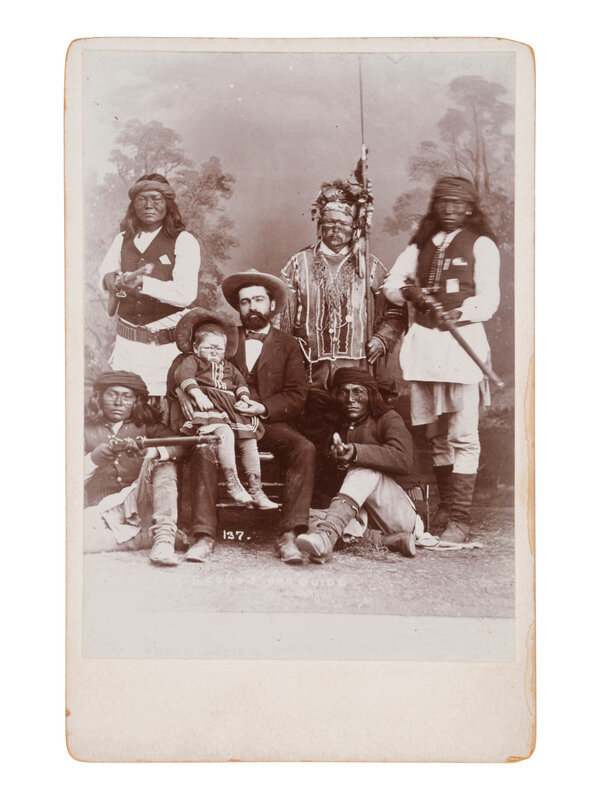
[NATIVE AMERICANS] Cabinet card of Al Sieber's Tonto Apache Scouts with unidentified white subjects
Studio photograph showing an unidentified white male subject seated at center, a white child wearing face paint on his lap, with an unidentified white man in Native dress, possibly a government official, standing behind him. Four Apache Scouts who purportedly worked with Albert Seiber are on either side of the white subjects. A caption, which is written in the negative, is difficult to discern but appears to read, in part, "Scouts and Guide." Uncredited, but possibly taken by Buehman of Tucson, AZ, ca 1880s.
Albert Sieber (1843-1907) was born in what is now Germany in 1843, the 13th of 14 children. As was too often the case in the past, his father died when he was just two years of age. His mother immigrated to Lancaster, PA with her eight living children in 1851. They later moved to Minnesota. In March 1862 he enlisted in the 1st Minnesota Volunteer Infantry and fought in a number of key battles over the next year, including Antietam, Fredericksburg, and Chancellorsville. At Gettysburg, the 1st MN was ordered to delay a Confederate assault on Cemetery Ridge on July 2, what many thought would be a suicide mission. It turned into one of the key maneuvers of the multi-day battle. The casualty rate for the unit in that battle was 82%, with Sieber being among the wounded. It was only one of at least 28 wounds suffered during his career.
After the Civil War Sieber went West to engage in a number of “Western” ventures – prospecting, ranching, and Indian fighting and scouting. General George Stoneman hired Sieber in 1871 as Chief of Scouts. He participated in Crook’s Apache campaign for the next two years. He continued working on the reservations and scouting for nearly one and a half decades. In 1883, he was involved in trying to locate Geronimo. He was in the field, but not present when Geronimo surrendered to Lieutenant Charles Gatewood and Nelson Miles in 1886.
In 1887 Sieber and most of the Army officials at San Carlos left on business, leaving the Kid, Sergeant of Scouts, in charge. The scouts decided to celebrate with an alcoholic beverage, things got ugly and The Kid’s father was killed. Then a friend of the Kid’s retaliated, killing the murderer and his brother. When Sieber and the officers returned, they disarmed the combatants until the shootings could be investigated. Someone in the crowd of onlookers fired a shot, more shots were fired, and Sieber was wounded again. This effectively ended his scouting career.
He was fired from his position as chief of scouts in 1890. He returned to prospecting for a while, and seems to have taken on other “odd jobs.” In 1907 he was leading an Apache work crew that was building the Tonto Road (Gila Co., AZ), a project under the supervision of another famous scout, Luther Kelly. A large boulder, estimated to weigh at least 5 or 6 tons, was being moved by Sieber’s crew. They dug around it all day, but could not get it to move. Sieber did not want to leave it until the next day, so he went below to see what the problem was. He is reported to have crawled under the rock to move an obstruction - and the rock finally did move, crushing Sieber as it tumbled downhill.
The Michael Feorino Collection of Native American and Western Photography
This lot is located in Cincinnati.