Condition Report
Contact Information
Auction Specialist
Lot 213
Sale 6330 - Fine Printed Books & Manuscripts, Including Americana
May 8, 2025
10:00AM CT
Live / Chicago
Own a similar item?
Estimate
$2,000 -
3,000
Price Realized
$1,280
Sold prices are inclusive of Buyer’s Premium
Lot Description
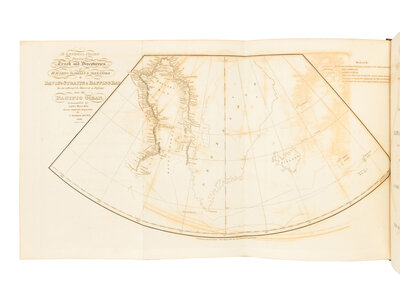
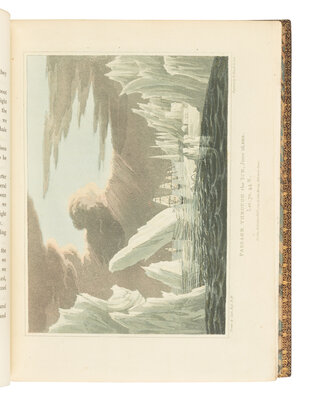
[TRAVEL & EXPLORATION]. ROSS, John, Sir (1777-1856). [First and Second Voyages]. London: John Murray, A.W. Webster, 1819, 1835.
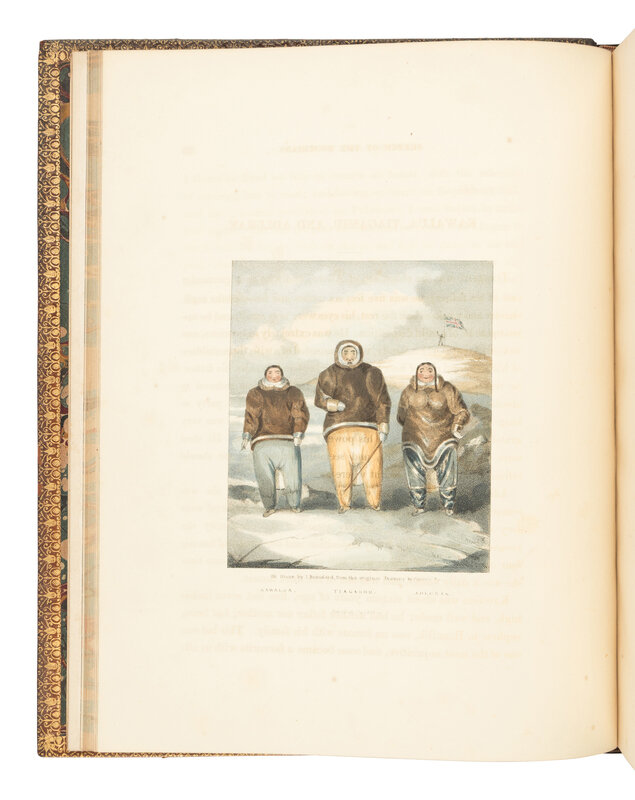
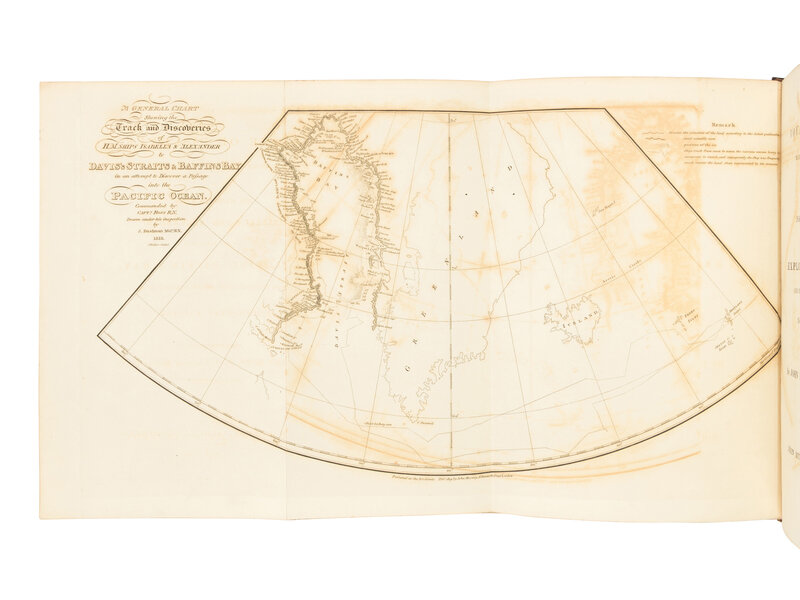
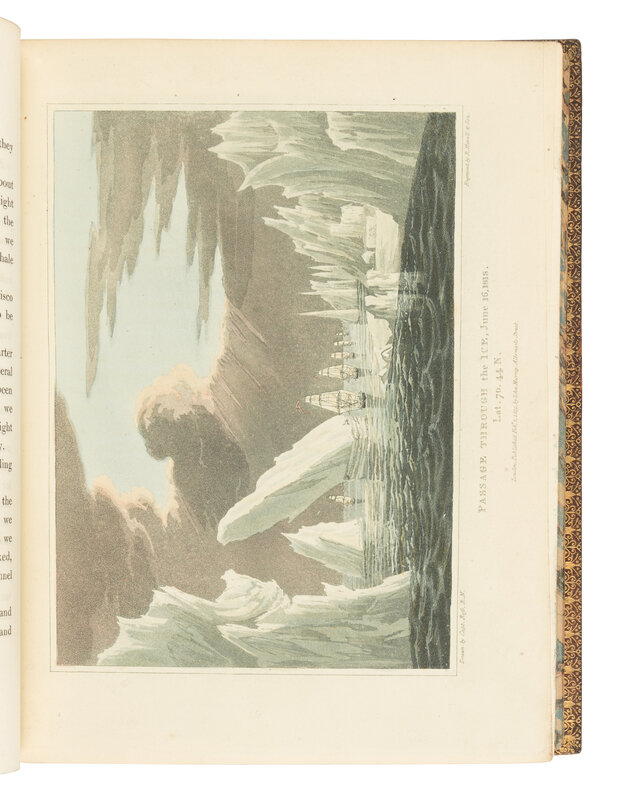
Together, 3 works in 3 volumes, 4to (273 x 216 mm). FIRST VOYAGE: 3 folding engraved maps, 29 aquatint plates (15 hand-colored). SECOND VOYAGE: 2 engraved folding maps, 19 aquatint plates (3 hand-colored). SECOND VOYAGE, APPENDIX: 20 aquatint plates (11 hand-colored). (Some folding plates with offsetting, also with offsetting to text from plates, occasional spotting or browning at margins.) Contemporary tree calf, spines in 6 compartments with 5 raised bands (boards detached or starting, flaking to spines, rubbing). Provenance: Isaac Adams (1802-1883), American politician and inventor of the Adam Power Press which became the leading printing press of the 19th century (ownership bookplates).
FIRST EDITIONS OF ROSS'S FAMOUS ACCOUNTS OF HIS FIRST AND SECOND VOYAGES WITH THE RARE SECOND VOYAGE APPENDIX.
FIRST VOYAGE: In 1818, Sir John Ross was given command of the Isabella with the aim of finding a Northwest Passage. Accompanied by Lieutenant William Edward Parry in command of the Alexander as well as his nephew James Clark Ross and scientist Sir Edward Sabine, he attempted to proceed westward through Lancaster Sound, making it a number of miles in before being stopped by what Ross described as a mountain range which he named the Croker Mountains. On his return to England, his observations were initially accepted as conclusive. He was promoted to post rank on 7 December 1818. Controversy would soon follow, as Sir John Barrow, who learned that there were some doubts as to the existence of the Croker Mountains, dispatched another expedition under the command of Parry. Despite Ross's willingness to make another voyage, he was not given another opportunity to lead an Arctic expedition until 1829.
SECOND VOYAGE: After Ross's disastrous voyage in 1818, the Admiralty refused to let Ross lead another expedition until 1829. He secured funding from gin magnate Felix Booth and contributed financially to the voyage himself. He sailed, with his nephew James Clark Ross as second in command, on the steam vessel Victory, which was the first steam-powered Arctic exploring vessel. Victory was beset in ice for four consecutive winters, during which the expedition explored Prince Regent Inlet, and discovered Boothia Peninsula and crossed it; James Clark Ross discovered the North Magnetic Pole. The party made their way by sledge and small boat to Lancaster Sound, where they found Ross's old ship, the Isabella, which they used to return to England. James Clark Ross was knighted for his discovery of the magnetic pole. The performance and loss of the Victory were long disputed by the Admiralty, her engine makers, and Ross, resulting in a pamphlet war. A supplementary Appendix volume was published later the same year which more fully detailed the expedition's scientific discoveries and provided the first descriptions of the Boothia Eskimos as well as vocabulary, reports on chronometers, meteorology and magnetism, tables of Latitude and Longitude, Ross's theory on the Aurora Borealis, and James Clark Ross and John Richardson's reports on the region's natural history. This appendix did not see as large a print run as the full narrative. Abbey Travel 634, 636; Arctic Bibliography 14866, 14873; Field 1321; Hill 1490; Lande 1426; Sabin 73381; Staton & Tremaine/TPL 1808.