
Condition Report
Contact Information
Auction Specialist
Lot 360
Sale 6319 - American Historical Ephemera and Early Photography
May 1, 2025
10:00AM ET
Live / Cincinnati
Own a similar item?
Estimate
$700 -
900
Price Realized
$840
Sold prices are inclusive of Buyer’s Premium
Lot Description
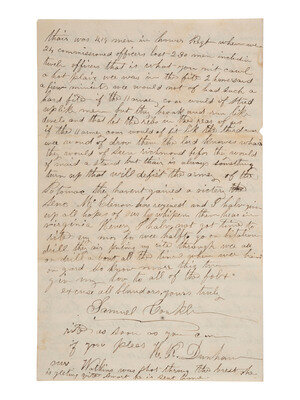
[CIVIL WAR]. Soldier's letter from Samuel Conklin, 141st PA Vols, recounting his and others' wounds sustained at the Battle of Chancellorsville. 20 May 1863.
[CIVIL WAR]. Soldier's letter from Samuel Conklin, 141st PA Vols, recounting his and others' wounds sustained at the Battle of Chancellorsville. 20 May 1863.
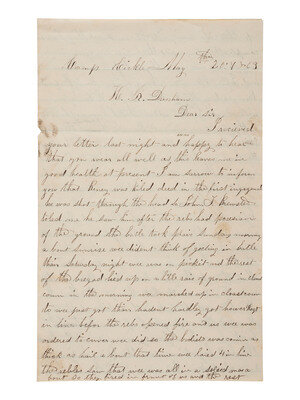
"Camp Cickle [sic]," 20 May 1863. Addressed to H. R. Dunham, a first lieutenant of the 141st Pennsylvania, who was discharged for disability in December of 1862. He and Conklin both served in Company K together.
4 pages, 4 7/8 x 7 7/8 in., creased at folds, with some smudges of soiling and one hole to bifolium edge.
Writing just two weeks after the bloody Battle of Chancellorsville, in which the 141st was heavily engaged, Conklin laments the death of a mutual friend, Joseph "Beney" Huffmaster," who Conklin learned was shot through the head during the battle. Conklin writes that the battle took place Sunday morning, which would have been 3 May, the fiercest day of the week-long battle. He writes that his regiment was on picket Saturday night while the rest of the brigade was position on an area of raised ground.
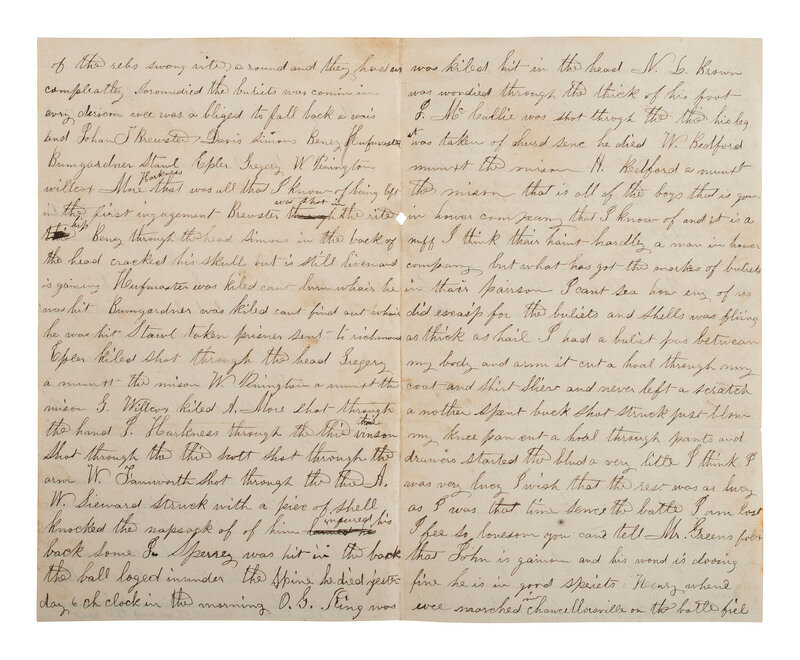
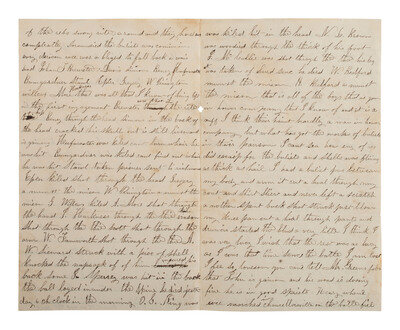
On Sunday morning, they marched up and when the Confederate soldiers began firing, Conklin's regiment was ordered to cover. He writes: "Wee [sic] did so the buliets [sic] was comin [sic] as thick as hail about that time wee laied [sic] 4 in line the rebles [sic] saw that wee was all in a solied [sic] mas [sic] a bout so they fired in frunt [sic] of us and the rest rest of the rebs swong [sic] rite [sic] around and they had us compleatley [sic] soroundied [sic] the buliets was comin in evry [sic] dericon [sic] wee was a bliged [sic] to fall back a wais [sic]."
He then lists numerous fellow Company K men who were casualties of the fight, including John Brewster, who was shot in the right hip; Joseph "Beney" Huffmaster, who was shot through the head; Davis Simmons, who was shot in the back of the head but is still living; G. J. Baumgartner, who was killed but Conklin does not know where he was shot; John Harkness, who was shot in the thigh; Gordon Wilcox, who was killed, Albert Moore, who was shot in the hand; and several others.
At the end of this long list, Conklin writes, "I think thair [sic ] haint [sic] hardly a man in hower [sic] company but what has got the markes [sic] of buliets in thair parrson [sic]. I can't sea [sic] how eny [sic] of us did escaip [sic] for the buliets and shells was fli'ing [sic] as thick as hail. I had a buliet pas [sic] betwean [sic] my body and arm it cut a hoal [sic] through my coat and shirt sliev [sic] and never left a scratch. A nother [sic] spent buck shot struck just blow [sic] my knee pan cut a hoal through pants and drawers started to bleed a very little I think I was very lucy [sic]." Conklin writes that in the time since the battle he has felt lost, and lonesome.
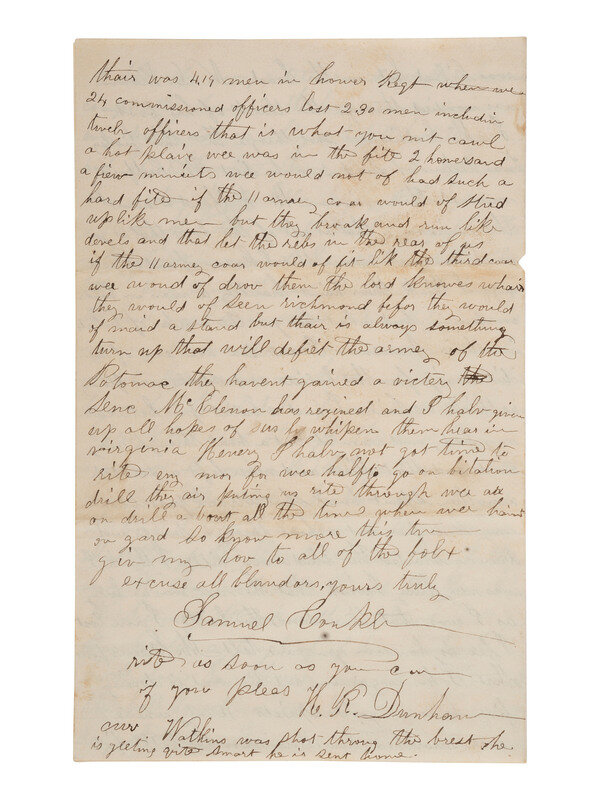
In an interesting turn, Conklin also lays blame for the great loss of his regiment at the feet of the XI Army Corps, commanded by General Howard from 1-3 May. The Corps was unprepared for the 2 May attack by Stonewall Jackson and, barely resisting, fled east. Conklin writes: "Wee would not of had such a hard fite [sic] if the 11 army coar [sic] would of stud [sic] up like men but they broak [sic] and run like devels [sic] and that let the rebs in the rear of us if the 11 army coar would of fit [sic] lik [sic] the third coar wee woud of drov [sic] them the lord knowes [sic] whair [sic]..."
Beneath his signature, Conklin adds, "Our Watkins was shot throug [sic] the brest [sic] he is geeting [sic] quite smart he is sent home."
The 141st saw heavy engagement throughout the war, including the Battle of Chancellorsville, where it suffered 235 casualties including Lieutenant Colonel Guy Watkins, who was wounded and taken prisoner. The regiment then fought at Gettysburg, positioned at the angle on the right of the Peach Orchard, leaving the men exposed in the field and sustaining incredible losses amounting to nearly 70 percent of their number. The battle at Kelly's Ford and the Mine Run Campaign ended took them into the winter of 1863. Thereafter, the regiment participated in the Rapidan Campaign, battles at the Wilderness, Spottsylvania, Spottsylvania Court House, and Cold Harbor before participating the Siege of Petersburg. The regiment was present at the fall of Petersburg and the surrender of Lee at Appomattox Court House before mustering out on 28 May 1865.