



Condition Report
Contact Information
Auction Specialist
Lot 357
Sale 6319 - American Historical Ephemera and Early Photography
May 1, 2025
10:00AM ET
Live / Cincinnati
Own a similar item?
Estimate
$800 -
1,200
Price Realized
$704
Sold prices are inclusive of Buyer’s Premium
Lot Description
[CIVIL WAR]. 1864 diary of Private Joseph C. Foster, 148th New York Infantry, wounded at Battle of Chaffin's Farm.
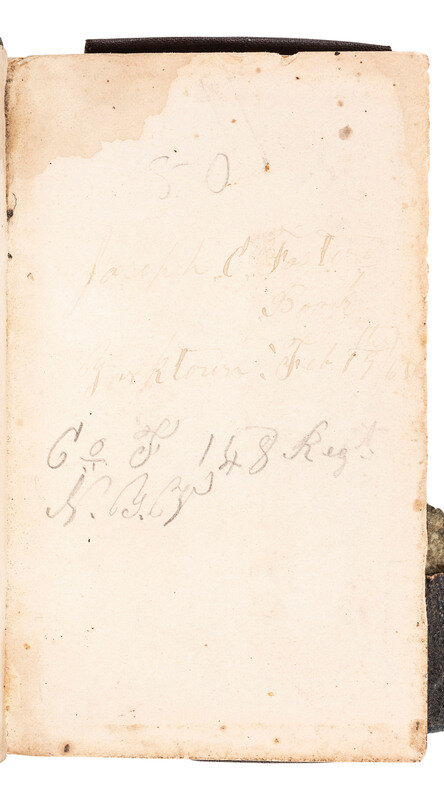
Leatherette 1864 pocket diary with entries spanning from 19 February - 30 December, approx. 117 inscribed pages (including front and back matter), 3 x 4 3/4 in. (loss to cover flap, wear to extremities). Almost daily entries. Inscribed on front free endpaper: "Joseph C. Foster's Book / Yorktown, Feb the 19 6 [indecipherable] / Co. F 148 Regt, N.Y.V."
Joseph C. Foster enlisted as a 23-year-old private on 28 August 1862, and mustered into Company F of the 148th New York Infantry Regiment the following month.
The 148th was recruited primarily from Ontario, Seneca, and Yates counties, organized at Geneva, and mustered into service for three years beginning on 14 September 1862. The regiment engaged mostly in garrison duty at Suffolk, Norfolk, and Yorktown, VA until 1864, when it attached to the 2nd "Wistar's" Brigade, 2nd Division, XVIII Corps, Army of the James.
Foster's early entries include reports of working on various construction projects and bits of war news. On 7 March, he writes of witnessing the execution of Thomas Abraham of the 139th New York Infantry Regiment. Abraham's records indicate that he allowed a prisoner to escape. On 12 March, Foster reports that "the Brigade of Colored Troops returne[d] from the Expedition, with about thirty prisoners..." The XVIII Corps included multiple colored brigades including Hincks' Colored Division. These units saw numerous engagements during the war.
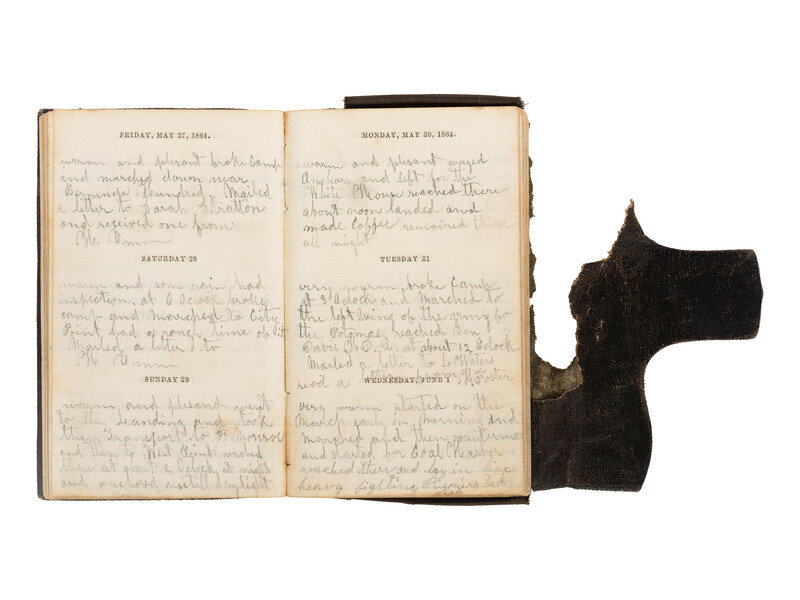
Foster's regiment participated in the Bermuda Hundred campaign during the month of May, on the 4th or 5th reaching Bermuda Landing, from which where Foster reports skirmishing on the turnpike between Richmond and Petersburg on the 6th and 7th. On the 9th, they broke camp and marched toward Petersburg, engaging with the enemy along the way: "...whole command marched towards petersburgh [sic] had a fight our Regt supported a Battery & Cos A and B was out schermish [sic]." This engagement would be called the Battle of Swift Creek.
On 16 May, the regiment was engaged at the Battle of Fort Darling, or Proctor's Creek. Foster writes, "...the Regt was engaged, Seven killed and several wonded [sic] in Co. F. Gen. Butler's command fell back to Bermuda Landing." Foster reports skirmishing around their position nearly every day from the 19th through the 24th, including his note on the 19th that the X Army Corps were skirmishing "all day with the bonny Rebs." On the 26th, his own regiment met the enemy and "commenced skirmishing; killed 4 missing 2 wounded severl [sic]; at night the Regt returned to Camp."
Foster's regiment broke camp and began marching on 31 May, reaching General Davis's Headquarters at noon. On the 1st of June, he writes, "started on the march early in morning and marched and then countermar[ched] and started for Coal [sic] Harbor. Reached there and lay in line heavy fighting Reb Prisoners taken."
The Battle of Cold Harbor waged on, with Foster reporting his own regiment laying in the line of battle, and engaging on the 3rd of June, suffering 3 killed and 10 wounded. On the 6th, "a Flag of Truce went over to the Rebs got permission to bury our dead and then was refused for arranging some guns in their sight." He reports on the 10th the death of James E. Woodin, of Company C, who "was killed by a piece of shell from our own battery." The 148th was relieved from the front line of battle by the 27th Massachusetts on the 11th, and the battle officially ended the following day.
Foster's regiment shifted almost immediately to the first assault on Petersburg, engaging heavily on 15 June, on which date Foster reports, "commenced skirmishing. Lost quite heavy in killed wounded and missing. I was detailed for Provost Guard, our men captured a Fort with 8 guns and a 1,000 prisoners." On the 18th, Foster's brigade was "in the advance, made three charges and carried the works each time, our Regt. lost 46 in killed and wounded heavy fighting on our left."
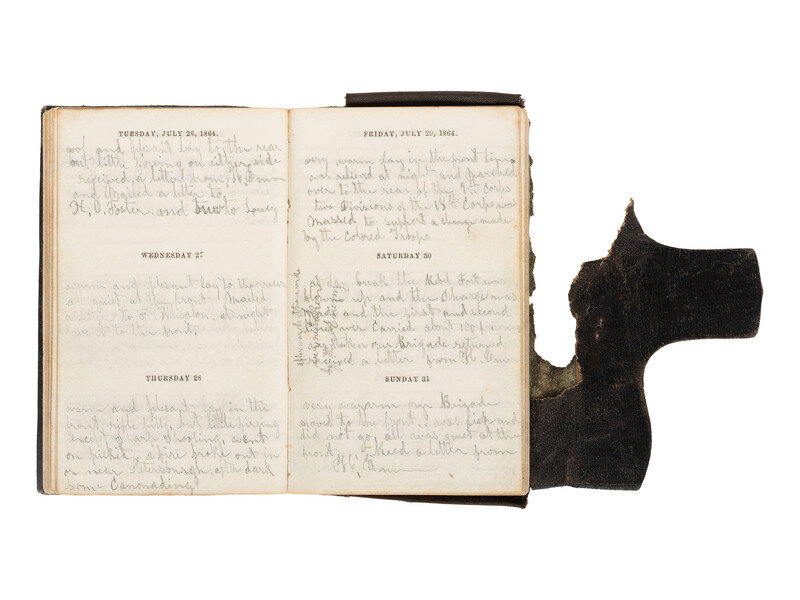
The regiment spent that summer doing duty in in the trenches before Petersburg and on the Bermuda Hundred front. On 29 July, Foster notes that after laying in the front line, he was relieved at night and marched to the rear of the IX Corps, and that "two Divisions of the 18th Corps was massed to support a charge made by the Colored Troops." In his entry from the following day, the charge is reported as being made, with the first and second lines carried, and about 100 prisoners taken.
Tragedy struck in the rifle pits on 15 August, when "in the afternoon it commenced to rain it flooded our camp and Sutlars [sic] and Commissarys [sic] was washed down the stream, and many were dround [sic] both Black & white."
News of General Philip Sheridan's victory in the Shenandoah Valley came to the 148th on 20 September, and the following day a salute was fired "all along the line in honor of Sheriden's [sic] victory."
The Battle of Chaffin's Farm would see the regiment suffer 24 casualties, including Foster himself. On 28 September, the regiment crossed pontoon bridges at the James River to get into position, marching in "close column by division" on the 29th, when skirmishing commenced. Foster writes, "Drove Chaffin's Bluff [sic], when shelling I got hit with a piece of shall was not able to go with the Regt any farther. Left for camp." Foster saw the doctor the next day and was "excused," remaining in camp that day and for 4 days thereafter.
The Battle of Fair Oaks commenced on 27 October. Foster had been in the hospital with ague, and marched from the field hospital north of the James River to the hospital at Point of Rocks. He writes that "the 18th A. C. marched to the right near Seven Pines had an engagement our Regt lost heavy." He reports some of the wounded from the 148th coming to the hospital the following day, 28 October. In all, the 148th lost one officer and 4 men killed or mortally wounded, one officer and 12 men wounded, and one officer and 65 men captured or missing.
Foster would remain in the hospital for a lengthy period. Muster rolls show that he was declared "Absent," being sick in the hospital from October 1864 to June 1865, when the regiment mustered out of service.
Accompanying the diary are photocopies of records from the National Archives detailing Foster's war record and pension application; a typewritten history of the 148th New York; a typewritten transcription of the diary entries; and a faint photocopy of a section of a newspaper from 20 August 1913 in which Foster's obituary appears.