Condition Report
Contact Information
Lot 111
Sale 624 - Adventure & Exploration Library of Steve Fossett
Oct 31, 2018
4:59AM CT
Live / Chicago
Own a similar item?
Estimate
$1,000 -
1,500
Price Realized
$813
Sold prices are inclusive of Buyer’s Premium
Lot Description
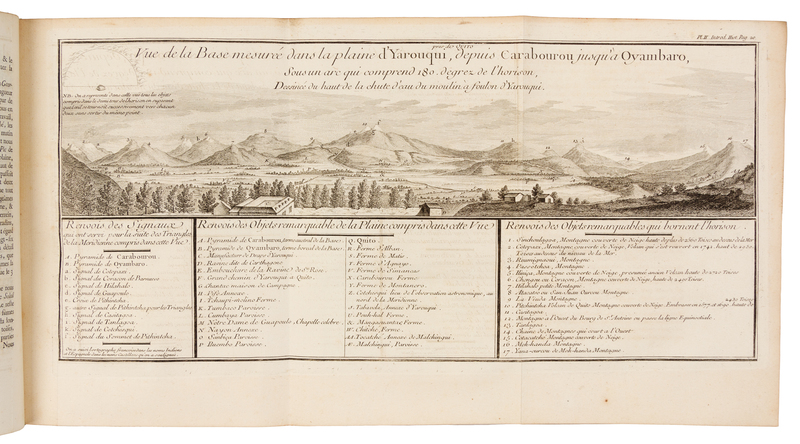
LA CONDAMINE, Charles Marie de (1701-1774). Journal du Voyage fait par ordre du Roi, a L'quateur, servant d'introduction historique a la Mesure des Trois Premiers Degrs du Mridien. --Histoire des Pyramides de Quito. --Mesure des Trois Premiers Degrs du Meridien dans L'Hmisphere Austral. Paris: L'Imprimerie Royale, 1751.
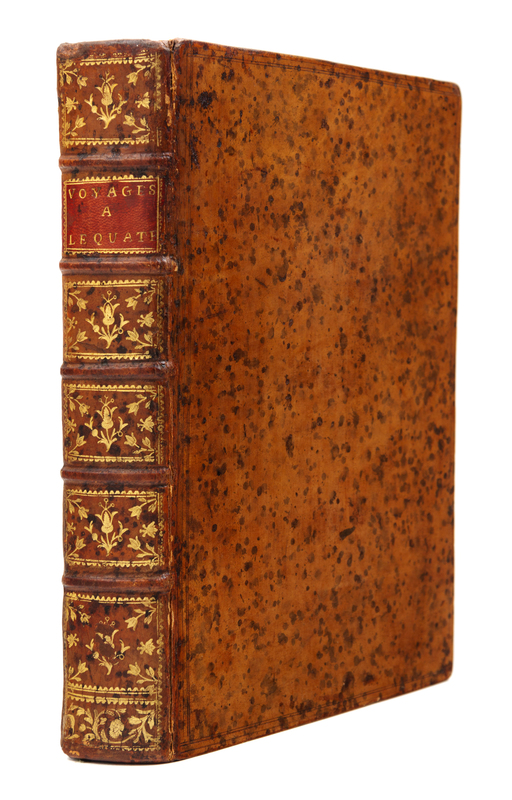
3 parts in one volume, 4to (251 x 192 mm). 3 title-pages. 2 engraved folding maps, 9 engraved plates (8 folding). Contemporary French speckled calf gilt, spines gilt, red morocco lettering-piece gilt (rear joint repaired). Provenance: Pierre Amalric (bookplate); Etienne Chizel (bookplate).FIRST EDITION of this first complete official account of the Equatorial research conducted during the French Academy of Sciences' two expeditions between 1735 and 1739 to measure several degrees of the meridian to accurately determine the dimensions and shape of the earth. In conjunction with a similar expedition to Lapland, this expedition helped settle the controversy between the Cartesians and Newtonians as to whether the earth was flattened or elongated at the poles. They embarked in 1735 and landed at Cartagena the following year. They crossed Panama to reach the Pacific, and set up their observatory at 8,000 ft. near Quito on the Andean plateau. They eventually completed their measurements in 1743, after which the scientists returned to France. La Condamine spent 2 months traveling down the Amazon, and 5 months at Cayenne before he returned to Paris in 1758. "The scientific result of the expedition was clear: the earth is indeed a spheroid flattened at the poles, as Newton had maintained. Bouger and La Condamine were unable, however, to agree on the joint publication of their works. Their long quarrel continued through a series of memoirs that were essentially mutual refutations of no scientific value; it ceased only with the death of Bouger in 1758" (DSB). Norman 1249 & 1250; Sabin 38479 & 38483.