Condition Report
Contact Information
Lot 707
Sale 2067 - American Historical Ephemera and Photography
Lots Open
Nov 6, 2024
Lots Close
Nov 20, 2024
Timed Online / Cincinnati
Own a similar item?
Estimate
$400 -
600
Price Realized
$254
Sold prices are inclusive of Buyer’s Premium
Lot Description
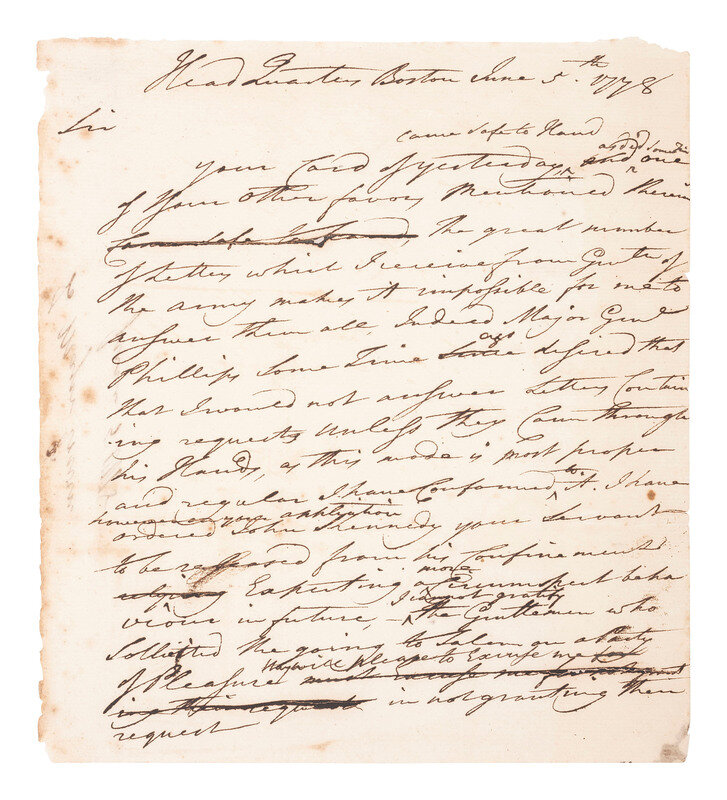
[REVOLUTIONARY WAR]. HEATH, General William (1737-1814). Letter from General Heath, 1778.
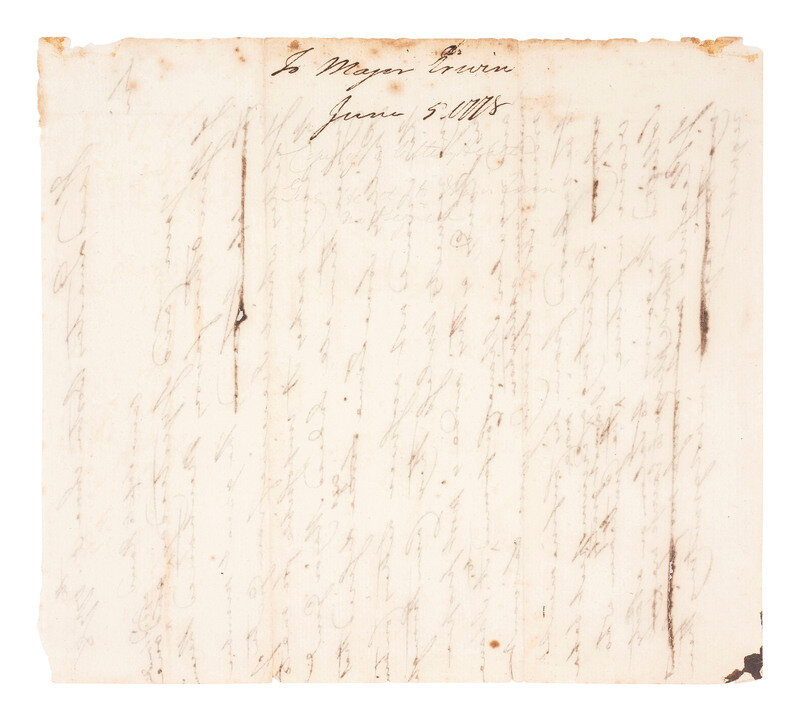
HEATH, General William. Autograph document, unsigned, written while in command of the Eastern Military District. "Head Quarters Boston." 5 June 1778. 1p, approx. 7 1/2 x 8 1/4 in. Addressed on verso "To Major Erwin / June 5 1778."
Heath writes to Major Erwin regarding the release of a servant, writing in part: "Your card of yesterday came safe to hand...The great number of letters which I receive from Gentlmn of the Army makes it impossible for me to answer them all. Indeed Major General Phillips some time ago desired that I would not answer letters containing requests unless they came through his hands, and this made it most proper and regular. I have confirmed to it. I have ordered however your application John Kennedy your servant to be released from his confinement expecting a more circumspect behavior in future. I cannot gratify the Gentleman who solicited the going to Salem on a Party of Pleasure. Please excuse me in not granting their request."
William Heath made his home for his entire life at his family’s farm in Roxbury, Massachusetts. He became active in the militia, and was a captain of the Roxbury Company of the Suffolk County militia regiment in 1760. By 1770 he was the regiment's colonel and its commanding officer. In 1765 he was elected as a member of the Ancient and Honorable Artillery Company of Massachusetts and was elected as the Company's lieutenant in 1768 and as its captain in 1770. In December 1774 the revolutionary government in Massachusetts commissioned him as a brigadier general.
Heath commanded Massachusetts forces during the last stage of the Battle of Lexington and Concord in April 1775. As the siege of Boston began, Heath devoted himself to training the militia involved in the siege. In June of that year, Massachusetts named him a major general in the state troops, and the Continental Congress commissioned him a brigadier general in the newly formed Continental Army. In 1776 Heath participated in the defense of New York City, and was one of those who urged General Washington not to abandon the city. He saw action at Long Island, Harlem Heights, and White Plains. In August 1776 he was promoted to major general in the Continental Army, but Washington had doubts about Heath's abilities and posted him where no action was expected. In November he was placed in command of forces in the Hudson River Highlands. In January 1777, Washington instructed Heath to attack Fort Independence in New York in support of Washington's actions at Trenton and Princeton, but Heath's attack was botched and his troops were routed. He was censured by Washington and thereafter was never given command of troops in combat. General Heath was placed in charge of the Convention Army of John Burgoyne’s surrendered troops after the Battle of Saratoga. In 1780 he returned to command the Highland Department after Benedict Arnold’s treason.
After the Revolutionary War, General Heath was a member of the Massachusetts Convention that ratified the United States Constitution in 1788. He served in the state Senate 1791–1792, and as a probate court judge. In 1806 he was elected the Lieutenant Governor of Massachusetts, but declined the office. He died at home in Roxbury on January 24, 1814, and was buried nearby in Forest Hills Cemetery. The town of Heath, Massachusetts, is named in his honor.