
Condition Report
Contact Information
Lot 702
Sale 2067 - American Historical Ephemera and Photography
Lots Open
Nov 6, 2024
Lots Close
Nov 20, 2024
Timed Online / Cincinnati
Own a similar item?
Estimate
$500 -
750
Price Realized
$699
Sold prices are inclusive of Buyer’s Premium
Lot Description
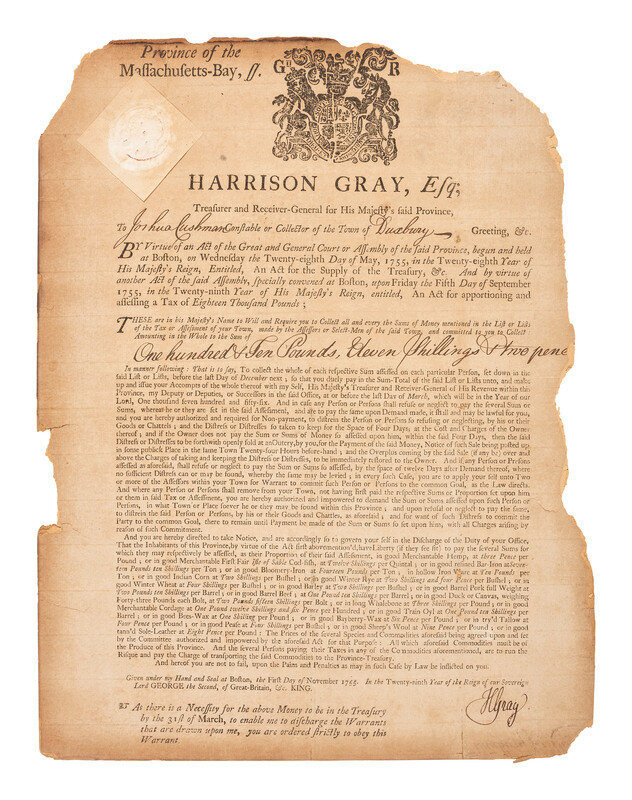
[COLONIAL]. GRAY, Harrison (1711-1794). Broadside signed. Boston, 1 Nov. 1755.
Broadside signed as Treasurer and Receiver-General, directing Joshua Cushman, Constable or Collector of the Town of Duxbury, to collect and remit certain taxes. Boston, Province of the Mass-Bay, 1 Nov. 1755. Approx. 15 1/4 x 11 3/4 in. Headed by the British Royal Coat of Arms flanked by "G.II" to the left and "R" to the right, with paper and wax seal to upper left.
Broadside reads, in small part: "Harrison Gray, Esq; Treasurer and Receiver-General for His Majesty's said Province. To Joshua Cushman Constable or Collector of the Town of Duxbury, greeting, &c...Theseare in his Majesty's Name to Will and Require you to Collect all and every the Sums of Money mentioned in the List or Lists of the Tax Assessment of your Town, made by the Assessors or Select-Men of the said Town, and committed to you to Collect Amounting in the Whole to the Sum of One hundred & Ten Pounds, Eleven Shillings & two pence...And hereof you are not to fail, upon the Pains and Penalties as may in such Case by Law be inflicted on you."
Early American broadside signed by Harrison Gray, a wealthy merchant who served as Treasurer and Receiver-General for the Province of Massachusetts Bay from 1753 until
the beginning of the American Revolution.
On the eve of the Seven Years War in the Province of Massachusetts, town constables such as Joshua Cushman shouldered an array of public responsibilities, including announcing town meetings, serving writs for the town clerk, and collecting local taxes. Although they received a commission for the taxes collected, constables were also held personally responsible for any taxes unpaid, authorized by writ of the Provincial Treasurer and enforced by County Sheriffs. By virtue of this warrant, Gray is compelling Cushman to his tax-collecting duties. But by 1775, Gray was forced to choose to between the cause of the Americans or loyalty to the British Crown. He remained a Loyalist. His property was ultimately confiscated, and in 1776 Gray was forced to flee Boston, spending the remainder of his life in London.