Condition Report
Contact Information
Lot 91
Lot Description
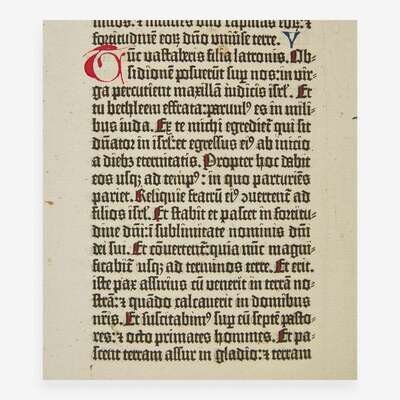
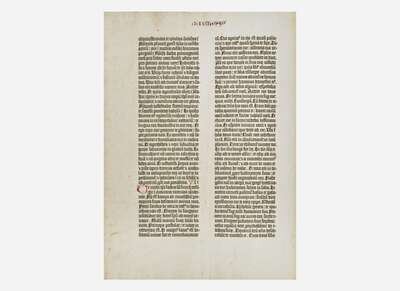
A Leaf from the Gutenberg Bible, Printing Micah's Messianic Prophecy
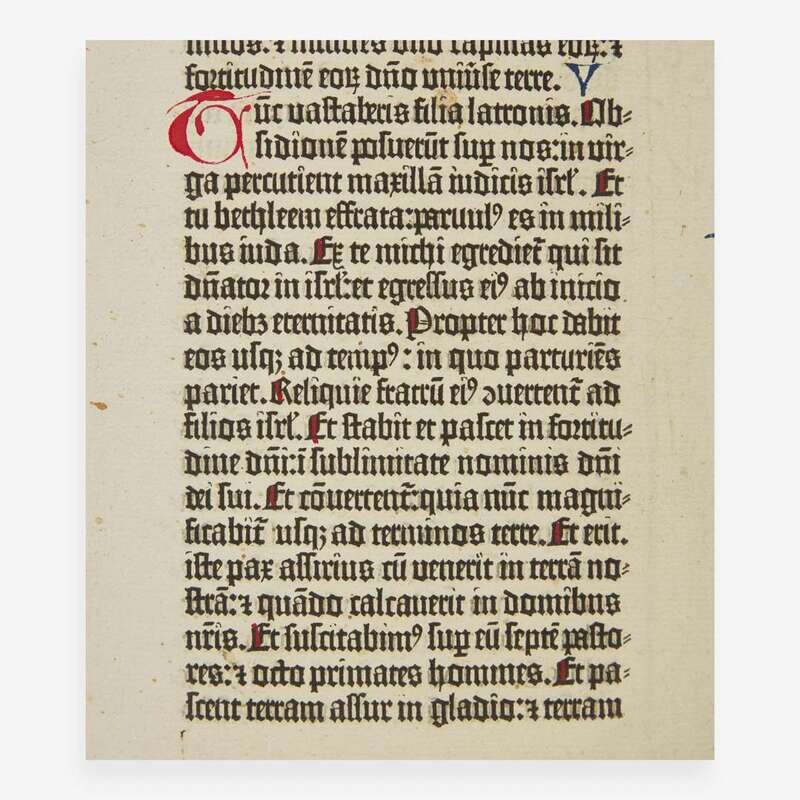
"But you, Bethlehem Ephrathah, though you are small among the clans of Judah, out of you will come for me one who will be ruler over Israel, whose origins are from of old, from ancient times.”
Gutenberg, Johannes, and Johann Fust
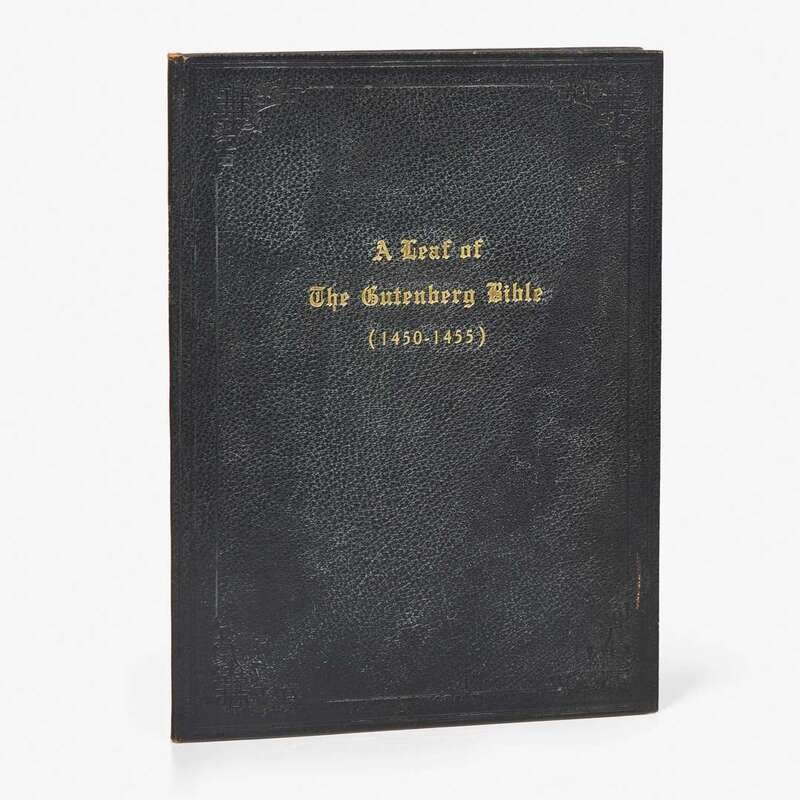
Leaf from the Gutenberg Bible
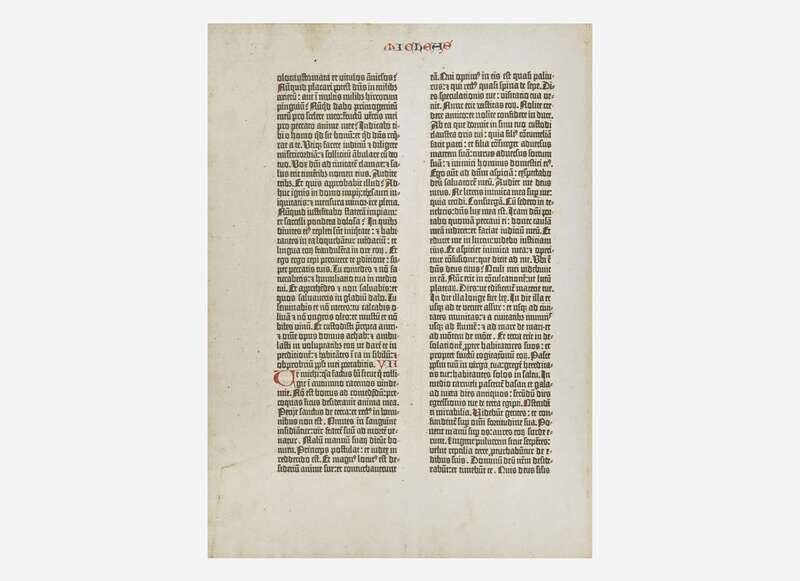
(Mainz, Germany: Johann Gutenberg and Johann Fust, 1450-55). Folio, 15 3/8 x 11 3/16 in. (390 x 284 mm). Leaf 75 (pp. 151-152) from the Old Testament, featuring Micah, full verses V and VI and portions of verses IV and VII. Printed in two columns, 42 lines, Gothic type. Rubricated initials in red and blue on recto, and in red on verso; headlines and chapter numbers in alternating red and blue, capitals accented in red, section title in red and blue. Bound as part of Gabriel Wells's A Noble Fragment, with A. Edward Newton's essay "A Noble Fragment, Being a Leaf of the Gutenberg Bible 1450-1455" (New York: Gabriel Wells, 1921). Full black morocco, stamped in blind and in gilt, extremities rubbed; by Stikeman & Co. Light marginal soiling to leaf; binding lightly rubbed and soiled.
A leaf from the first printed book in the West, featuring Micah's prophecy of the coming Messiah: "But you, Bethlehem Ephrathah, though you are small among the clans of Judah, out of you will come for me one who will be ruler over Israel, whose origins are from of old, from ancient times.” (V:II)
Produced under the partnership of Johann Gutenberg and Johann Fust between the years 1450-55, the first edition of their Bible consisted of approximately 180 copies (150 on paper, 30 on vellum), with only 49 copies, in varying states of completeness, surviving today. This leaf originates from a defective copy once housed in the Munich Royal Library and purchased by English traveler and diplomat Robert Curzon in 1832. In 1920 the volume was broken up by bookseller Gabriel Wells and then sold as individual leaves, bound with an accompanying essay by Philadelphia bibliophile A. Edward Newton.