Condition Report
Contact Information
Lot 150
Lot Description
“The Question is not whether I am guilty of this Indictment, but whether this Indictment be legal, it is two general and imperfect an Answer, to say it is the Common Law, unless we knew both where, and what it is; For where there is no Law, there is no transgression; and that Law which is not in being, is so far from being Common, that it is no Law at all.”
[Penn, William]
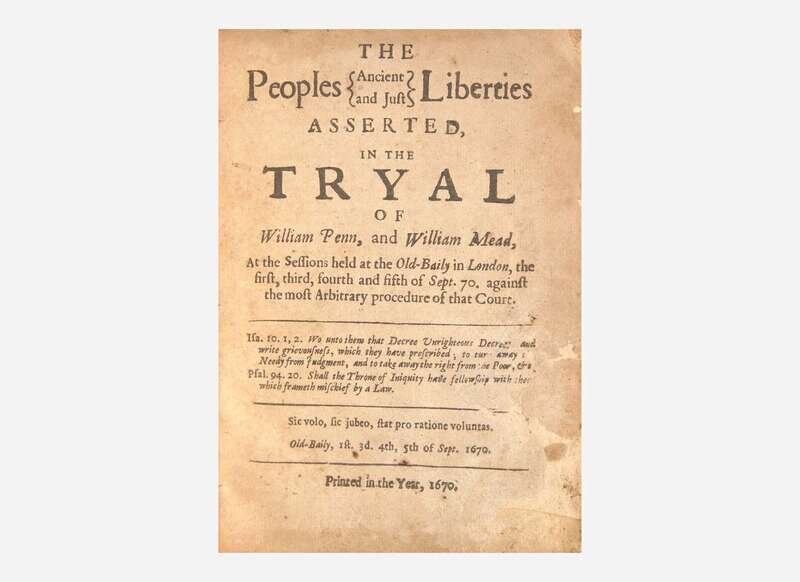
The Peoples {Ancient and Just} Liberties Asserted in the Tryal of William Penn, and William Mead…
(London): Printed in the Year, 1670. Second edition (with “Asserted” on title-page spelled correctly). Association copy, from the Pemberton family, Quaker allies of William Penn. With “Ralph Phineas Pemberton”, inscribed three times on front free endpaper (now-verso of title-page), twice crossed out, and with “Aspoole” (now Aspull, Lancashire, England), inscribed at bottom of same and now crossed out. Small 4to. 62, (2) (blank) pp. Modern three-quarter brown calf over marbled paper-covered boards, stamped in blind; all edges trimmed; original front free endpaper now mounted to back of title-page; spotting and toning to title-page; bottom corner of first two text leaves worn; page numbers of last two leaves partially excised with contemporary numbers in ink applied; text toned and spotted; light dampstaining in fore- and bottom edge of final seven leaves. Smith, Friends’ Books, II, p. 285; ESTC R40049; Sabin 59723
An important account of the trial against Quakers William Penn and William Mead, a defining event in the emergence of Penn as a defender of religious liberty and as a “celebrated and controversial public figure.” (Murphy, William Penn: A Life, p. 76). Penn and Mead were arrested on August 14, 1670 for preaching outside of the Quaker Meetinghouse on London’s Gracechurch Street, shut down in the government’s attempt to silence Dissenters. At their trial the government denied Penn and Mead’s attempts to examine the charges against them, as well as the opportunity to provide for their own defense. In consequence, the men protested directly to the jury to nullify the charges, and after further protest, they were held in contempt of court and removed from the courtroom for the remainder of the trial. The jury was sympathetic to the men and refused to abide by the judge’s instructions, even after threats by him to find them both guilty. In an extraordinary turn, they found Penn and Mead not guilty. In retaliation the judge then had the jury imprisoned and fined. One juror, Edward Bushel, would go on to petition for relief from these fines in a case that helped establish the principle of jury independence. The trial proved to be a cause celebre in 17th century Britain and a landmark case in common law jurisprudence. For Penn, it firmly established him on the public stage as a heroic defender against religious intolerance.
Phineas Pemberton (1649-1702) was a founding member of Bucks County Quakerism and the son of Ralph Pemberton (1611-85) and Margaret Seddon (1622-55). He was a close friend of William Penn, his neighbor at Pennsbury Manor, and served as his chief administrator in Bucks County. Phineas, along with his father and family, were some of the first Quaker settlers in Pennsylvania, and immigrated from Aspull, Lancashire, England, in 1682, aboard the ship Submission. They settled on 300 acres opposite Bordentown, New Jersey along the bend in the Delaware River, just below Pennsbury Manor. Phineas served as Clerk of all Courts, Register of Wills, Receiver of the Proprietary Quit Rents, and Master of the Rolls. He also served three terms in the Provincial Council, four terms in the General Assembly, including President of the Assembly. Upon his death, Penn called Phineas, “the ablest as well as one of the best men in the province.”
Smith and Sabin both note that there were two editions of this book printed in 1670, distinguished by the miss- or correctly spelled “Asserted” on the title-page. ESTC further distinguishes four typographically different versions presumably from these two editions, this copy with A2r, line 6, beginning "bitrarily"; line 20 beginning "fined and imprisoned"; F3v, line 2, beginning with "ing;".
A previous cataloguer notes this volume as from the collection of Edwin and Irma Grabhorn, founders of the Grabhorn Press.