Condition Report
Contact Information
Lot 138
Lot Description
Woolf Writes to Clive Bell Regarding Her ”Sepulchral Day”
Woolf, Virginia
Autograph Letter, initialed
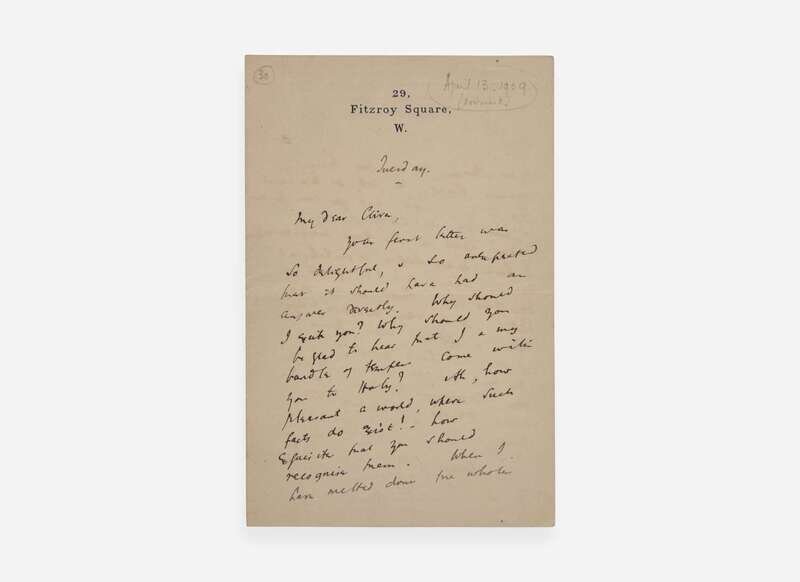
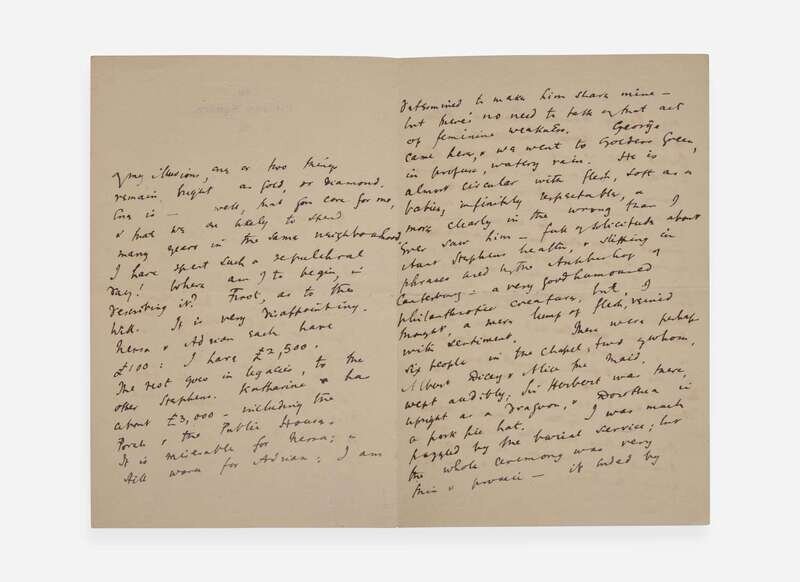
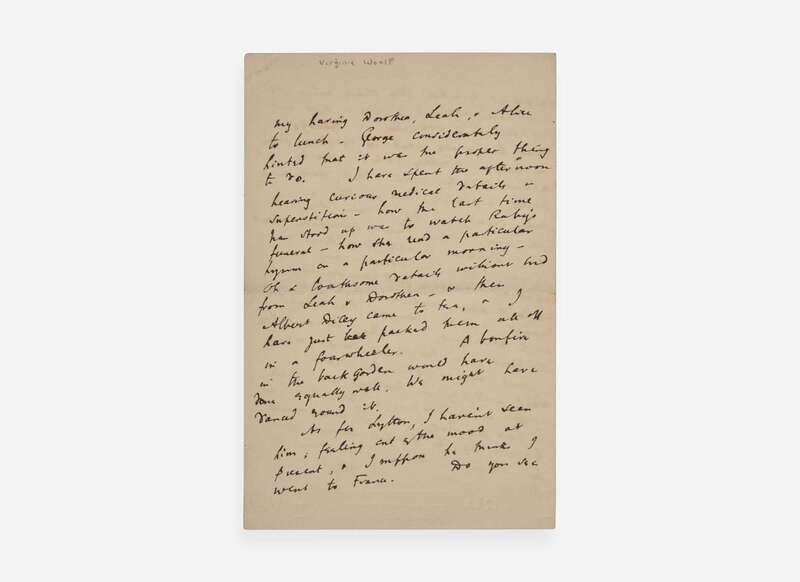
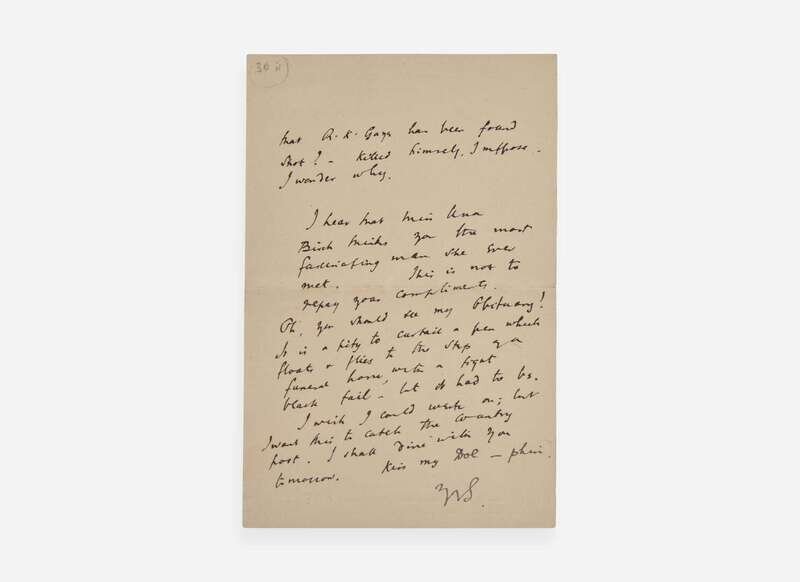
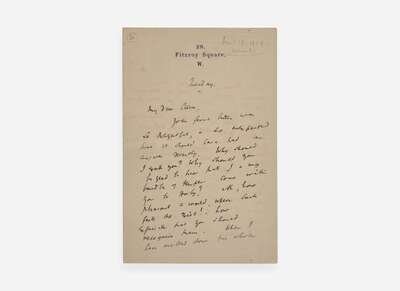
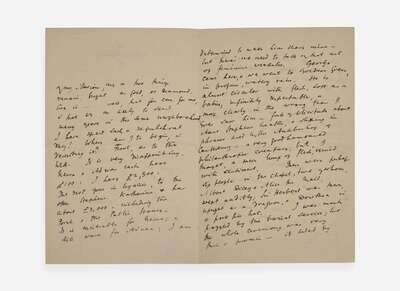
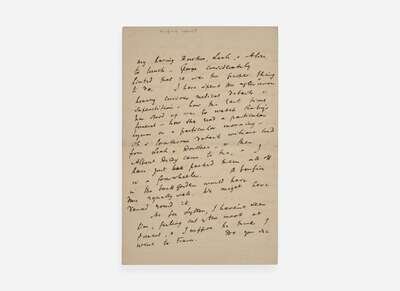
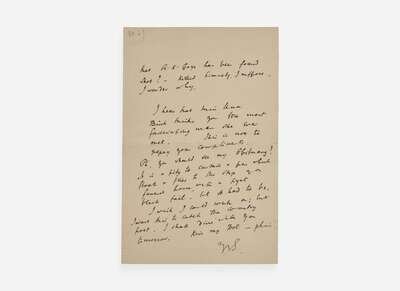
(London, April 13, 1909). Comprising two sheets; one sheet folded to make four pages, and one single sheet, 6 x 4 in. (152 x 102 mm). Lengthy five-page autograph letter, on 29, Fitzroy Square, W. stationery, from Virginia Woolf to her brother-in-law Clive Bell, recounting her "sepulchral day" including the funeral and will of her aunt Caroline Emilia Stephens, Woolf's obituary for her, as well as mentioning her sister Vanessa Bell and Lytton Strachey. Creasing from contemporary folds. Printed in The Letters of Virginia Woolf, Volume I: 1888-1912 (481, pp. 391-391).
"My dear Clive,
Your first letter was so delightful, & so unexpected that it should have had an answer directly. Why should I excite you? Why should you be glad to hear that I and my bundle of tempers come with you to Italy? Ah, how pleasant a world, where such facts do exist! how exquisite that you should recognize them. When I have melted down the whole of my illusions, one or two things remain, bright as gold, or diamond. One is--well, that you care for me, & that we are likely to spend many years in the same neighborhood. I have spent such a sepulchral day! Where am I to begin, in describing it? First, as to the Will. It is very disappointing. Nessa and Adrian each have £100: I have £2,500. The rest goes in legacies, to the other Stephens. Katharine has about £3,000--including the Porch & the Public House. It is miserable for Nessa; & still worse for Adrian; I am determined to make him share mine--but there's no need to talk of that act of feminine weakness.
George came here, & we went to Golders Green, in profuse, watery rain. He is almost circular with flesh, soft as a babies, infinitely respectable, & more clearly in the wrong than I ever saw him--full of solicitude about Aunt Stephens health, & slipping in phrases used by the Archbishop of Canterbury--a very good humoured philanthropic creature, but, I thought, a mere lump of flesh, veined with sentiment.
There were perhaps six people in the chapel; two of whom, Albert Dicey & Alice the Maid, wept audibly; Sir Herbert was there, upright as a dragoon, & Dorothea in a pork pie hat. I was much puzzled by the burial service; but the whole ceremony was very thin and prosaic--it ended by my having Dorothea, Leah & Alice to lunch. George considerably hinted that it was the proper thing to do.
I have spent the afternoon hearing curious medical details and superstitions--how the last time Nun stood up was to watch Ruby's funeral--how she read a particular hymn on a particular morning--Oh & loathsome details without end from Leah & Dorothea--& then Albert Dicey came to tea, & I have just packed them all off in a fourwheeler. A bonfire in the back garden would have done equally well. We might have danced around it.
As for Lytton, I haven't seen him; feeling out of the mood at present, & I suppose he thinks I went to France. Do you see that R.K. Gaye has been found shot?--Killed himself, I suppose. I wonder why.
I hear that Miss Una Birch thinks you the most fascinating man she ever met. This is not to repay your compliments.
Oh, you should see my Obituary! It is a pity to curtail a pen which floats and flies to the step of a funeral home, with a tight black tail--but it had to be.
I wish I could write on; but I want this to catch the country post. I shall dine with you tomorrow. Kiss my Dol--phin.
Yr VS."
An early and affectionate letter from Virginia Woolf to her fellow Bloomsbury Group member, confidant, and husband of her sister Vanessa, Clive Bell. Opening with a flirtatious response to Clive's romantic overtures, Woolf writes, "when I have melted down the whole of my illusions, one or two things remain, bright as gold, or diamond. One is--well, that you care for me, and that we are likely to spend many years in the same neighborhood." She then recounts in often amusing detail her "sepulchral day" attending her aunt Caroline Emilia Stephens's (1834-1909) burial service. Caroline, nicknamed by the Stephen family "The Quaker" or "Nun", was a respected Quaker and author on Quakerism, and the younger sister of Woolf's father, Leslie Stephen. An independent spirit, Caroline was an early role model for Virginia in her formative years, and bequeathed Virginia in her will an inheritance that contributed to her financial and social independence.
According to family lore, the cause of Caroline's death was attributed to be from a broken heart following the death of an unrequited love, however more contemporary interpretations attribute it to the demanding effects of being the family caregiver, often at the expense of her own health. Following her father's death in 1904, Virginia spent time staying at Caroline's house in Cambridge (called "The Porch"), where she recovered from a mental breakdown, and where she attended Quaker meetings with her aunt. It was in this quiet and reflective setting that Virginia first began to seriously explore her own writing, and where in 1904 she published her first work (she would not publish her first novel until 1915). As evidence of the bond between the two, in her will Caroline left Virginia £2,500, a generous sum when compared to the £100 she left for Virginia's sister Vanessa and her brother Adrian. The money contributed to Virginia's financial independence that allowed her to pursue her literary interests full-time. As a testament to the effect Caroline's generosity had on her career, twenty years later in A Room of One's Own, Virginia wrote that her "aunt's legacy unveiled the sky to me, and substituted for the large and imposing figure of a gentleman, which Milton recommended for my perpetual adoration, a view of the open sky."
While the death of her aunt filled Virginia with melancholy, the service and its guests did not, as can be gleaned from the pithy remarks regarding its attendees, like her cousin Dorothea Stephen, the maid Leah, and Albert Venn Dicey, a distant relative and Professor of English Law at Oxford. After enduring their "loathsome details" she sent them off, but wished to had packed them all into a “bonfire in the backyard," that she “might have danced around.” In an aside at the end of the letter, Woolf mentions her friend, the English writer Lytton Strachey, whom, she informs Clive, she had not seen. Only a few weeks before, on February 17, Strachey had proposed to Woolf, but almost immediately withdrew the offer when he realized they were not in love.
A fine and early letter.