Condition Report
Contact Information
Lot 121
Sale 2600 - Books and Manuscripts
Sep 27, 2023
11:00AM ET
Live / Philadelphia
Own a similar item?
Estimate
$4,000 -
6,000
Lot Description
[Travel & Exploration] Adam, R(obert).
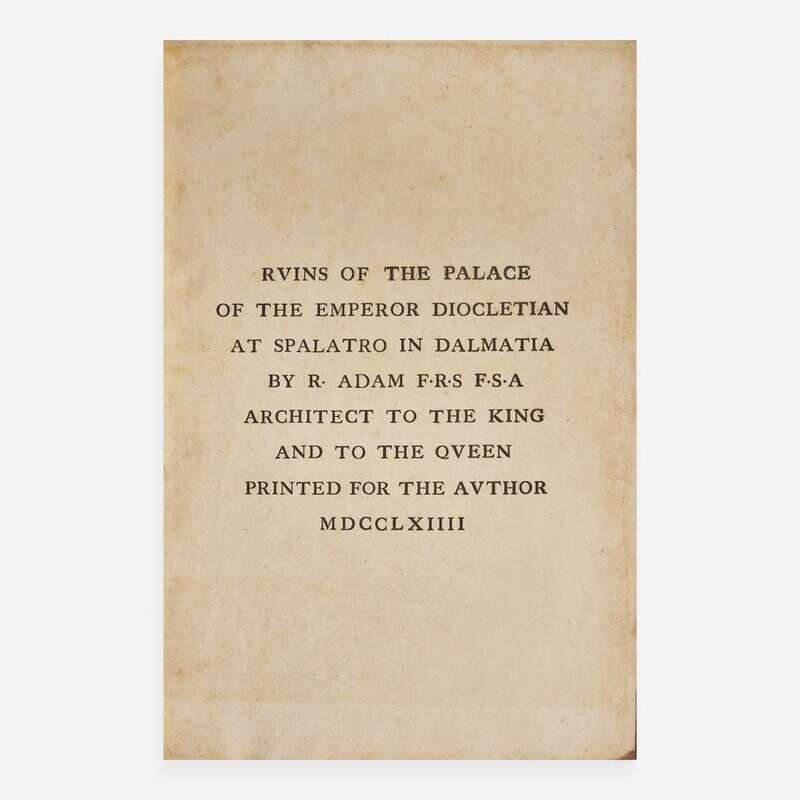
Ruins of the Palace of the Emperor Diocletian at Spalatro in Dalmatia
Adam, R(obert).
Ruins of the Palace of the Emperor Diocletian at Spalatro in Dalmatia
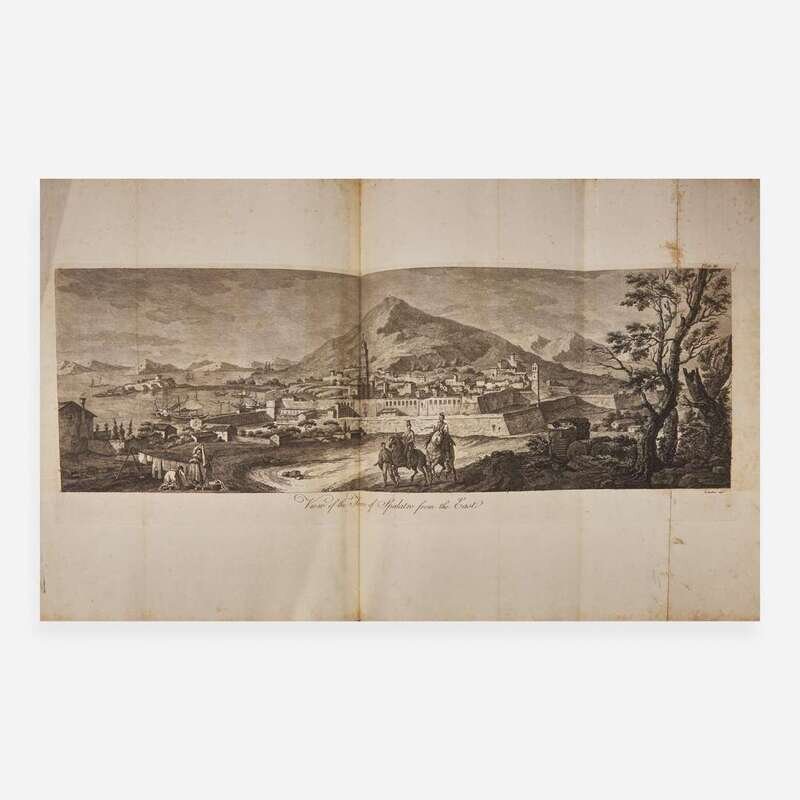
(London): Printed for the Author, 1764. First and only edition. Folio, 21 x 14 1/2 in. (533 x 368 mm). iv, (viii), 33, (1) pp. Illustrated with 61 numbered engraved plates (including frontispiece, 10 folding plates, and seven double-page plates); engraved by F. Bartolozzi, E. Rooker, F. Patton, P. Santini, A. Walker, (A.) Zucchi, P. Mazell, Dom. Cunego, and J. Bassire, after drawings by Charles-Louis Clérisseau. Full contemporary brown calf, black morocco spine labels, stamped in gilt; joints, corners, and spine ends expertly restored; boards rubbed and scratched; chipping along spine; all edges trimmed; marbled endpapers; dampstaining in bottom corner of all leaves, with tip of same repaired on frontispiece; foxing to text; moderate to heavy foxing to plates; vertical creasing in several folding plates, with foxing, dampstaining, and wear along same; top left corner creased in Plate III; dampstaining in fore-edge, Plates VII and IX; several leaves at rear toned and heavily foxed; in brown cloth fall-down-back box. Blackmer 3; Fowler, pp. 3-4; ESTC T46923; Brunet 1:46 An important work by British Neoclassical architect Robert Adam (1728-92), describing the ancient Roman palace-fortress of Emperor Diocletian, located in present-day Split, Croatia. Adam conceived of this work while on his Grand Tour (1754-58) through France and Italy studying classical architecture. In the summer of 1757, with the help of his teacher, the French architect and antiquary, Charles-Louis Clérisseau (1721-1820), and two accompanying draughtsman, Adam began to survey the largely forgotten palace ruins, built by Diocletian following his abdication in 305 AD. Adam worked closely with Clérisseau for five weeks before returning to London, while Clérisseau stayed on in Venice, from 1757-60, to oversee the engraving of some of the drawings of plans, elevations, and views. While back in London, Adam enlisted Scottish historian William Robertson to write the introduction, and he oversaw the engraving of the remaining plates. The resulting work was instrumental in advancing Adam's career, and contributed to the development of the Neoclassical style that bears his name.