Condition Report
Contact Information
Lot 7
Lot Description
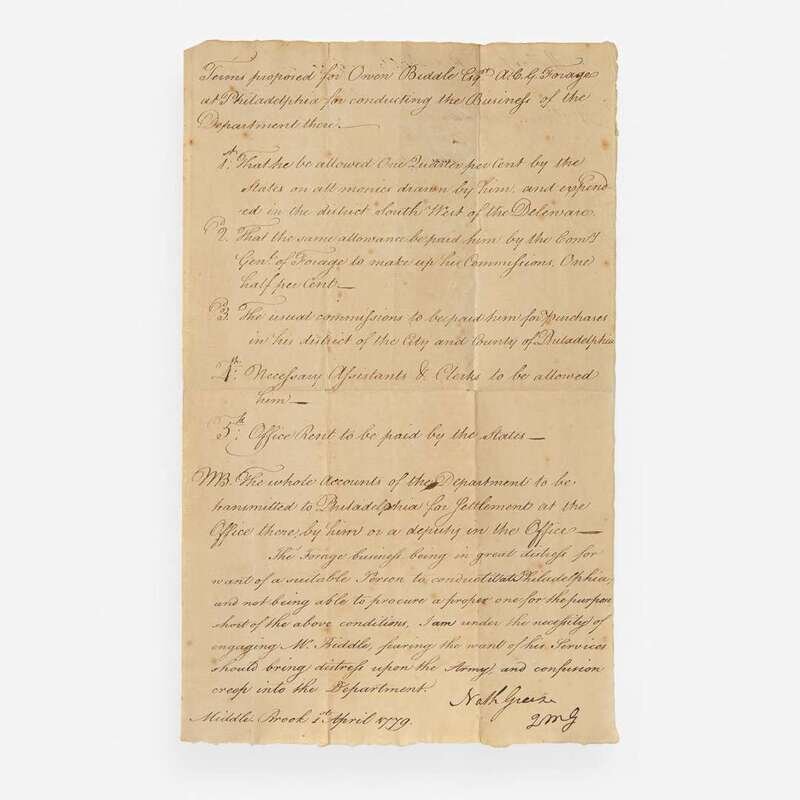
Major General Nathanael Greene Confirms Owen Biddle's Employment as Assistant Commissary General of Forage in Philadelphia
"The Forage business being in great distress for want of a suitable Person to conduct it at Philadelphia; and not being able to procure a proper one for the purpose short of the above conditions, I am under the necessity of engaging Mr. Biddle, fearing the want of his Services should bring distress upon the Army, and confusion creep into the Department."
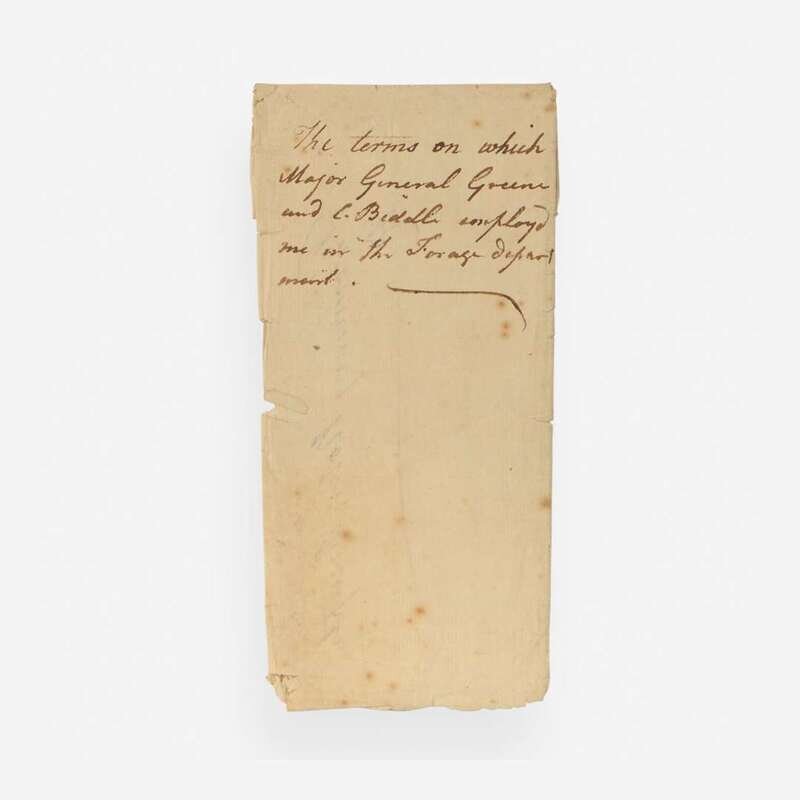
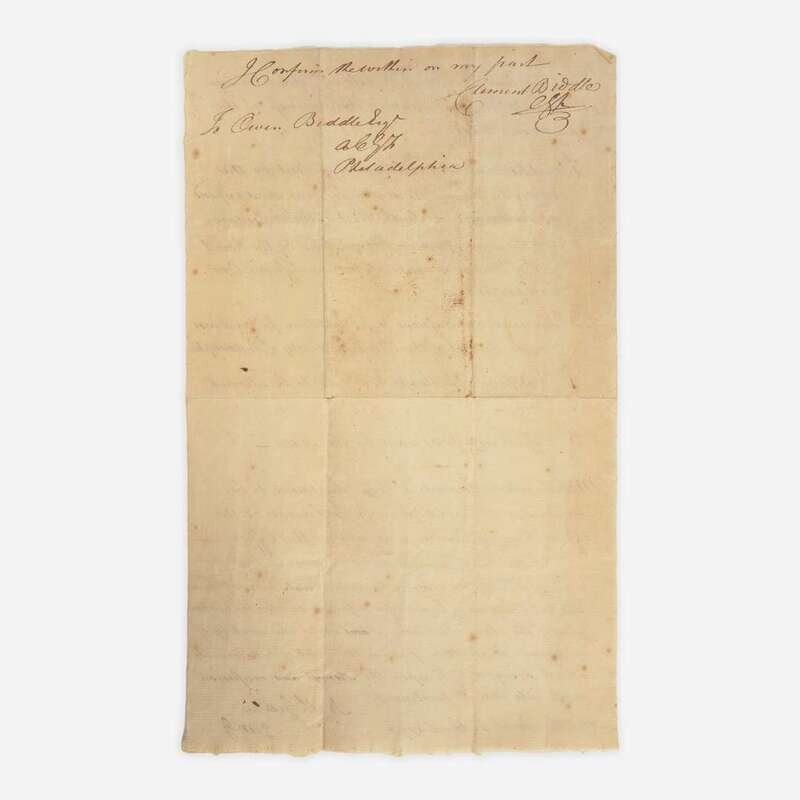
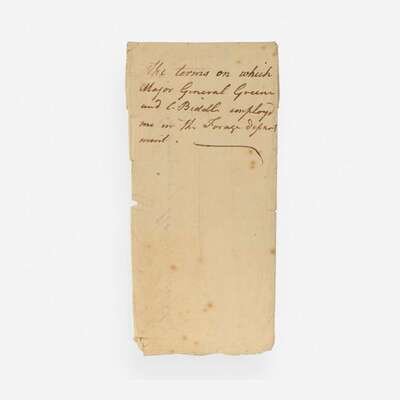
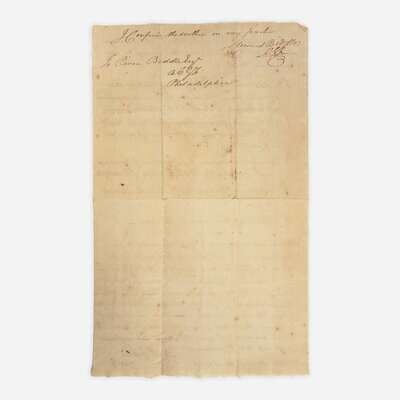
Middle-Brook, (New Jersey), April 1, 1779. One sheet, 12 1/4 x 7 1/2 in. (311 x 190 mm). Manuscript document in a secretarial hand, signed by Quartermaster General Nathanael Greene ("Nath Greene / QMG"), confirming the terms of employment for Owen Biddle, Sr., as Assistant Commissary General of Forage in the Quartermaster Department in Philadelphia; inscribed on verso by Owen's brother, Clement Biddle, as Commissary General of Forage, "I Confirm the within on my part / Clement Biddle / To Owen Biddle Esq / ACGF / Philadelphia". Creasing from contemporary folds; scattered minor spotting; with separate leaf used to enclose the above document, inscribed by Owen Biddle, "The terms on which / Major General Greene / and C. Biddle employed / me in the Forage Depart / ment." This document is transcribed and reproduced in Owen Biddle in The Pennsylvania Magazine of History and Biography, Vol. 16, No. 3 (Oct., 1892), pp. 311-313.
Persistent shortages of adequate rations, suitable clothing, forage for horses, and other supplies, plagued the Continental Army almost as soon as it was created. As the war progressed and George Washington and his men were put on the move by the British, the lack of these essentials seriously imperiled their ability to continue the conflict. The issue of securing a steady and reliable supply of forage for the Army's horses and mules became so essential that it threatened to completely cease military operations without it, as artillery and other goods could not be transported. "If transportation was the crux of the supply problem during the American Revolution, the heart of the transportation problem was forage supply. Without an adequate supply of forage, the supply teams, the regimental wagons, the Artillery, and the Cavalry could not be kept in motion. Yet a scarcity of forage continually plagued the Continental Army. An administrative unit devoted solely to solving the problems of an adequate forage supply did not begin to develop in the Quartermaster's Department until the summer of 1777." (Erna Risch, Supplying Washington's Army, 1981, p. 97).
Congress authorized the creation of the position of Commissary General of Forage in May, 1777 to address these severe shortages that threatened to dissolve the Army. Clement Biddle, then-Deputy Quartermaster General, was appointed by George Washington in July, 1777 as the first Commissary General of Forage for the Continental army. During the next year Biddle worked tirelessly, but often with little support, to locate, acquire, and provide forage, wagons, and other goods, as well as maintain storage magazines and manage proper record keeping. By early 1779, following the resignation of Thomas Mifflin and the appointment of General Nathanael Greene as Quartermaster General, Biddle began to implement a series of much-needed reforms aimed at reorganizing and streamlining the department's often chaotic operations. Under his direction, Biddle oversaw 25 deputies, 128 assistant deputies, as well clerks, forage masters, measurers, collectors, weighers, stackers, superintendents, and laborers, stretched across Pennsylvania, New Jersey, Delaware, New York, Maryland, and as far south as Virginia. This included his older brother, Owen--as seen in this document--who was employed to run the Forage Department office in Philadelphia, and who was tasked with purchasing forage in that city and directing all purchases west of Delaware, as well as to Trenton, the site of a major forage depot. Hired on a commissioned rate--as was usual for officers in the department--Biddle was paid "One Quarter per Cent by the States on all monies drawn by him...the same allowance be paid him by the Comy. Genl. of Forage to make up his Commissions. One half per Cent...The usual commissions to be paid him for purchases in his district...", as well as funds for, "Necessary Assistants & Clerks..." and "Office Rent to be paid by the States". During his tenure, Owen, like his brother, labored to provide adequate provisions for the Continental Army's horses and mules, often against unreliable subordinates, a Congress persistently short on funds, and reluctant farmers who were concerned about being paid.
Passed down within the Biddle family and never before offered for sale.