Condition Report
Contact Information
Lot 32
Lot Description
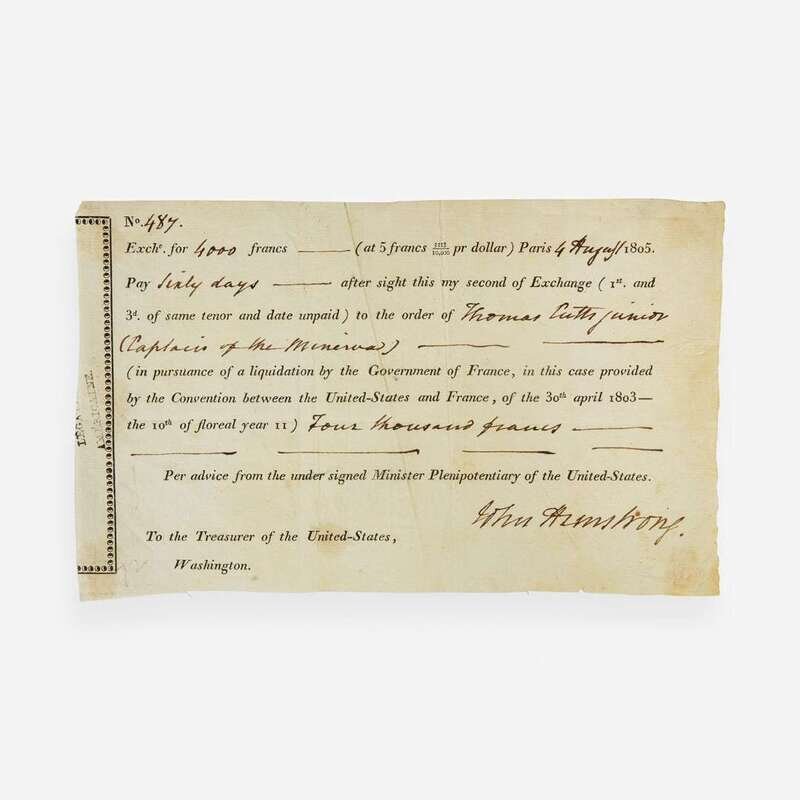
Paris, August 4, 1805. One oblong sheet, 5 1/4 x 8 1/2 in. (140 x 216 mm). Partially-printed second bill of exchange (No. 487) for 4,000 francs to be paid from the United States Treasury to shipping merchant Thomas Cutts, Jr.: "Pay Sixty days--after sight this my second of Exchange...to the order of Thomas Cutts junior (Captain of the Minerva)--(in pursuance of a liquidation by the Government of France, in this case provided by the Convention between the United-States and France, of the 30th april 1803...)"; signed by John Armstrong as Minister Plenipotentiary of the United-States to France; remnants of contemporary French ink stamp at left edge. Creasing from old folds; scattered edge-wear; glue residue from old mount on verso. Hessler, An Illustrated History of U.S. Loans (1988), "1-3 surviving pieces" (p. 80)
A rare second bill of exchange paid by the United States as part of the terms of the Louisiana Purchase Treaty with France in 1803. As part of the treaty, the United States agreed to assume responsibility for $3.75 million in debts the French government owed United States citizens, primarily for seized ships, crews, and cargoes. This document represents one of those claims. Captain Thomas Cutts, Jr. (1769-1839), was master and owner, with his father, Thomas Cutts, Sr., of the 319-ton merchant ship Minerva. The Minerva was seized by the French twice, once in 1794 and again in 1795, and Cutts was awarded over 30,000 livres under the April 30, 1803 Treaty (Greg H. Williams, The French Assault on American Shipping, p. 247).
Rare. Financial documents relating to the funding of the Louisiana Purchase seldom come to market. We have only been able to locate two examples similar to this.
Together with:
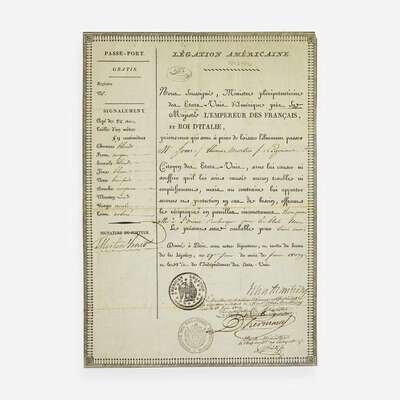
Partially-Printed French Passport
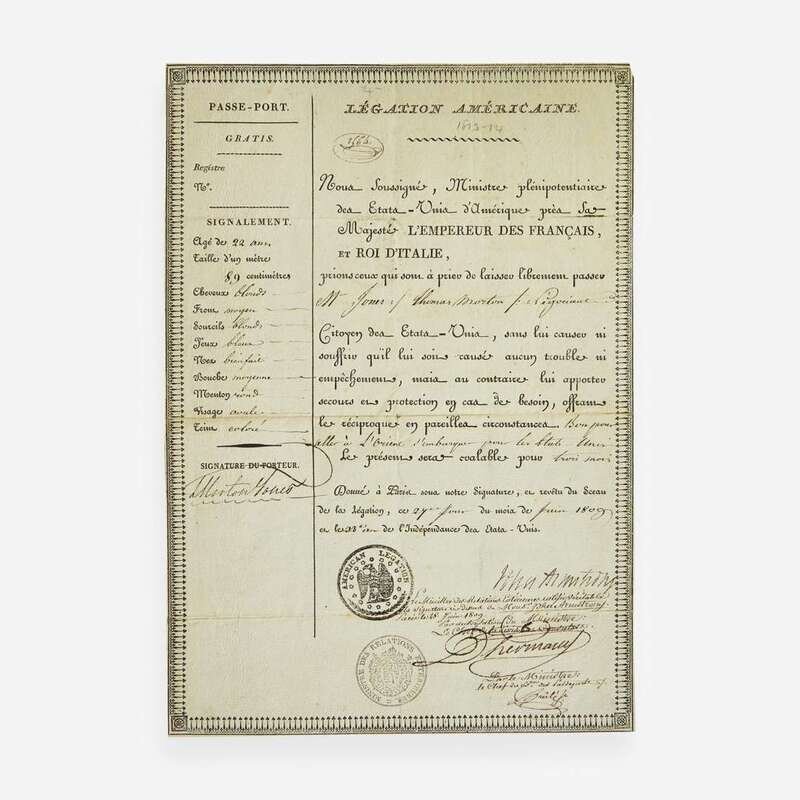
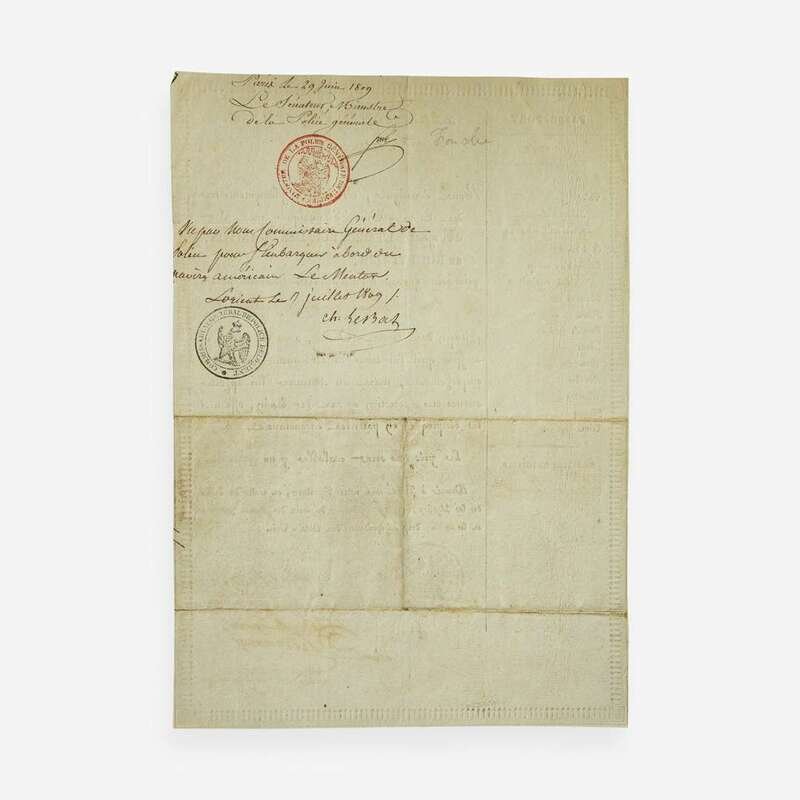
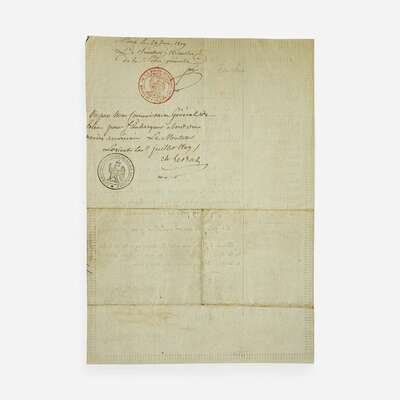
Paris, June 1809. One sheet, 12 3/8 x 8 5/8 in. (314 x 219 mm). Partially-printed French passport, signed by Armstrong as Minister Plenipotentiary of the United-States to France, as well as two French Ministers, and issued to American traders M. Jones and Thomas Morton; "American Legation" and "Ministre des Relations Exterieures" ink stamps at bottom; signed on verso by French Minister of Police Joseph Fouche, and the French Commissar General of Police; creasing from contemporary folds.
John Armstrong, Jr. (1758-1843) was a native of Carlisle, Pennsylvania, and attended the College of New Jersey (now Princeton University). In 1776 he joined the Continental Army and served as an aide to Hugh Mercer and Horatio Gates with the rank of major. In 1783 he was the anonymous author or scribe of the document circulated in the camp at Newburgh, New York that expressed discontent with Congress, known as the Newburgh conspiracy. He returned to Pennsylvania after the war and served as secretary of the state’s Supreme Executive Council and adjutant general. In 1789 he married the sister of Robert R. Livingston (future Minister to France whom Armstrong would later replace), and moved to New York to oversee his newly acquired Dutchess County estate. He remained active in politics and aligned with the Democratic-Republican interests, and later represented New York for two partial terms in the U.S. Senate, from 1800 to 1802, then again from 1803 to 1804. He resigned his seat to accept the appointment as minister to France. He served in that role for six years and returned to the United States in 1810. He then served as secretary of war from 1813 to 1814.