Condition Report
Contact Information
Lot 148
Lot Description
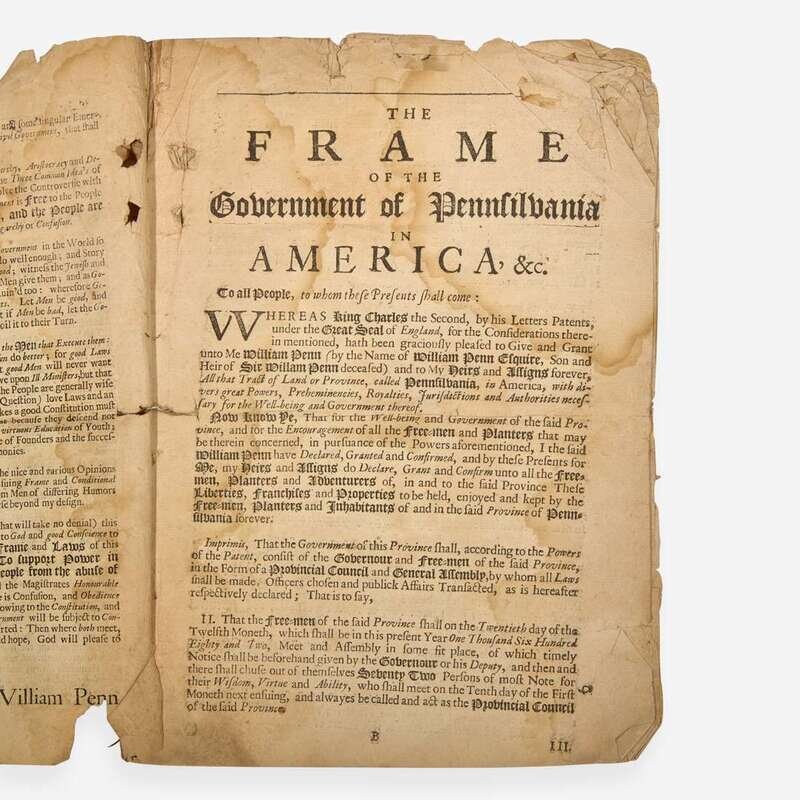
William Penn's 1682 Frame of Government: The First Proposed Constitution for Pennsylvania
"Any Government is Free to the People under it (what-ever be the Frame) where the Laws Rule, and the People are a Party to those Laws, and more then this is Tyranny, Oligarchy or Confusion."
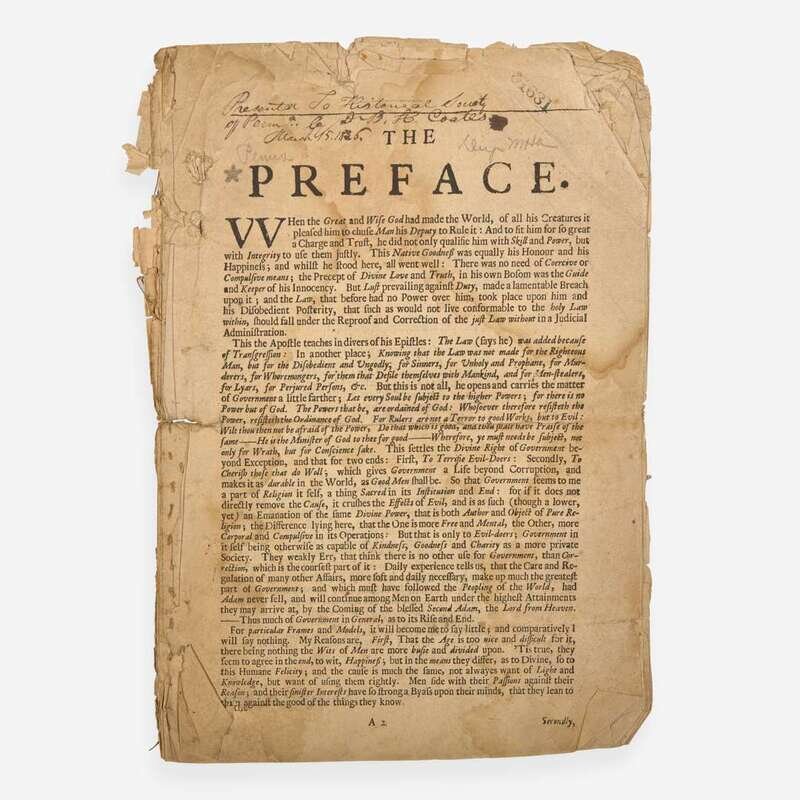
(London: William Bradford, 1682). First edition. Small folio. 7 (of 8) leaves; lacking title-page. Small remnant of original wrapper remains, original thread largely intact; gift inscription at top of first leaf, "Presented To Historical Society / of Penna. by Dr. B. A. Coates / March 15, 1826"; two later pencil notations below same, one being "Dup MHA"; library number ink-stamped at top of first leaf; all leaves worn and soiled; dampstaining along upper and fore-edges of all leaves; top and bottom corners creased; horizontal crease along center of leaves, with open tears to same in D2, affecting some words; top and bottom edges variously chipped, touching letters in rear leaves; final two leaves very worn, with D2 partially adhered to final blank; upper inner portion of final leaf separated. Duplicate copy, deaccessioned from the Historical Society of Pennsylvania. Church 676; Sabin 59696; Streeter 11-941; ESTC R18855
A significant document pertaining to the early history of Pennsylvania: William Penn's first proposed Pennsylvania constitution of 1682. Published just four months before Penn's first trip to his newly chartered colony, this document delineates the proposed structure for Pennsylvania's government. It also outlines many features that made his "Holy Experiment" unique at the time, including liberty of conscience, religious toleration, freedom of speech and dissent, and freedom from cruel and unusual punishment. As Penn writes in his preamble, this Frame was devised "to support Power in Reverence with the People, And to secure the People from the abuse of Power; that they may be free by their just Obedience, and the Magistrates Honourable for their just Administration: For Liberty without Obedience is Confusion, and Obedience without Liberty is Slavery." The Frame called for a bicameral legislature composed of an upper house of up to 72 members--the Provincial Council--and a lower house made up of no more than 200 members--the General Assembly. It also created the position of Governor--to be occupied by Penn, and then his heirs--who would have three votes on the Council, as well as the ability to veto legislation. Of the two houses, the Council was imparted with significantly more powers, such as the ability to propose all legislation, erect courts, situate cities and ports, execute laws, and supervise the treasury, among other things. In comparison, the General Assembly was restricted to confirming or denying laws proposed by the Governor or Council. The final section, "Laws Agreed Upon in England" is a series of 40 statutes regarding voting rights, taxation, the judicial system, education, religious toleration, and prescriptions of allowed behavior and morals.
Penn's Frame went through numerous drafts before its publication in London in April 1682, vacillating between schemes that limited or increased Penn and the Council's power. After seeking the advice of trusted colleagues, including Benjamin Furley, Thomas Rudyard, and Algernon Sidney, the final document ultimately affirmed Penn's powers, but reflected the balance of roles he was playing: colony proprietor; subject of the English Crown; businessman. Shortly after Penn arrived in Pennsylvania in October 1682 he convened the election of a 42-member assembly to meet in Chester to ratify the Frame and 40 statutes. To Penn's dismay the Assembly rejected it and in March 1683 a new and more practical constitution was adopted.
Very rare. ESTC locates only 18 institutions worldwide with copies. This is the first copy of this document to come to auction in 40 years, and according to Rare Book Hub only the seventh copy ever offered.